Loading cart…
No products in the cart.

Save articles to your collection
Log in or create a free account, and this article will be waiting in your Private Collection.
Log in or sign upArt Guides · Art Nouveau
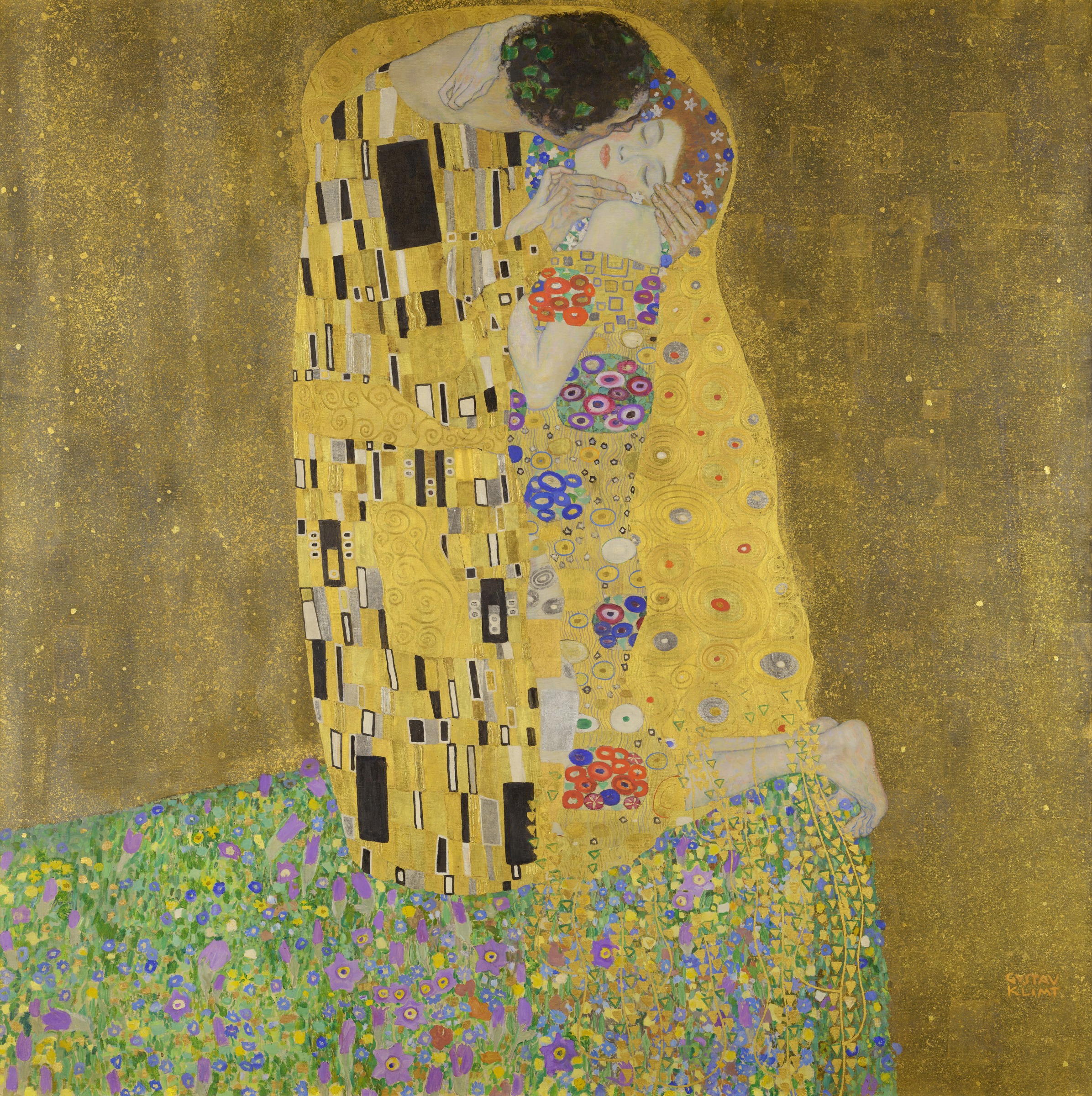
A gold robe absorbs two lovers. Lilies gather around a pale Madonna. Eight mask-like faces watch over a mysterious blue figure. In these Art Nouveau paintings, the surrounding patterns help tell the story.
This selection follows ten painted works through Vienna, Prague’s artistic world, Budapest, Glasgow and Switzerland. Some are central Art Nouveau examples; others show its close connections with Symbolism and the Secessions. The numbers provide a route through the guide, rather than a measured ranking of popularity.
Art Nouveau is an international movement of the late nineteenth and early twentieth centuries, especially associated with flowing lines, forms drawn from nature and the integration of art with design. In painting, those concerns can appear as strong outlines, stylised flowers, flattened space and figures whose clothing merges with an ornamental setting.
Its best-known manifestations include architecture, furniture, jewellery and printed graphics. Painted works belong to that larger world, but they need not all look alike. The German-speaking term Jugendstil, the Vienna Secession and the Glasgow Style describe related artistic settings with their own histories.
Symbolism names a different concern: images that suggest ideas, dreams or states of mind. It can overlap with Art Nouveau’s visual language. Hodler and Stuck make that overlap particularly clear. Calling them Symbolists does not erase their connections to the Secessions, nor does a decorative surface make every work an identical example of one movement.
Here the focus stays on paintings. Mucha’s famous posters and decorative lithographs are essential to Art Nouveau, but their printed editions should be identified as prints. His Madonna of the Lilies offers a painted example instead.
Movement context: The Metropolitan Museum of Art; National Gallery of Art: Art Nouveau, 1890–1914.
| Painting | Artist | Date |
|---|---|---|
| 1. The Kiss | Gustav Klimt | 1908 to 1909 |
| 2. Madonna of the Lilies | Alphonse Mucha | 1905 |
| 3. Golden Age | János Vaszary | 1898 |
| 4. Portrait of Adele Bloch-Bauer I | Gustav Klimt | 1907 |
| 5. The Mysterious Garden | Margaret Macdonald Mackintosh | 1911 |
| 6. The Day | Ferdinand Hodler | 1899 to 1900 |
| 7. Judith I | Gustav Klimt | 1901 |
| 8. The Sin | Franz von Stuck | 1893 |
| 9. Spring | Ferdinand Hodler | 1901 |
| 10. Hope II | Gustav Klimt | 1907 to 1908 |
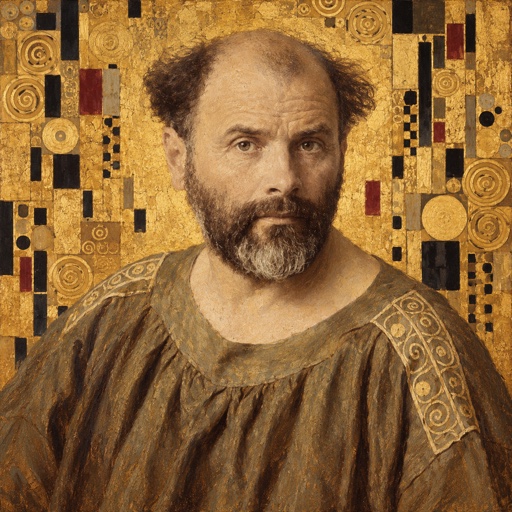 Explore the artistGustav Klimt →
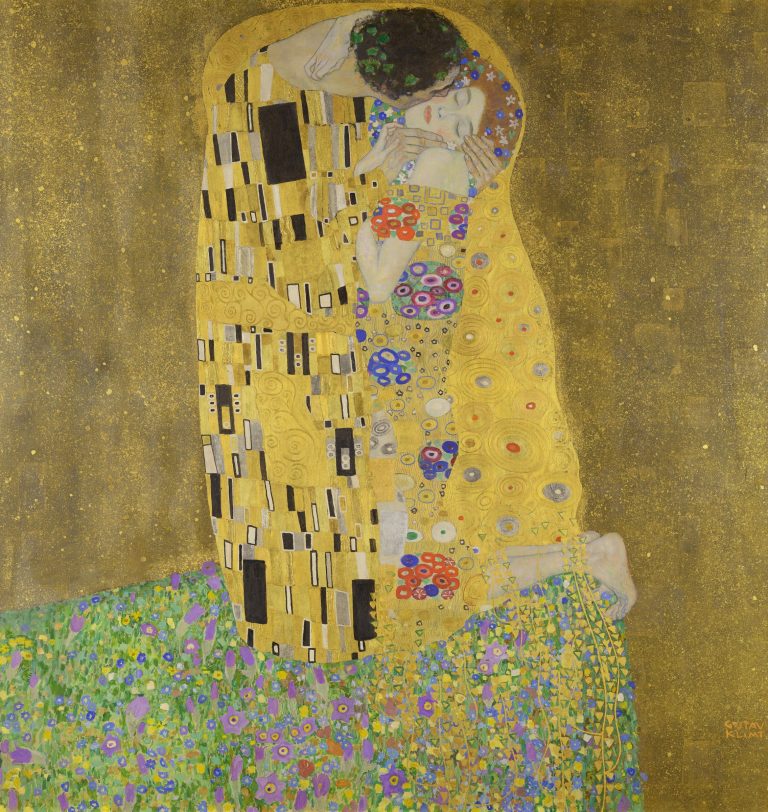
The lovers seem to share a single golden outline. His robe carries strong black-and-white rectangles; hers breaks into rounded, coloured forms. Their faces and hands remain recognisably human, while much of their clothing becomes a patterned surface. At the bottom, her bare feet meet the edge of a flower-covered ledge.
First exhibited at Vienna’s Kunstschau in 1908 and completed in 1909, The Kiss is one of the clearest meeting points between painting and decorative design. The Belvedere identifies it with the high point of Klimt’s Golden Period. Its gold gives the couple a setting that is difficult to measure as ordinary space.
The contrast is the reason to look beyond the embrace. Skin has volume; ornament spreads flat across the canvas. The meadow has individual flowers, yet the background offers little sense of a distant landscape. Klimt can suggest intimacy through a hand on a cheek while allowing two bodies to merge into a larger decorative shape.
Collection reference: Belvedere, Vienna.
Gustav Klimt · oil on canvas, made to order
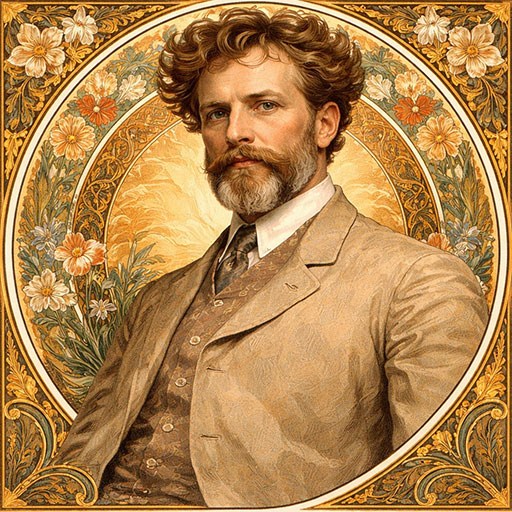 Explore the artistAlphonse Mucha →
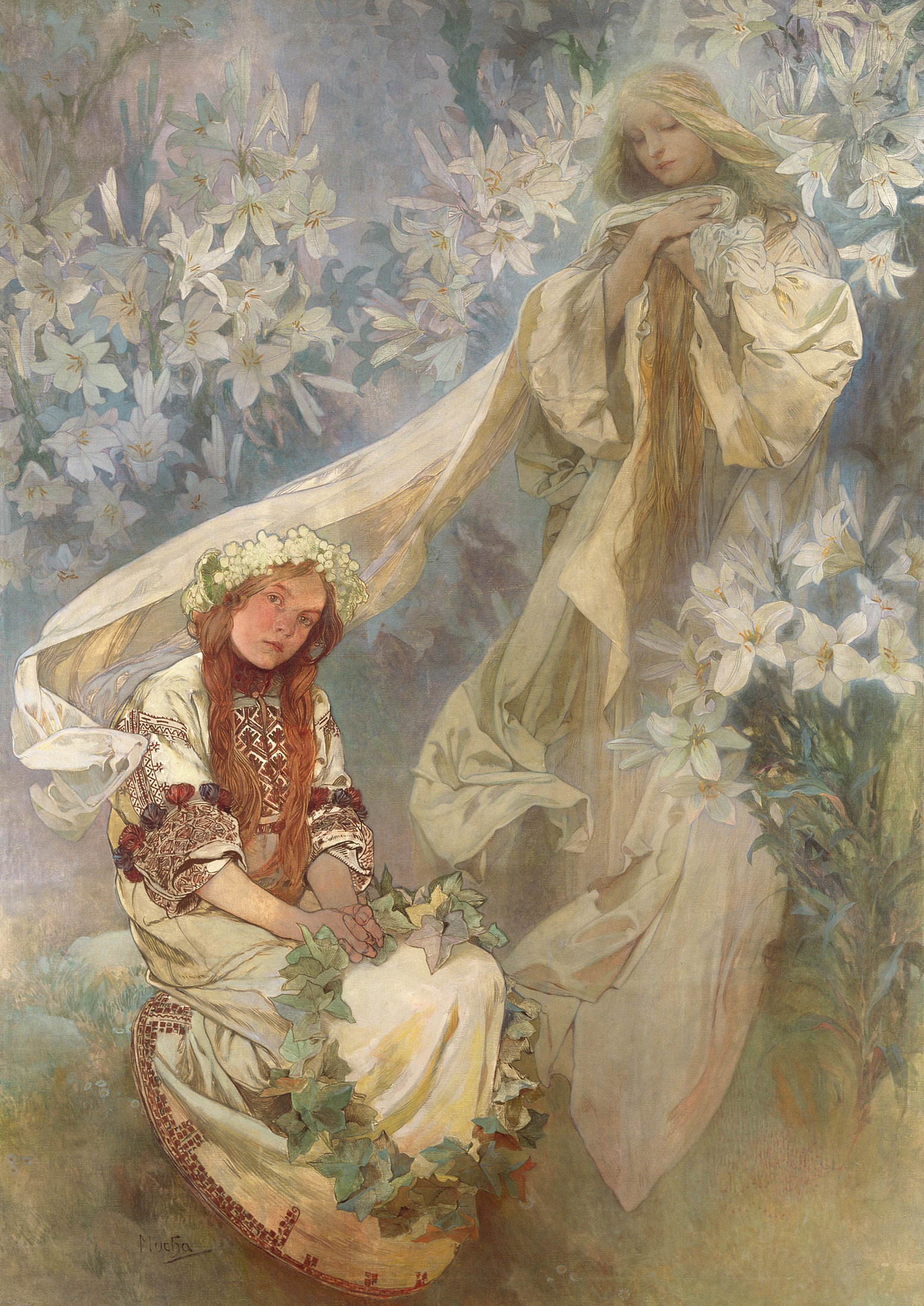
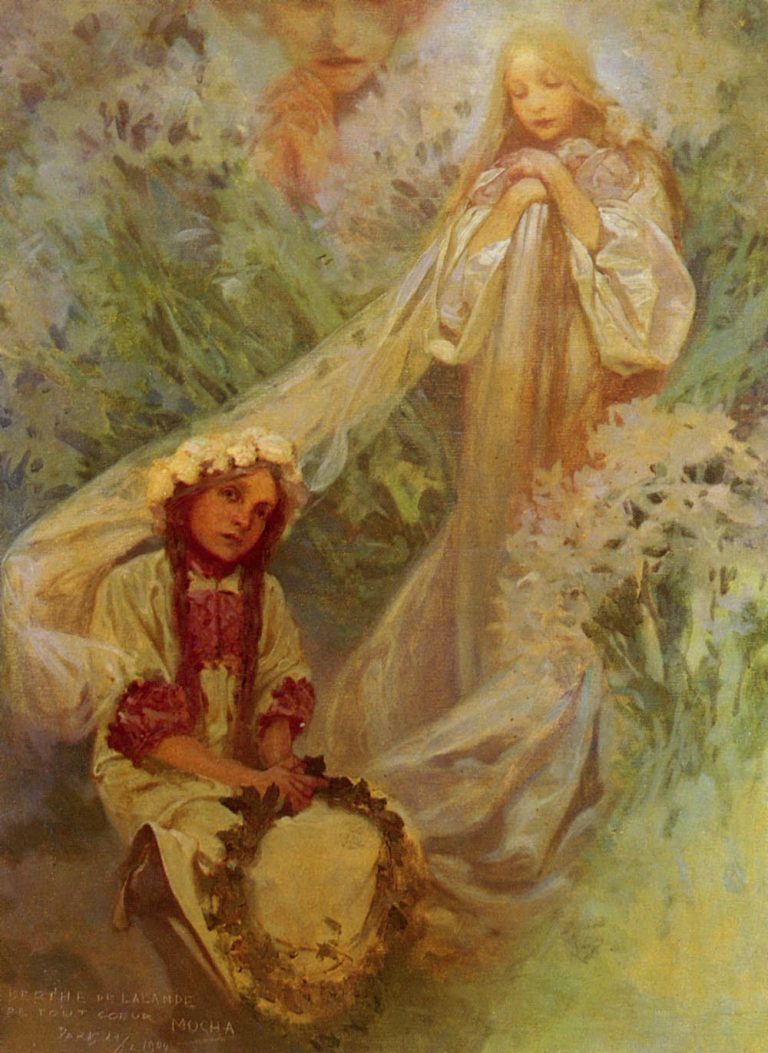
Mucha’s familiar flowing lines belong here to a religious vision. A seated girl occupies the lower part of the painting. Above her, the pale Madonna appears amid a dense growth of lilies. The fabric connecting the figures drifts across the picture, so clothing and flowers seem to belong to the same movement.
The Mucha Foundation records this as the final version of a work intended for a church in Jerusalem. The commission began in 1902 but was later cancelled. This surviving tempera painting shows a side of Mucha that is easily missed when his career is reduced to advertising posters.
The Foundation relates the lilies to purity and the girl’s ivy wreath to remembrance. Just as noticeable is the difference between the two figures: the seated girl has a firm physical presence, while the Madonna is light and elusive. The floral setting carries both the image’s symbolism and its structure. It does more than fill an attractive background.
Collection reference: Mucha Trust Collection.
Alphonse Mucha · oil on canvas, made to order
 Artist in the museum collectionJános Vaszary →
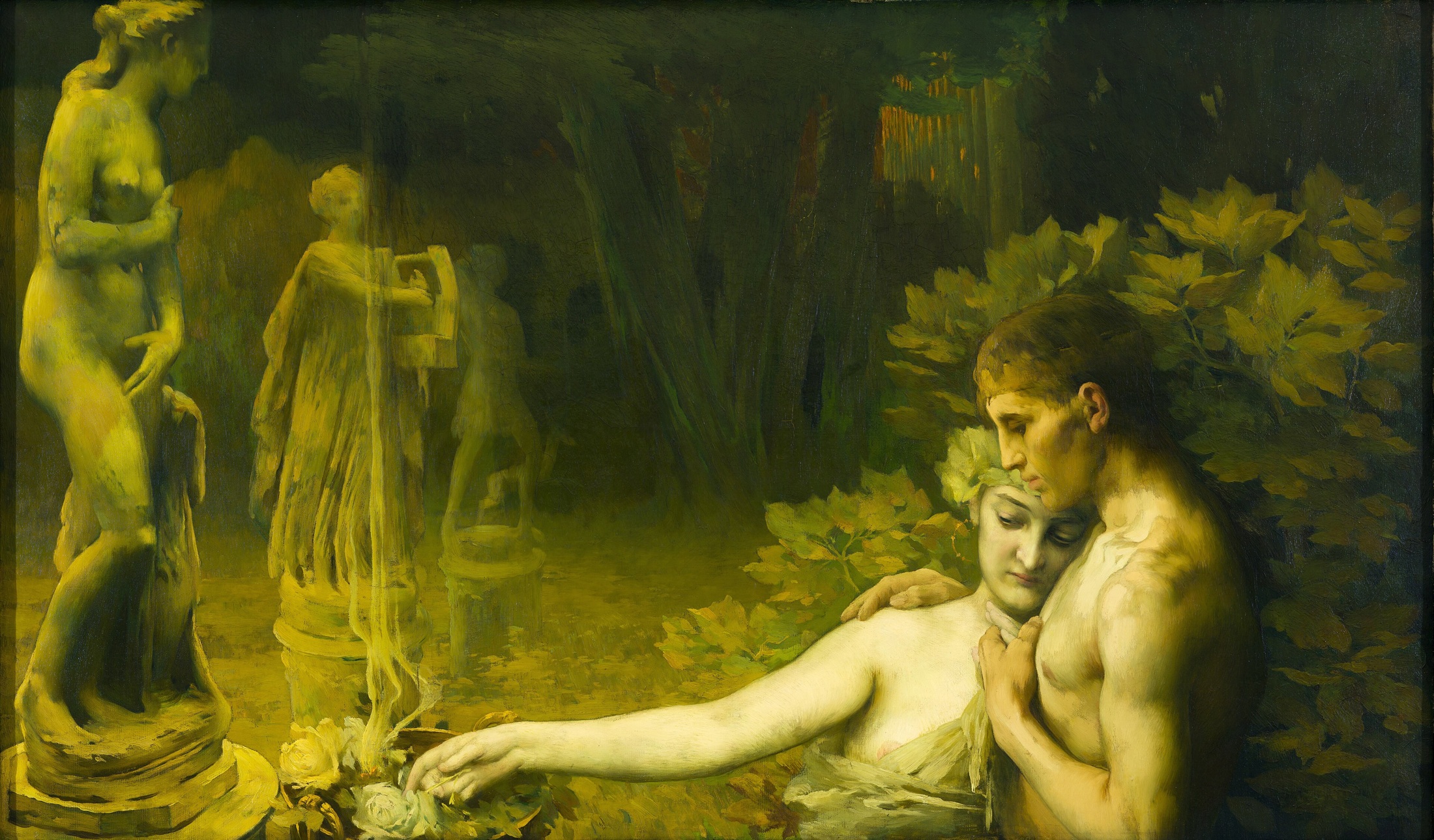
A green haze fills the garden. The embracing couple at the right is brighter than the surrounding vegetation, and a thin rising thread of smoke leads the eye towards the statues. Bodies, foliage and the smoke’s curves create a continuous, enclosed atmosphere.
The Hungarian National Gallery calls Golden Age an emblematic work of Hungarian Art Nouveau. It identifies the couple’s action as an offering to Venus, with statues of Apollo and Diana in the park. Vaszary combines modelled bodies with a setting that seems to hover between landscape and ornament.
This makes it a useful counterpoint to Klimt’s gold. Vaszary does not need a metallic ground to turn a scene into a decorative whole. His close green tones hold the picture together, while the pale figures draw attention to its intimate ritual. The work won recognition in Budapest in 1898 and a bronze medal at the Paris Exposition Universelle in 1900, according to the museum.
Collection reference: Hungarian National Gallery, Budapest.
Explore the artistGustav Klimt →
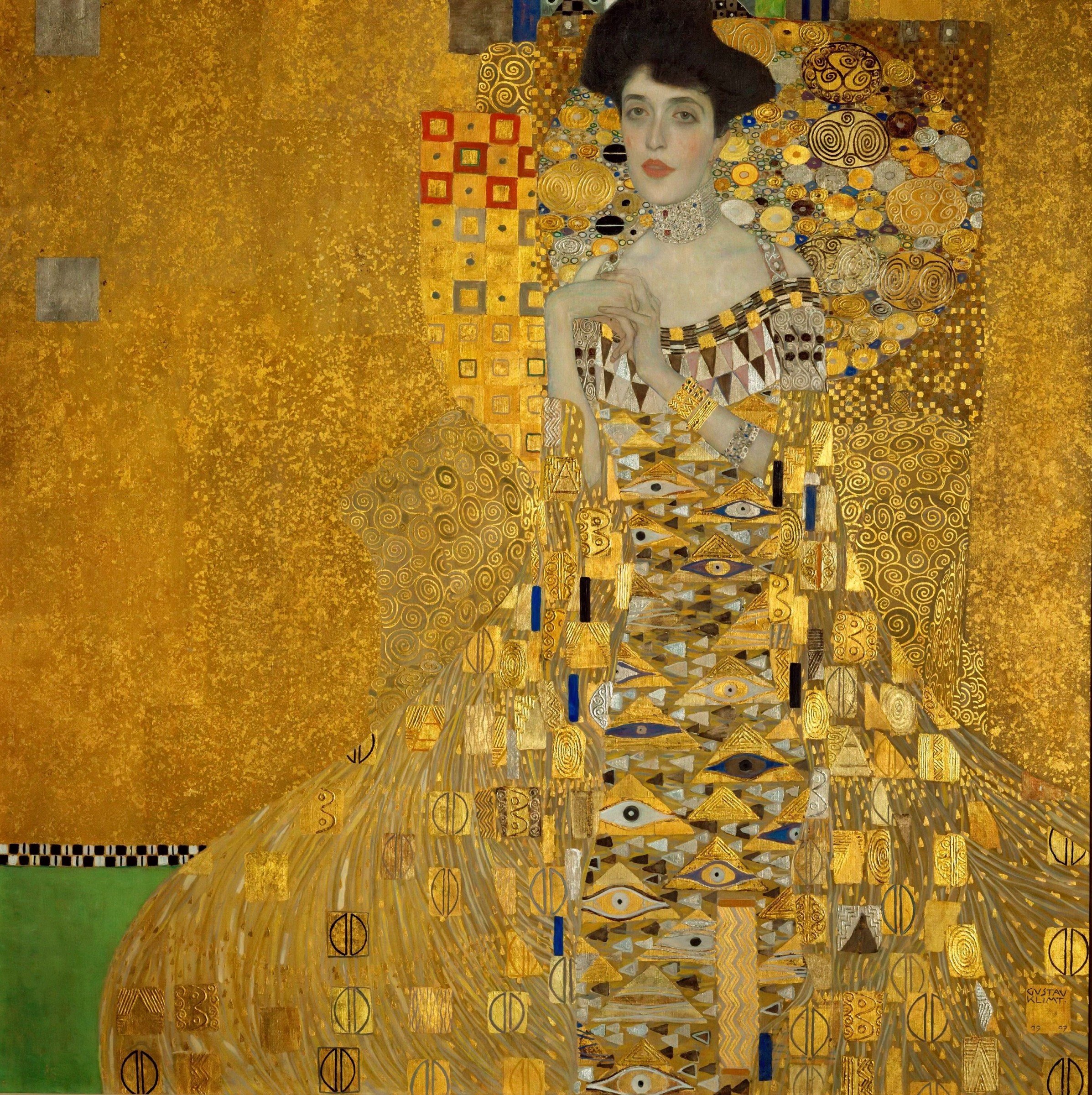
At first the portrait can look almost entirely golden. Then Adele’s pale face and interlaced hands establish a human presence within it. The dress, chair and background are difficult to separate, because repeated shapes carry the eye from one surface into the next.
Neue Galerie identifies the medium as oil, gold and silver on canvas. The metallic materials are part of the work itself. They help transform a portrait of a named patron into an image whose surface has something of the density of jewellery or mosaic.
Adele Bloch-Bauer was an important patron and subject for Klimt. This first portrait dates to 1907; it should not be confused with the very different second portrait of 1912. Here, the tension between an individual face and an overwhelming field of decoration is central. Following the contours of her hands is one way to find the sitter again after the patterns have taken over.
Collection reference: Neue Galerie New York.
Gustav Klimt · oil on canvas, made to order
 Explore the museum collectionMargaret Macdonald Mackintosh →
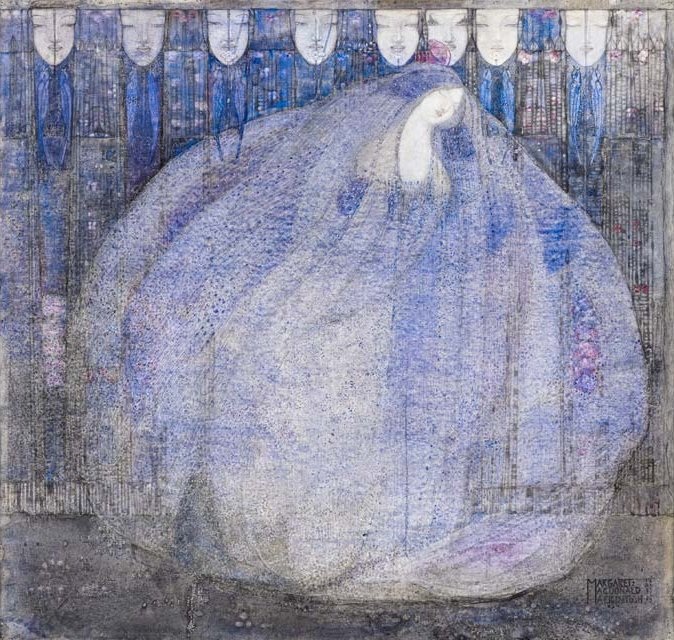
Eight pale heads form a strange row above a figure whose eyes are closed. Much of the body seems to disappear into a rounded mass of blue and violet forms. Thin vertical lines hold the surface together, but the broad flowing shape refuses to resolve into an ordinary dress or a recognisable garden.
This is a watercolour painting, with ink and pencil on vellum, rather than an oil canvas. The National Galleries of Scotland places its fantasy forms within Art Nouveau and the Glasgow Style. Macdonald’s work as a designer and painter lets the image move naturally between a dream scene and an intricate decorative surface.
The museum suggests a possible connection with Maurice Maeterlinck’s play The Blue Bird, performed in Glasgow in 1910. It presents that link as a possibility, not a settled explanation. The uncertainty suits the picture: the heads may belong to a dream, and the central figure may be asleep. Looking closely does not require solving the scene into a single story.
Collection reference: Scottish National Gallery of Modern Art, Edinburgh.
 Explore the artistFerdinand Hodler →
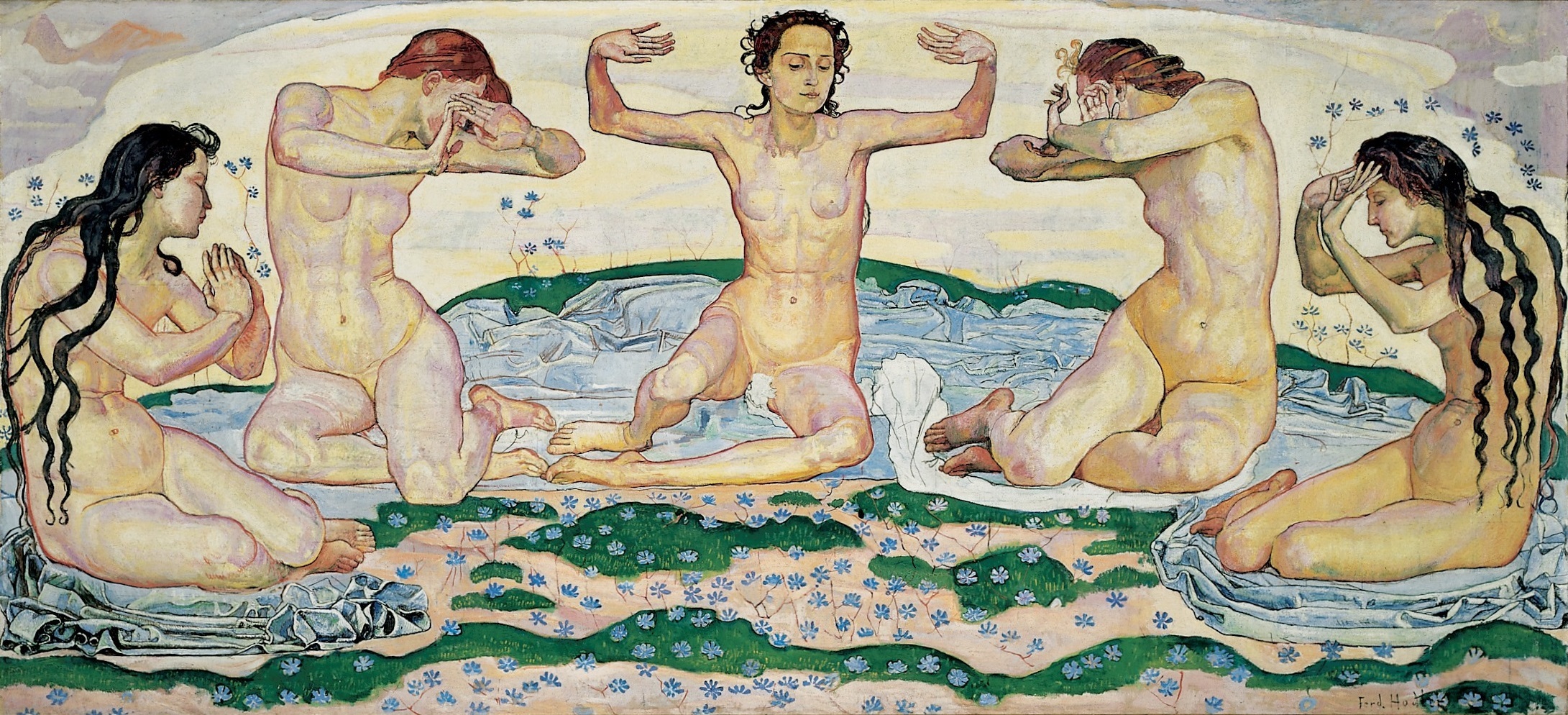
Five women sit across a long, shallow space. The central figure faces us with raised arms, while the women to either side repeat and vary the movement. The blue fabric and scattered flowers help connect their separate bodies into a single rhythm.
The version shown here is the 1899 to 1900 painting in Kunstmuseum Bern. Hodler made other versions, so the date and collection matter. His women can be understood as greeting the day, but the scene has the measured order of a ritual rather than the incidental gestures of an ordinary morning.
Hodler is usually described as a Symbolist. His relevance to this guide lies in the decorative arrangement of figures and his close involvement with the Secession movement. Repeated contours and balanced groups make the human body part of a larger surface design. The result shows how Art Nouveau’s visual concerns could meet painting without relying on a mass of curling flowers.
Collection reference: Kunstmuseum Bern.
Secession context: Klimt Foundation: Ferdinand Hodler.
Explore the artistGustav Klimt →
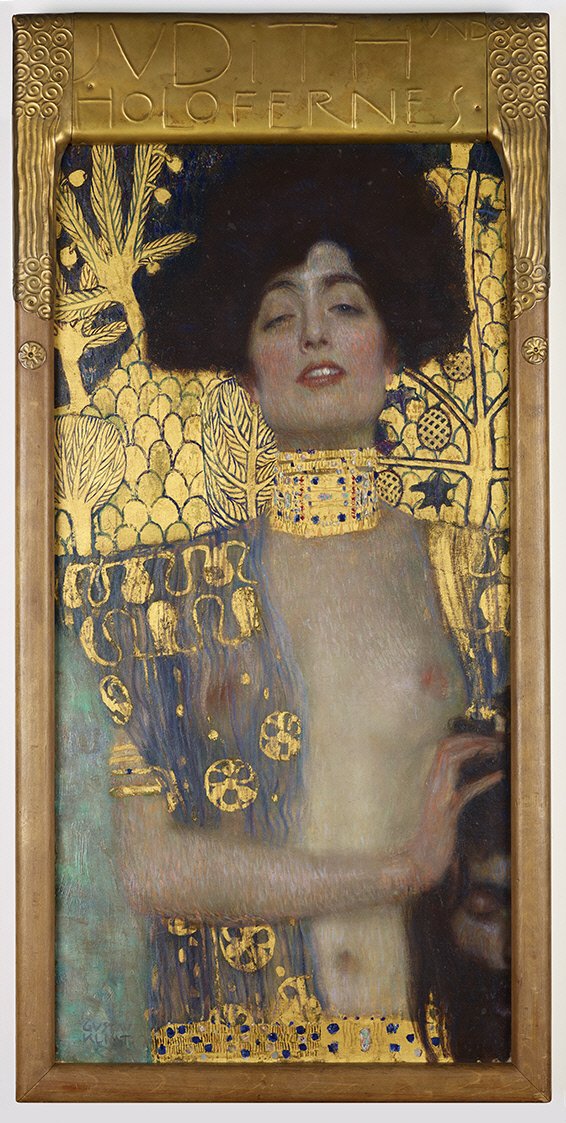
Judith’s lifted head and partly closed eyes are easy to notice before the severed head at the lower edge. A broad gold collar divides her face from her body. Leaves and stylised forms flatten the space behind her, and the narrow format presses the figure close to the viewer.
The subject is the biblical Judith after the killing of Holofernes. Klimt places the result at the margin instead of presenting the violent action. Her expression and the decorated surface occupy more of our attention than a complete account of the narrative.
The Belvedere records oil and gold leaf on canvas. In the complete framed image, the inscription identifies Judith and Holofernes, an important reminder that this is not Salome with the head of John the Baptist. Art Nouveau’s ornament and Symbolism’s charged subject matter meet in a picture where beauty and violence remain uncomfortably close.
Collection reference: Belvedere, Vienna.

Gustav Klimt · oil on canvas, made to order
 Explore the artistFranz von Stuck →
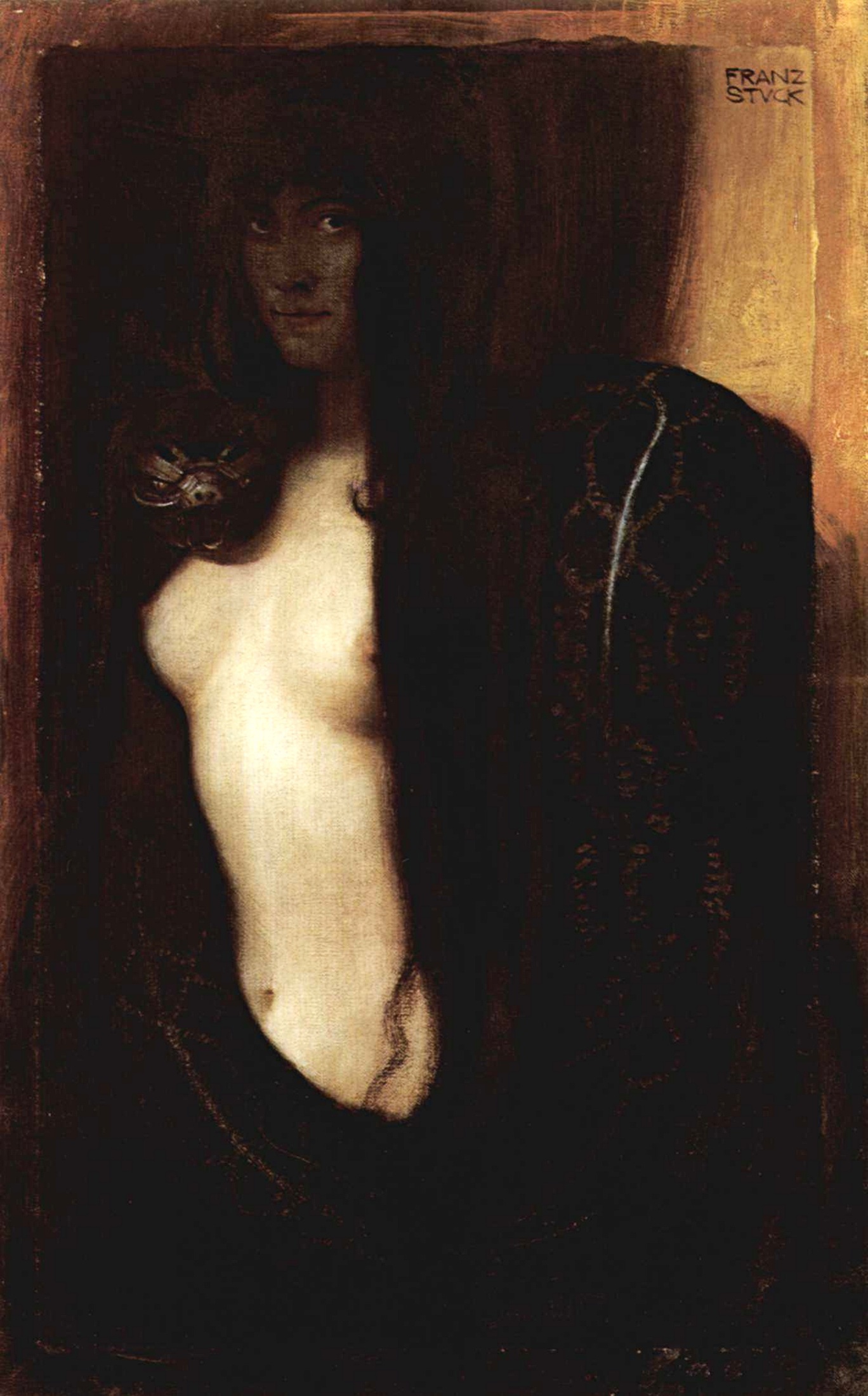
A pale torso emerges from the darkness. The woman’s face is much less clearly lit, and the snake beside it offers another set of eyes. The two heads sit close enough to feel like a paired presence, while dark hair and the animal’s body form an enclosing outline.
The 1893 version belongs to Munich’s Neue Pinakothek. Stuck returned to the subject in several paintings; the exact version shown here should not be confused with later examples in other collections. The title gives the image its allegorical direction, but the immediate encounter is with a body, a gaze and a threatening animal.
This is primarily a Symbolist painting by a leading figure of the Munich Secession. It belongs in the wider Art Nouveau conversation through that setting and its concentrated decorative silhouette. Its darkness also widens the guide’s mood. The art of the period could make an image feel dangerous and enclosed as readily as graceful or floral.
Collection reference: Neue Pinakothek, Munich.
Explore the artistFerdinand Hodler →
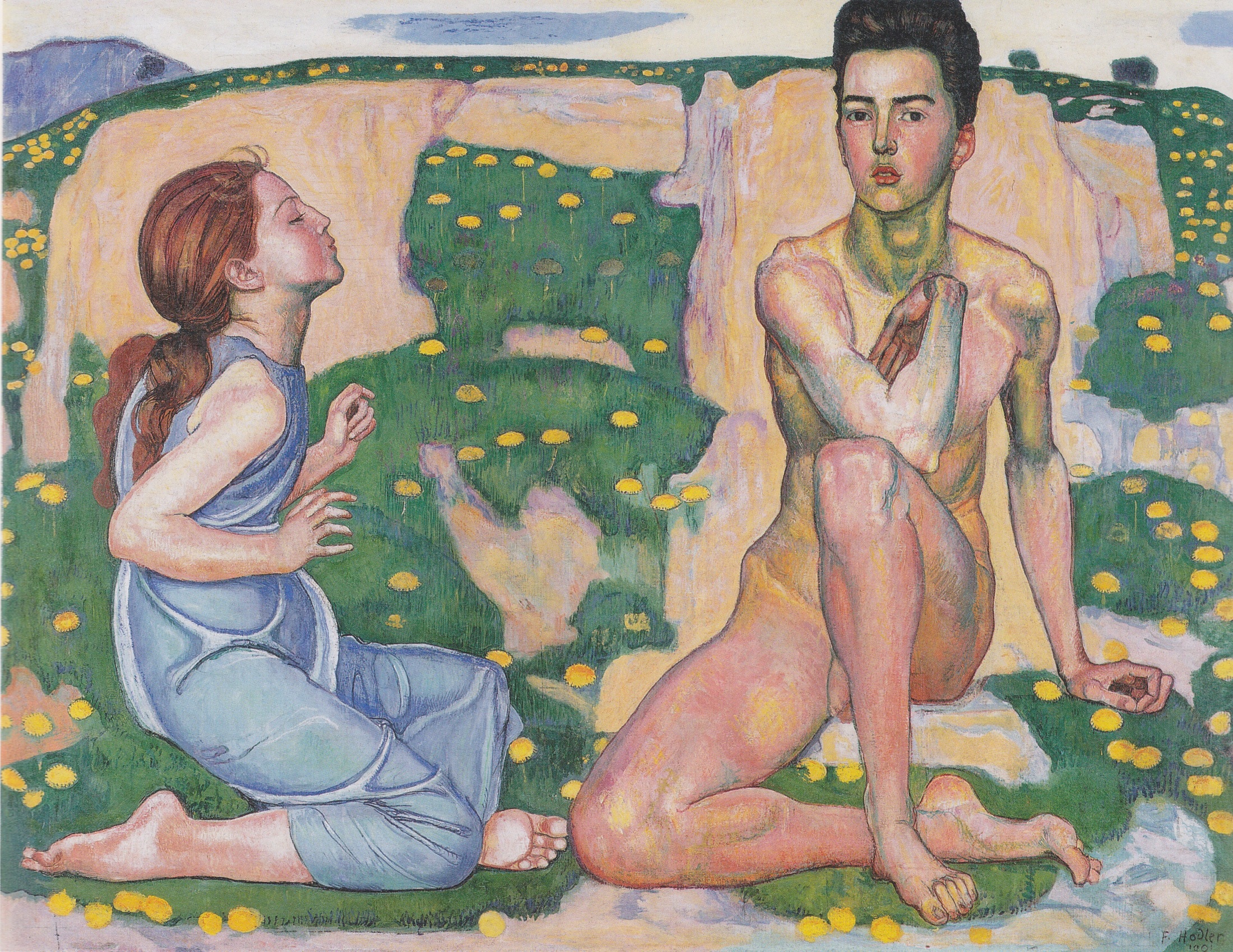
The two figures share the flowered ground but turn their bodies differently. The young woman looks towards the young man; his head faces outward, while his arms create a compressed arrangement in front of his chest. Behind them, the landscape separates into broad, coloured bands.
The Museum Folkwang painting dates to 1901. Hodler also made later versions, and a lithograph titled Spring is a separate object. The painted example’s strong contours and simplified setting help the figures read almost like shapes placed on an ornamental ground.
Hodler’s connection to Vienna is documented by the Klimt Foundation’s research: Spring was shown at the twelfth Secession exhibition in 1901. That historical link is more useful than treating every outline or flower as proof of one style. The work brings youthful bodies and the season’s renewal together through pose, colour and a carefully arranged surface.
Collection reference: Museum Folkwang, Essen.
Secession context: Klimt Foundation: Ferdinand Hodler.
Explore the artistGustav Klimt →
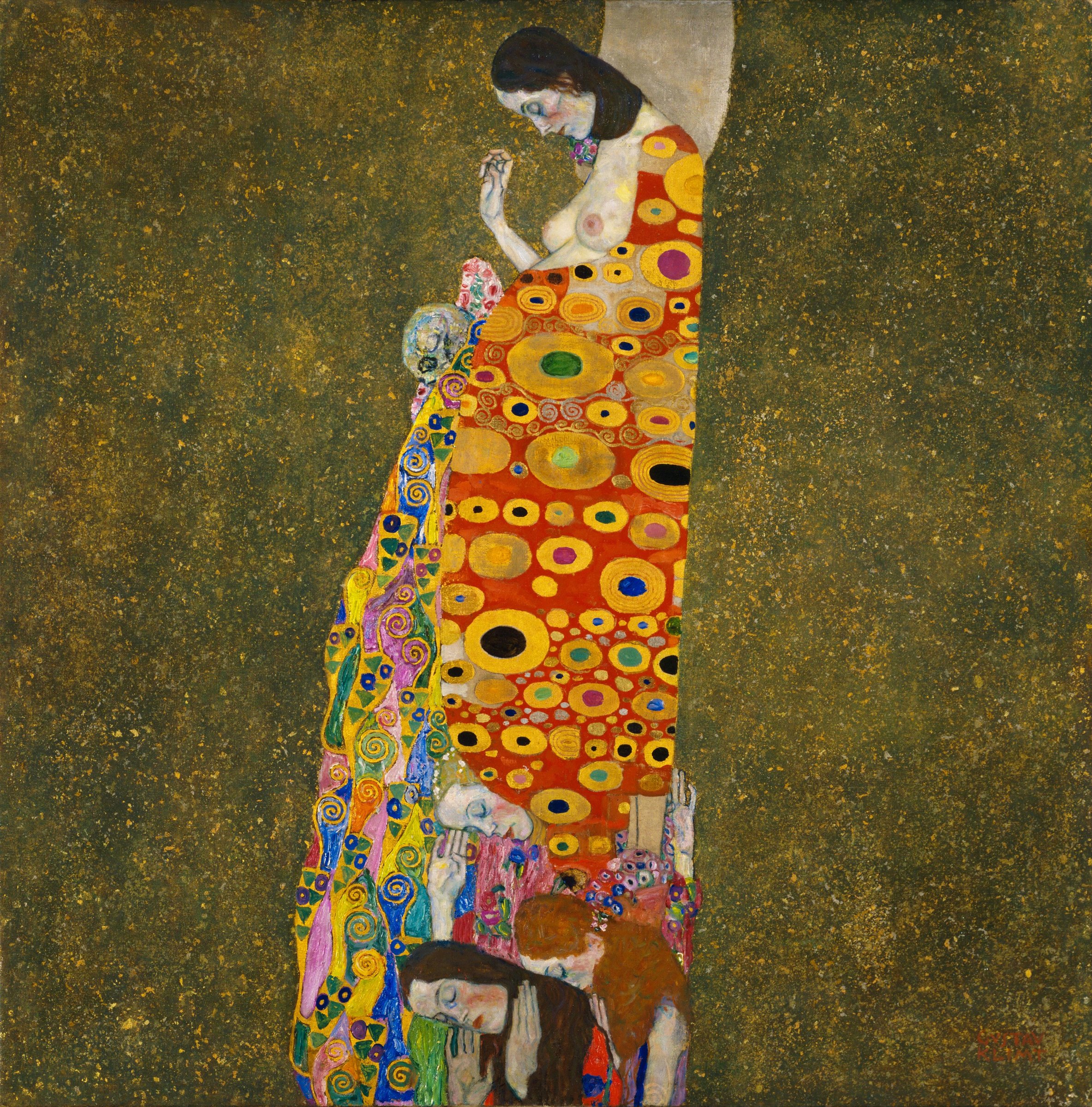
Bright circles and patterned fabric surround the pregnant woman. Her head bends down towards her body. Lower in the painting, three other women bow their heads, while a skull introduces a different presence among the coloured forms.
MoMA reads these gestures as suggesting prayer and possibly mourning. The painting holds pregnancy and mortality together without showing a literal event that resolves the tension. Its decorative richness can attract the eye before the skull changes the mood.
The museum records oil, gold and platinum on canvas, and notes that Klimt called the work Vision. Its familiar title, Hope II, became attached through association with his earlier painting Hope. Ending here reveals how much emotional range lies behind the idea of Art Nouveau decoration: patterned surfaces could hold uncertainty, fear and expectancy as well as pleasure.
Collection reference: The Museum of Modern Art, New York.
Gustav Klimt · oil on canvas, made to order
Begin with a contour. In The Kiss, the outer edge of the golden clothing contains two people. In Madonna of the Lilies, fabric and stems carry a shared movement. In The Mysterious Garden, a broad blue shape almost replaces the body. In Hodler, repeated postures bring separate figures into a larger arrangement.
Then look at the space behind them. These painters often let the surface remain visibly organised rather than making every part behave like a view through a window. Ornament can concentrate attention, conceal a body, make a figure feel ceremonial or introduce an uneasy mood. The pattern is part of what happens.
Gustav Klimt and Alphonse Mucha are central names. Margaret Macdonald Mackintosh and János Vaszary reveal important Scottish and Hungarian approaches. Ferdinand Hodler and Franz von Stuck connect the discussion with Symbolism and the Secessions.
Yes. The Belvedere identifies Klimt’s The Kiss as an icon of Viennese Jugendstil. Its patterned garments, flattened gold setting and union of ornament with the figure explain that connection.
A poster may begin with a drawing or painted design, but a printed poster edition is a print. Identify the object being shown. Mucha also made paintings, including the tempera-on-canvas Madonna of the Lilies featured here.
Art Nouveau developed around the turn of the twentieth century and often favoured organic curves and plant-like forms. Art Deco became prominent later, especially in the 1920s and 1930s, and frequently used stronger geometric shapes and streamlined designs. Neither label reduces every work to one kind of line.
No. Symbolism concerns suggestive subjects, ideas and inner experience. Art Nouveau concerns a broader artistic and decorative language across media. A painting can participate in both, as several works in this guide demonstrate.
Explore the available hand-painted reproductions, from Klimt’s patterned portraits to Mucha’s painted visions.
Browse the Art Nouveau CollectionThe museum, foundation and collection records are linked beneath each painting. They establish the versions, dates, media and historical context used here. Interpretations and uncertain identities remain qualified.
The images depict historical artworks, not completed ByMuseum studio reproductions. Original media and museum dimensions describe the historical works; reproduction options are provided on the relevant product pages.
Enjoyed this story?
Save articles to your collection
Log in or create a free account, and this article will be waiting in your Private Collection.
Log in or sign up
Man Writing a Letter
Gabriel Metsu, c. 1664
The gallery list
Every painting is already 50% off. Join the list and we will send you an extra $15 code, plus first access to new collections.
No spam. Unsubscribe anytime. · Privacy Policy
Welcome
Your $15 code is on its way. Explore the gallery while you wait.