Loading cart…
No products in the cart.

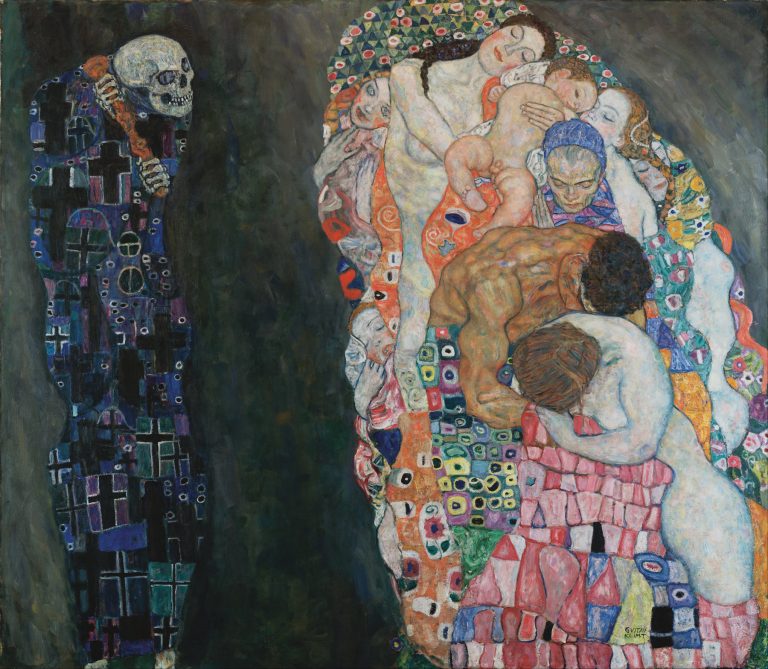
1910/11; reworked 1912/13 and 1915/16 · Oil on canvas · Leopold Museum, Vienna, Austria
Save articles to your collection
Log in or create a free account, and this article will be waiting in your Private Collection.
Log in or sign up Explore the artistGustav Klimt →
At first, the living seem to have found a place where nothing can reach them. Bodies lean into other bodies. A child rests against a woman. Near the bottom, a couple fold themselves into an embrace. Across the empty ground, a skeleton watches.
Then one face breaks the calm. At the left edge of the human group, a young woman has her eyes wide open and her hands drawn up to her chest. She is close to the others, but she does not share their apparent peace.
Gustav Klimt’s Death and Life sets a solitary, armed skeleton opposite people of different ages gathered together. Its meaning grows from that unequal encounter: individual lives are vulnerable, while affection, birth and successive generations keep the group of the living going.
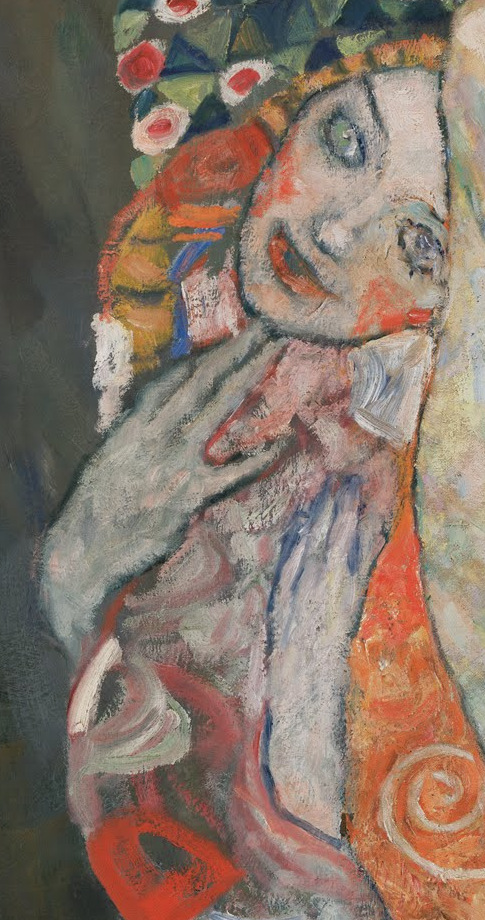
The young woman gives that large idea a particular expression. Her face tilts sideways; the eyes are enlarged, the fingers pressed close to her body. The Leopold Museum’s interpretation identifies her gesture as fear and describes Death’s gaze as falling upon her. This reading supports the sense that she recognises what the people beside her refuse to see.
We cannot recover a private thought from a painted face. But we can follow the difference Klimt makes visible: most of the group turn inward, while this woman looks outward. Through her, the threat enters their shared refuge.
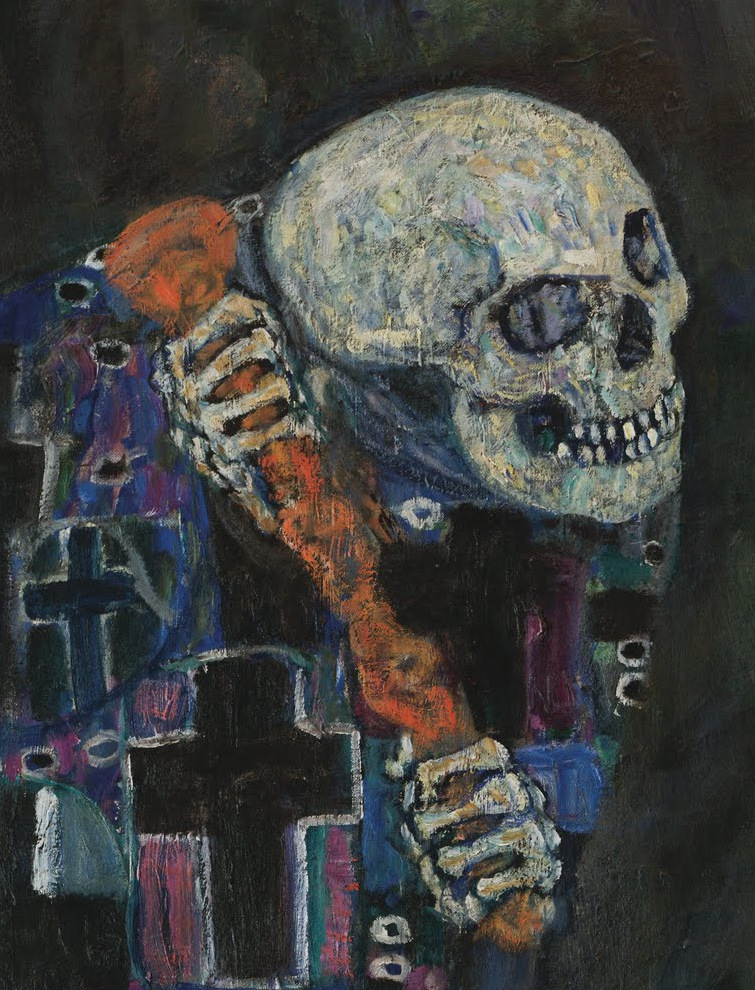
The skull has no flesh with which to smile. Nevertheless, its exposed teeth and sideways turn create a disturbing suggestion of pleasure. It appears alert, almost expectant. Nothing in its posture resembles sleep.
Below the head, two skeletal hands grip a reddish club. One holds it high, close to the skull; the other closes around the lower part. Following the object from hand to hand makes its blunt, physical presence hard to miss. Death has something with which to strike.
No blow has landed. That matters to the picture’s tension. Klimt leaves the action suspended: the living remain together, the skeleton remains opposite, and the threat has not yet become a specific loss. The open-eyed woman seems to inhabit that waiting moment.
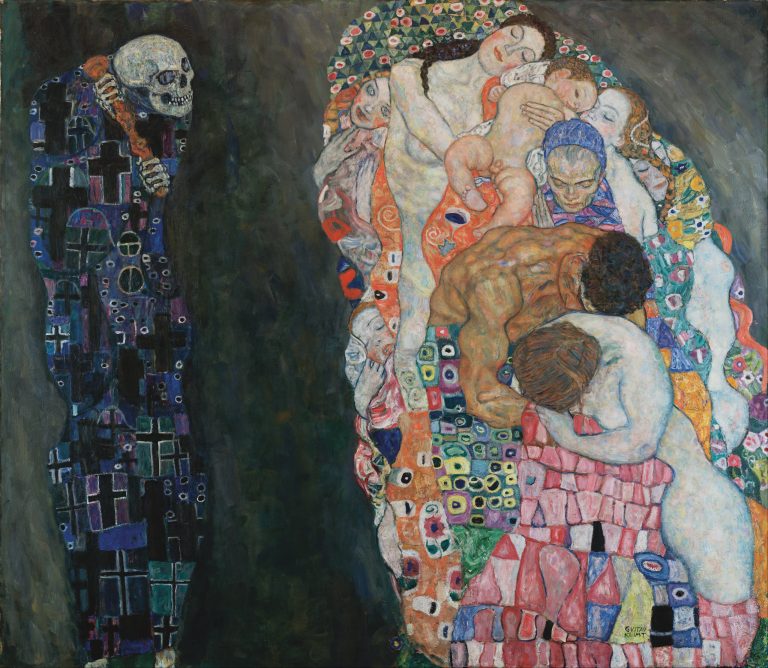
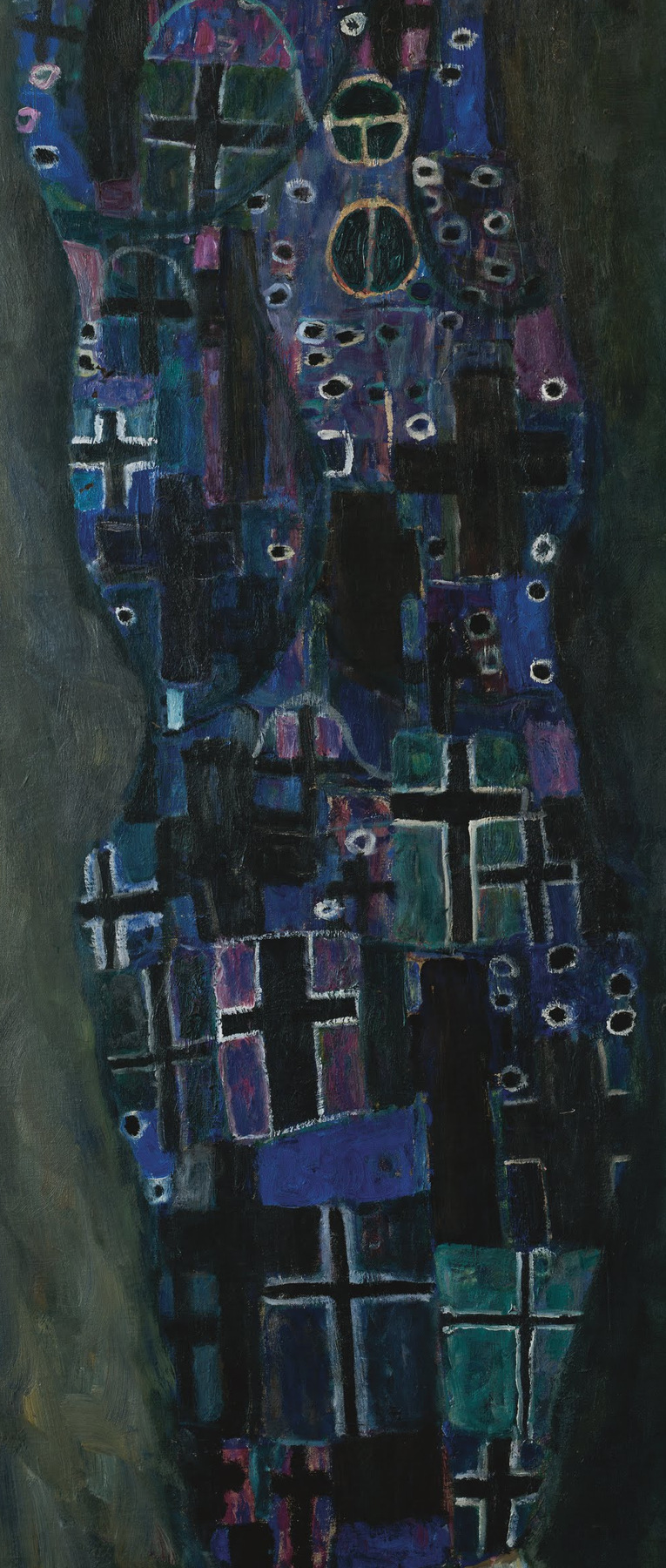
From a distance, Death looks like a narrow dark column. Close up, its garment is busy with colour. Black crosses stretch through blue, purple and green patches. Small rings and rectangles fill the spaces between them.
Pattern therefore belongs to both halves of the painting. On the left, repeated crosses dominate a long, enclosed silhouette. On the right, ornament curves around bare shoulders, cheeks and arms. The same attention to decoration produces very different sensations.
The crosses bring Christian associations into view, but treating every mark as a separate hidden message would lose the larger effect. Together, they give Death’s robe a persistent rhythm. The skeleton is surrounded by signs while the living are surrounded by one another.
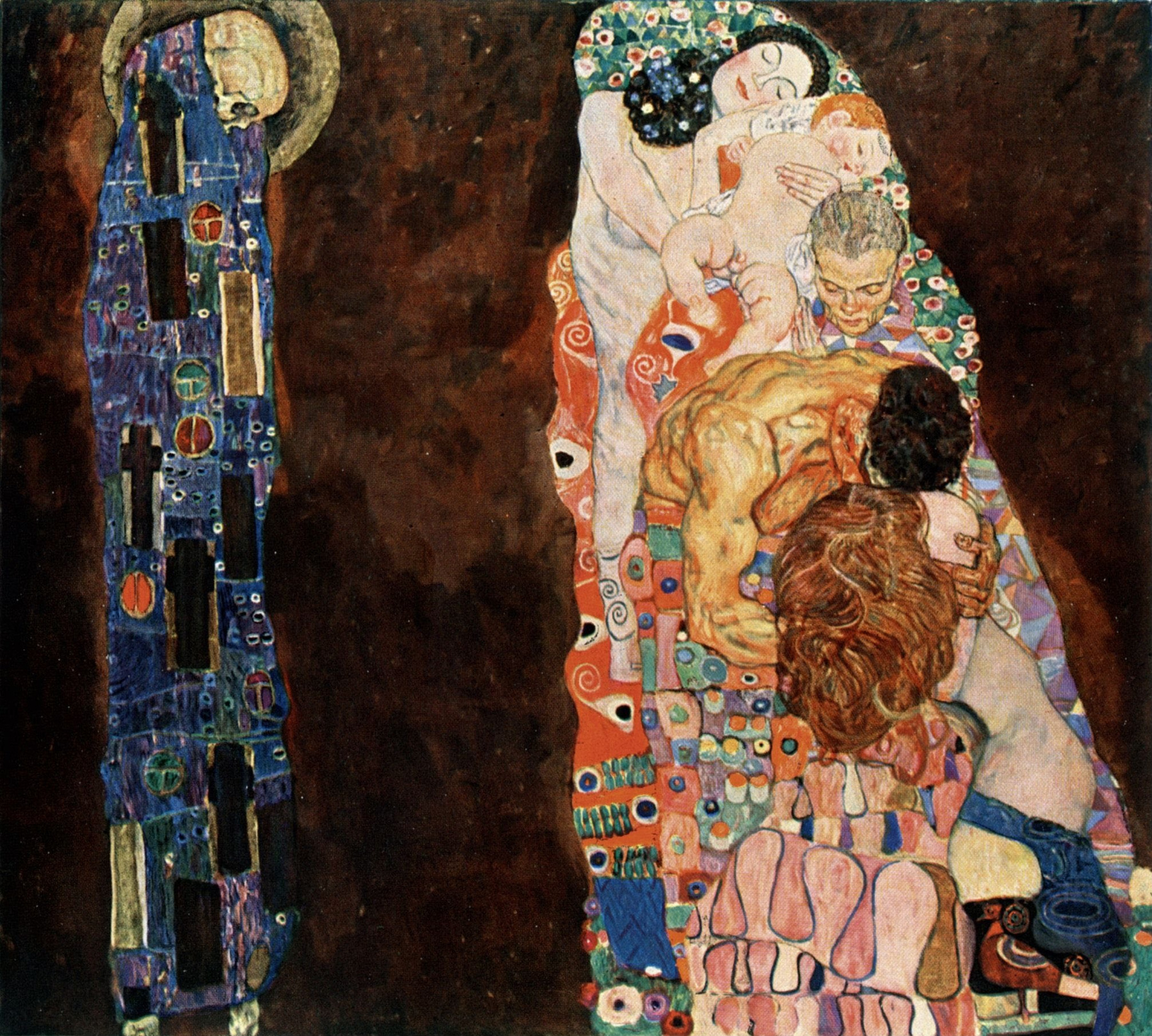
This historical reproduction preserves an earlier appearance of Death and Life. Look first at the skull. Its head bends downward, enclosed by a halo-like outline. The club is absent. The human group is slimmer, and the wide-eyed woman at its left edge is not yet there.
These differences make the revision more than a change of background colour. Death becomes an active watcher, and the enlarged Life group gains a figure whose expression answers that attention.
The museum dates the canvas 1910/11, reworked in 1912/13 and 1915/16. Its earliest ideas go back to drawings from 1908. The first exhibited version won Klimt a gold medal in Rome in 1911, but recognition did not stop him returning to it.
A separate Leopold Museum record of Moriz Nähr’s photograph explains how the earlier state survives through photographs and printed reproductions. The image here records that earlier appearance; it is not a second, untouched oil painting hanging beside the revised canvas.
The museum’s account of the changes describes a gold-coloured background, possibly containing gold leaf, being covered by bluish-grey. It also identifies added female figures and the newly direct encounter with Death. The precise reason for Klimt’s revisions remains unknown. The changes are visible; a personal explanation for them would be speculation.
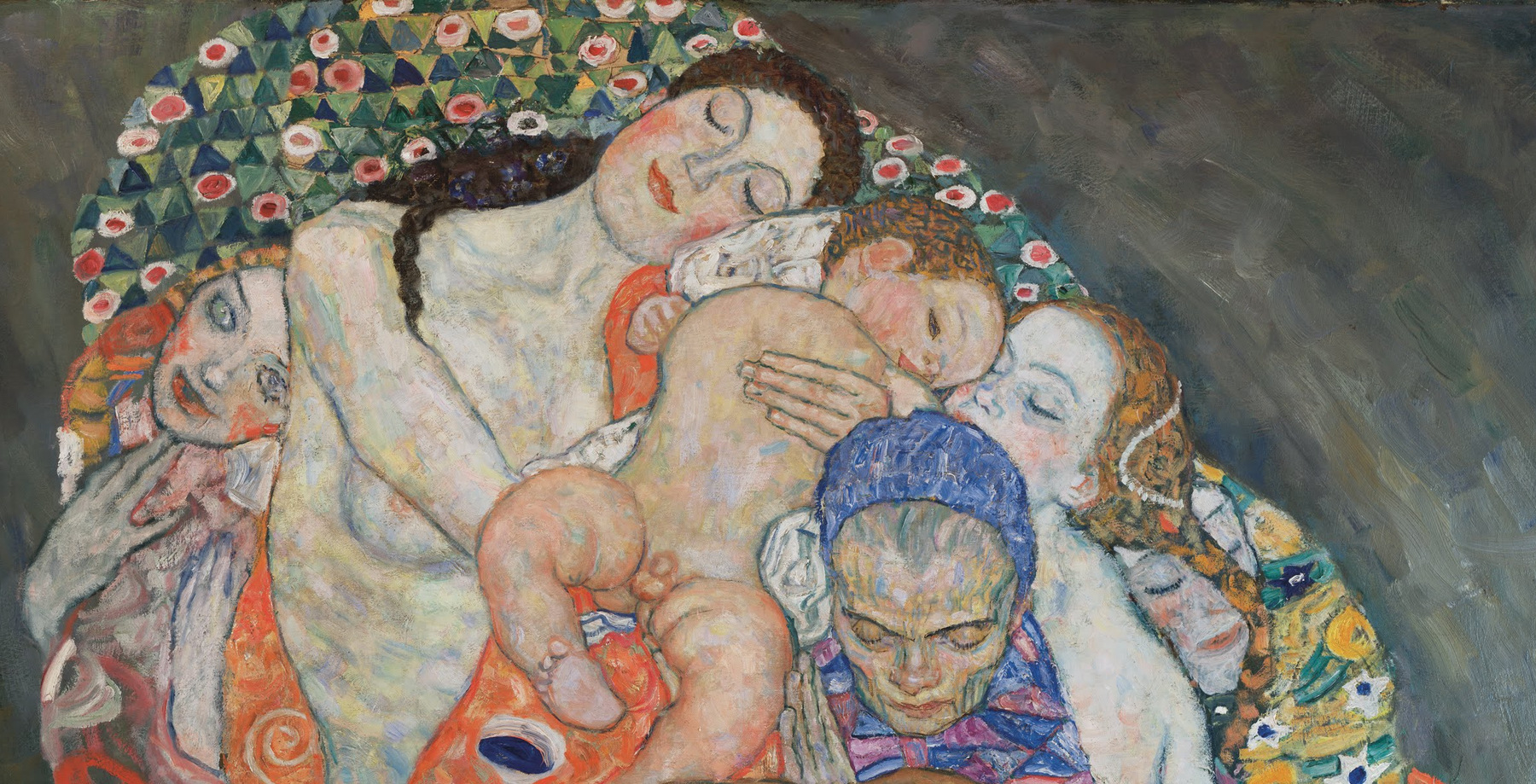
The child’s small body curls into the upper part of the group. Nearby, an elderly woman bows her head beneath a blue covering. Klimt brings the beginning of a life close to its later years without arranging a neat sequence from youngest to oldest.
Look at how the heads gather. One rests sideways, another turns down, and another leans into a neighbouring body. They suggest different ages and different kinds of dependence. Nobody occupies an independent little room within the composition.
This is why the painting can feel tender before it feels frightening. The figures have contact. A supporting hand, a shoulder and the closeness of another face make their vulnerability visible without reducing them to anonymous victims.
The bowed elderly face also prevents the brighter colours from becoming an image of endless youth. Old age is already inside Life. The skeleton does not have to enter the group to remind us that its members are mortal.
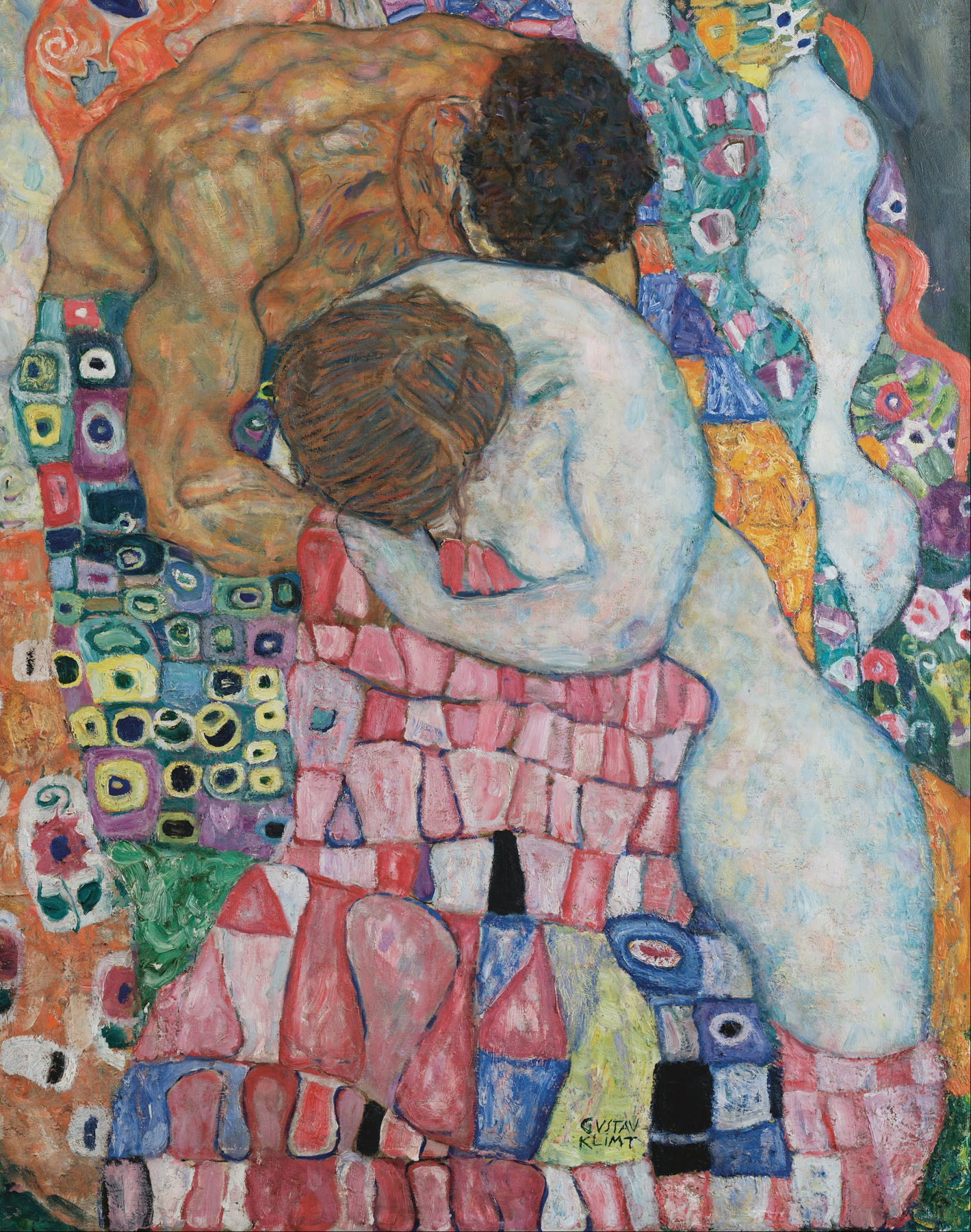
At the lower right, the man bends over the woman. His back is broad and darkly modelled; her paler body turns inward beneath him. Their heads come close, and their arms lead the eye around the embrace.
It is easy to read the man’s muscular back as protection. Yet he faces into the group rather than out toward Death. The embrace creates intimacy, not a defensive wall. Even the strongest body in the picture is absorbed in another person.
Compare this with Klimt’s The Kiss. Both compositions let an embrace become a shape larger than the two separate people. Here, however, that closeness belongs to a crowd of different ages, and a skeleton stands in the same pictorial space.
The lovers do not cancel the danger. Their presence gives us something to care about while we look at it.
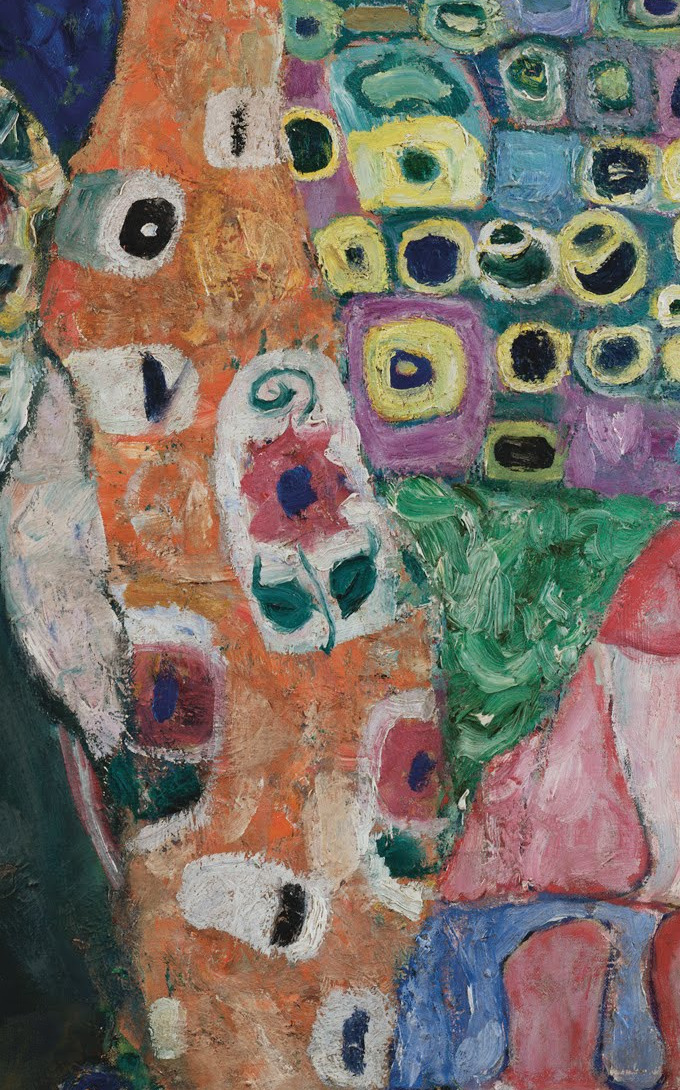
Following the outlines of the living is surprisingly difficult. A patch of pink passes beneath a body. Green and yellow shapes run beside an arm. Flesh disappears into ornament and returns somewhere else.
Some motifs resemble flowers; others look like rounded squares, small eyes or irregular rings. Their changing scale keeps the surface moving. They do not form the orderly setting of a bedroom or a garden. They help turn the gathered figures into a single dense shape.
The colour continues where a body can no longer be followed. That visual connection allows the group to suggest more than a meeting of individuals. It can stand for human life extending beyond any one of its members, although the painting offers no promise that a particular person will survive.
Return to the complete painting. The grey-green ground between Death and Life contains no path, doorway or barrier. It gives no practical explanation for their separation.
At its narrowest, the gap brings the skull unsettlingly close to the alert woman. Farther down, it widens beside the group’s rounded outline. The empty area makes us keep comparing the two sides, even when a bright face or decorative patch pulls our attention away.
Death is alone. Life is crowded. That difference remains after every other detail has been examined. One figure carries a weapon; the others have the warmth and burden of belonging to each other.
The picture can therefore hold fear and reassurance together. Its living people cannot be made invulnerable, but neither does the skeleton possess the whole canvas. The group still has colour, closeness and continuity. The open-eyed woman makes the cost of that fragile peace impossible to ignore.
For another view of mortality within Symbolist painting, see Hugo Simberg’s The Garden of Death, where skeletal figures tend living plants.
The Austrian artist Gustav Klimt painted Death and Life, known in German as Tod und Leben. It is an allegory, rather than an illustration of one named historical event.
The solitary skeleton represents death, while the intertwined figures suggest human life across generations. Their closeness offers a sense of continuity without removing the danger faced by each person.
Her wide eyes and raised hands distinguish her from the group’s sleep-like figures. The Leopold Museum reads her expression as fear and links it to Death’s gaze. This is an interpretation of her painted gesture, not an identified incident from her life.
The Leopold Museum’s object heading dates it 1910/11, with reworking in 1912/13 and 1915/16. Shorter labels such as 1910–1915 compress a painting history that involved several changes.
The original oil painting belongs to the Leopold Museum in Vienna, inventory number 630. It measures 180.8 centimetres high by 200.6 centimetres wide.
Death grips a small red club in its skeletal hands. The club, turned skull and expanded Life group distinguish the revised composition from its earlier appearance.
Gustav Klimt, Death and Life. Leopold Museum, Vienna, Inv. 630. Faithful public-domain reproduction via Wikimedia Commons / Google Art Project.
Enjoyed this story?
Save articles to your collection
Log in or create a free account, and this article will be waiting in your Private Collection.
Log in or sign up
Man Writing a Letter
Gabriel Metsu, c. 1664
The gallery list
Every painting is already 50% off. Join the list and we will send you an extra $15 code, plus first access to new collections.
No spam. Unsubscribe anytime. · Privacy Policy
Welcome
Your $15 code is on its way. Explore the gallery while you wait.