Loading cart…
No products in the cart.

c. 1743 · Oil on canvas · National Gallery, London
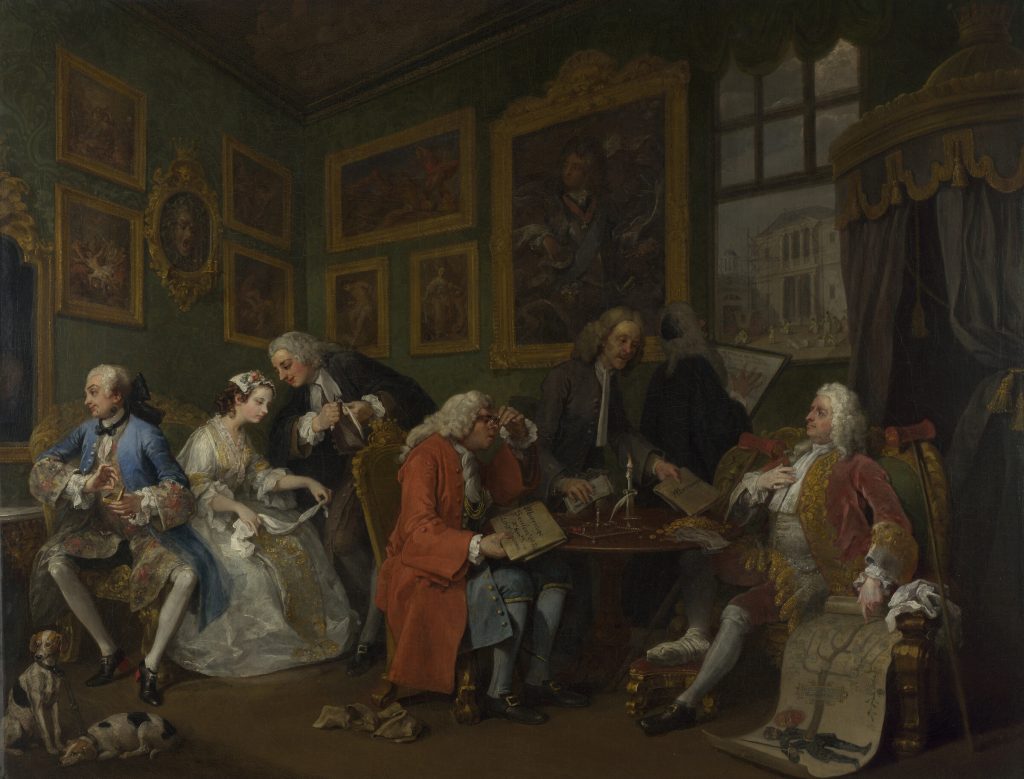
A contract has parties, consideration and witnesses, and Hogarth painted all three. This is the first of six pictures and it is the only one in which anyone is doing what they came to do. Everything that happens in the other five rooms follows from what is agreed in this one, and nobody in it can see it coming. So read it the way the lawyers in it are reading it: clause by clause, and watch for the small print.
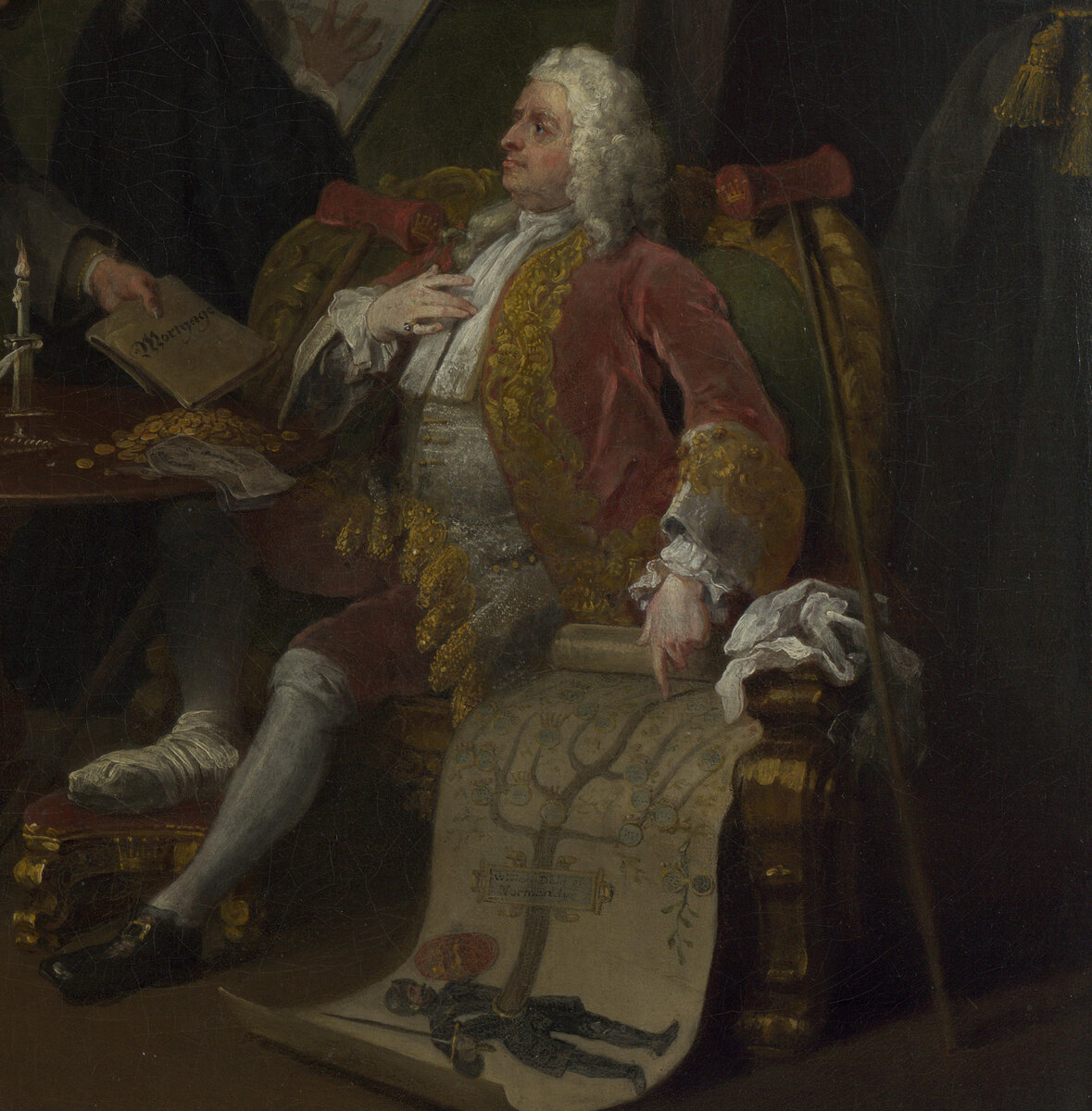
Party of the first part, on the right in red and gold, is the Earl of Squander. He has a coronet on his crutch, a coronet on his bed and a coronet on his footstool, and he points with one hand to the family tree that unrolls from his chair to the floor. It starts with William the Conqueror. His other foot is bandaged and propped on a stool: gout, the disease of men who have eaten and drunk too well for too long. He has the name. He has not got the money, which is why he is here.
Party of the second part, in the plain brown coat and spectacles, is the Alderman, a rich man from the City of London. He is reading the marriage settlement with the care of someone who reads contracts for a living. He has the money. He has not got the name, which is why he is here. Between them, on the table, is what each is buying from the other.
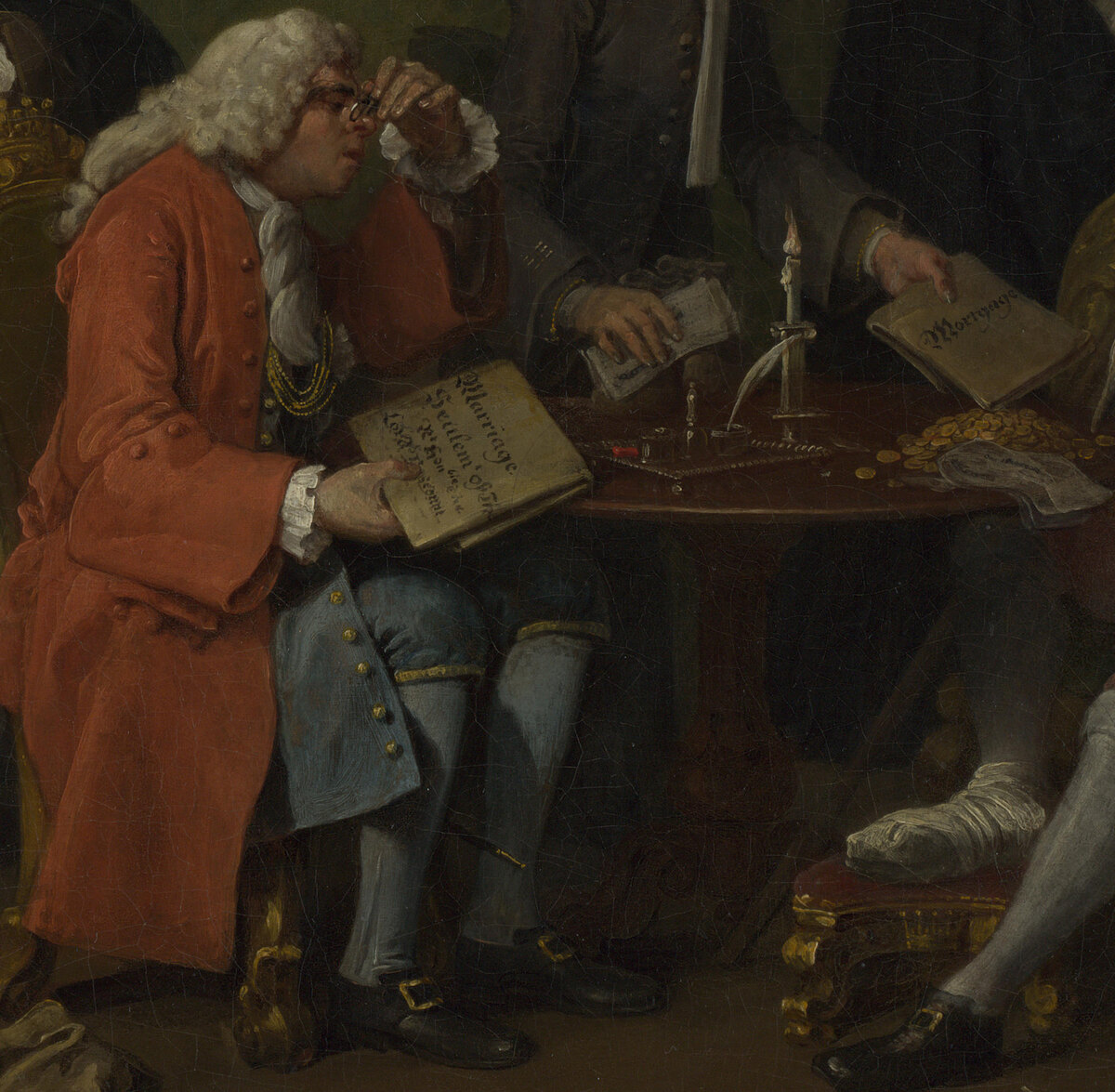
The gold is already out of its bags. That is Hogarth's first joke and his first fact: the Alderman's money has crossed the table before the ink is dry. A thin man in black hands the Earl a document that the National Gallery reads as a mortgage, the Alderman's cash paying off the Earl's debts as fast as it arrives. Through the window you can see where the debts came from.
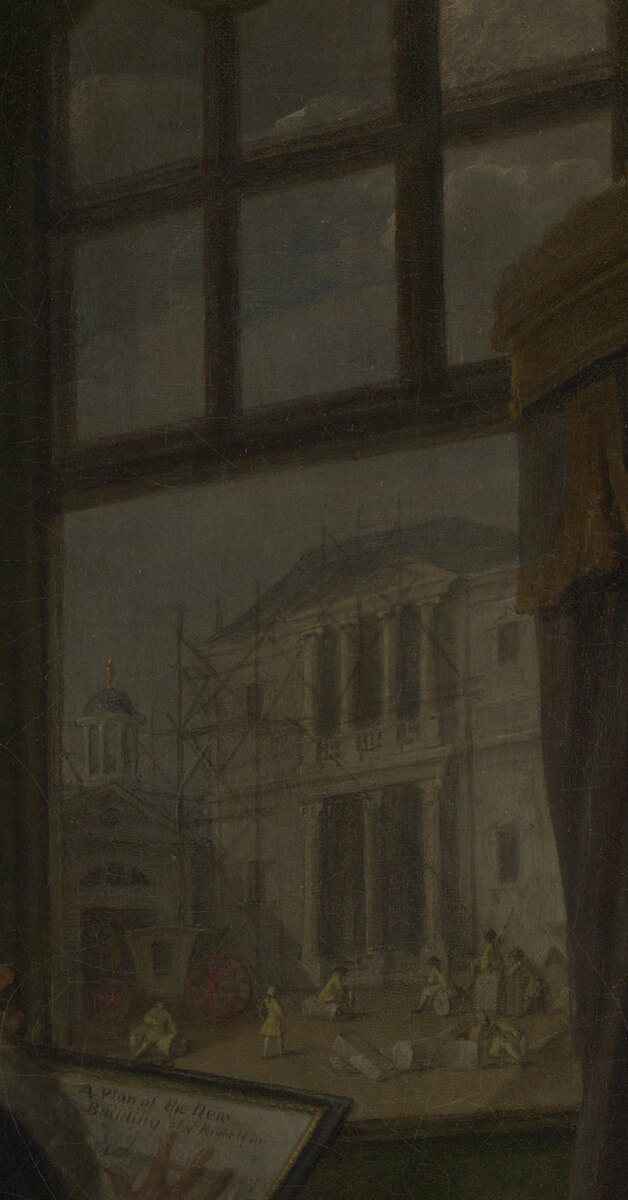
The half-built house outside is the Earl's, in the newest Palladian fashion, and it has stopped. There is scaffolding but no work. He has spent the family's money on a building he cannot finish, and the marriage is going to finish it. The Alderman, for his part, gets a title for his grandchildren. The bride and groom, who are also in the room, are the goods.
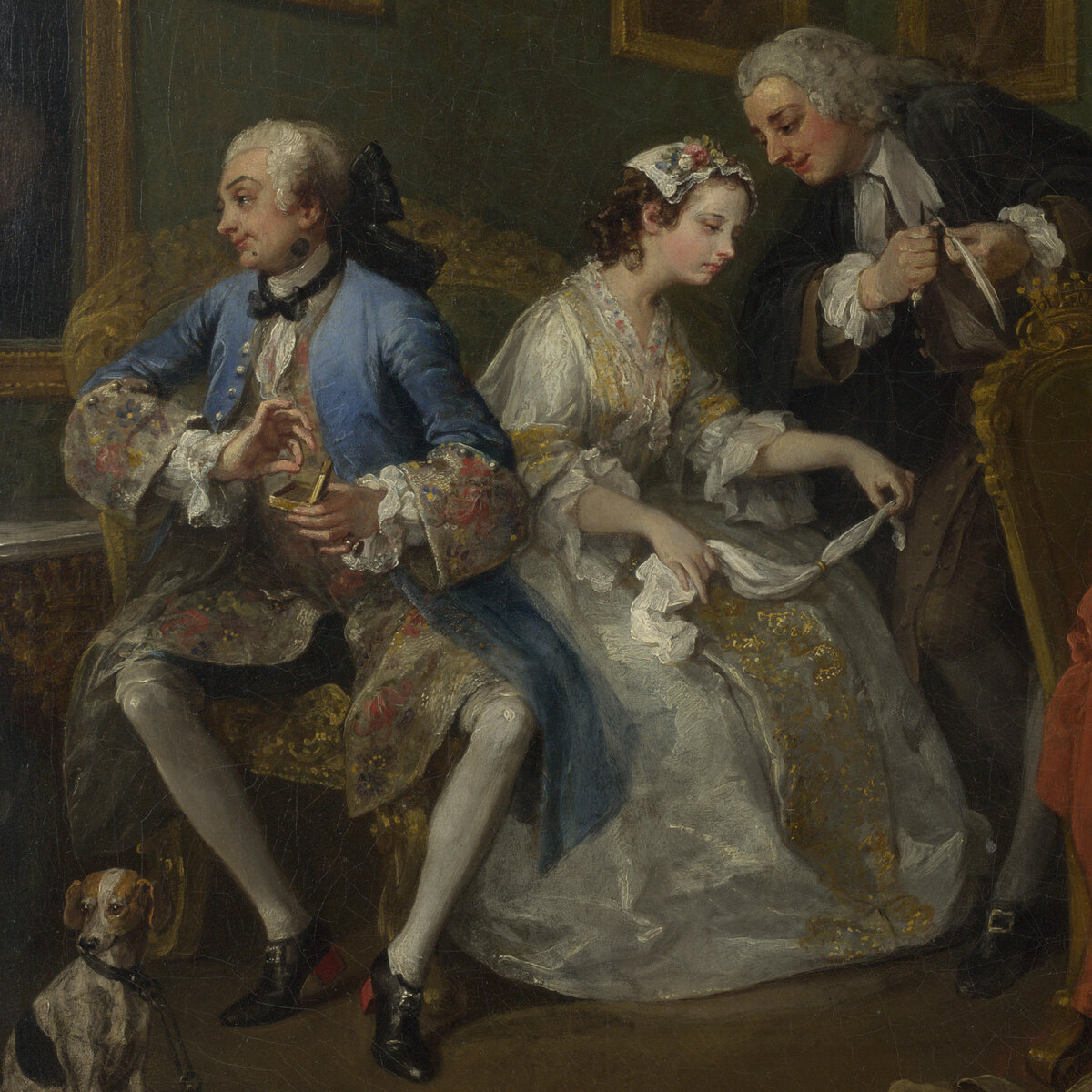
On the sofa at the left are the two people being married, and they have their backs to each other. The Viscount, the Earl's son, sits in blue silk with a black bow on his wig and a black patch on his neck, and admires himself in the mirror. He takes snuff. He is, Hogarth makes sure you understand, a fool, and the patch on his neck is a detail you will want to remember in Room 3.
The bride is in white and has not been asked her opinion. She slides her wedding ring up and down a handkerchief and listens to the man leaning over her shoulder, who is sharpening a quill. He is the lawyer, and Hogarth gave him a name: Silvertongue. He is the only person in the room paying attention to her, and the series is going to follow what comes of that.
Six Prints, representing a Variety of Modern Occurrences in High-Life ... particular care will be taken that there may not be the least objection to the decency or elegancy of the whole work, and that none of the characters represented shall be personal.
William Hogarth, advertisement for the engravings, April 1743
None of the characters are personal, he promised, and none are. They are types, which is why the story still works: the aristocrat with a name and no money, the merchant with money and no name, the two children who are the price of the exchange.
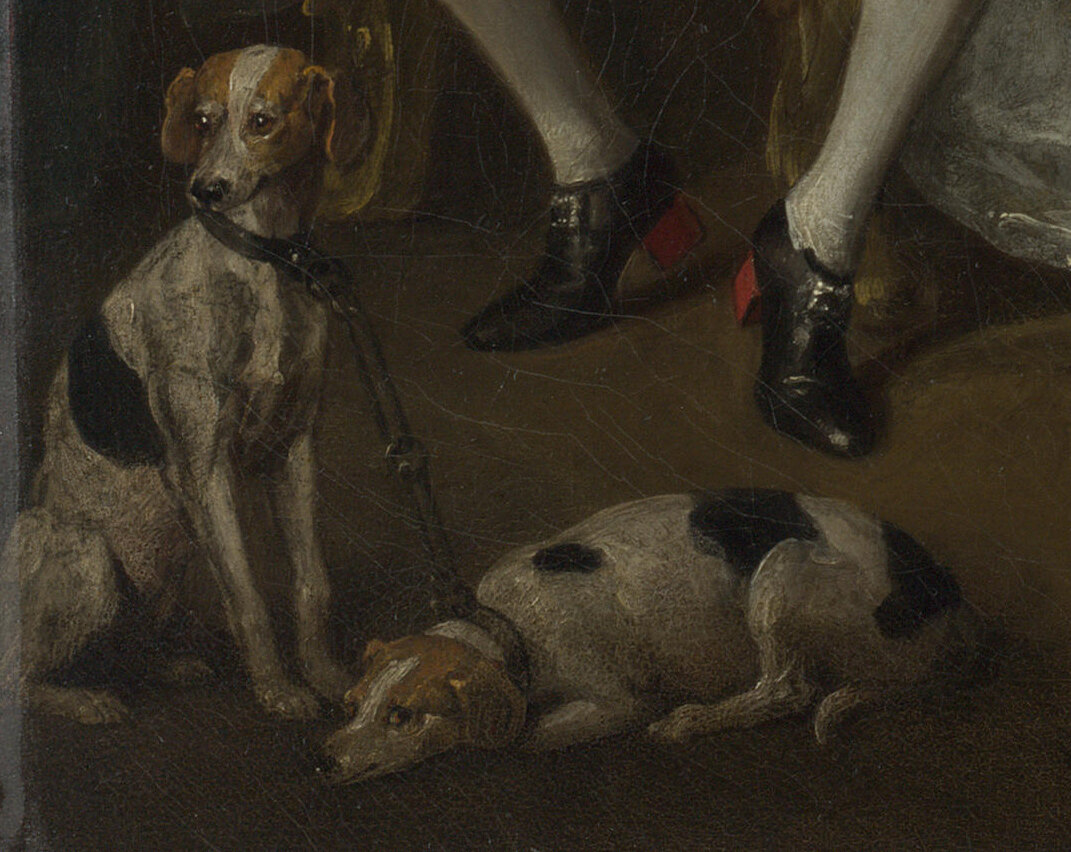
Every contract needs witnesses, and Hogarth's are on the floor. Two dogs, a hound and a bitch, are chained together at the neck. One sits, one lies down with its back turned. They are the marriage in one image, and they are the kind of joke Hogarth could not resist: obvious, cruel and exact.
The other witnesses are on the walls. The Earl's collection of dark old-master paintings runs to martyrdoms, a Medusa's head screaming in an oval frame, and a huge portrait of the Earl himself in Roman armour with a cannon going off behind him. Hogarth hated this kind of picture, the imported and expensive kind, and he filled the Earl's room with it. The Medusa is placed directly above the couple's heads.
Hogarth painted the six pictures around 1743 and had them engraved in Paris by French engravers, because he wanted the prints to look elegant enough for the people he was mocking. The prints came out in 1745 and sold well. The paintings did not. He auctioned them in 1751 and a single bidder, a Mr Lane, bought all six for 120 guineas, a price Hogarth thought so insulting that he never held a public sale again. In 1797 the banker John Julius Angerstein bought them for over a thousand pounds, and when the government bought Angerstein's collection to found the National Gallery in 1824, the six rooms came with it. They have been in the same building ever since.
The deal is done. The couple have not looked at each other yet. In the next room they will have been married for a few months, it is twenty past noon, and there is a woman's cap in his pocket that his wife has not found. The dog has.
The original hangs with the other five in the National Gallery in London, where the series has been since the Gallery opened in 1824. Our hand-painted reproduction of The Marriage Settlement is painted in oil on canvas from the National Gallery original, and the six scenes can be ordered singly or as a set to hang in order. More Hogarth in our William Hogarth collection.
Visible details, documented facts and interpretation are kept separate throughout this article. Hogarth left no written key to the series; readings of individual objects follow the National Gallery and Paulson and are marked as readings.