Loading cart…
No products in the cart.

1508 to 1509 · Fresco · Sistine Chapel, Vatican City
Save articles to your collection
Log in or create a free account, and this article will be waiting in your Private Collection.
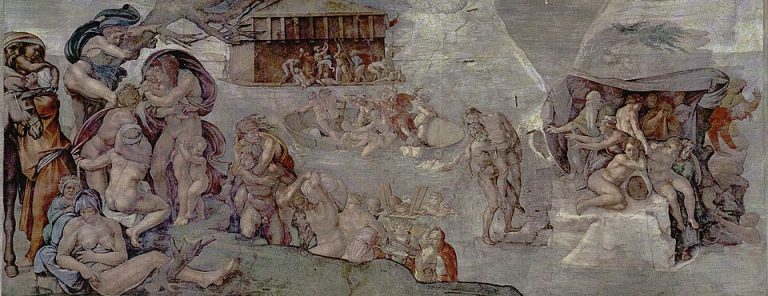
Log in or sign upThe Deluge was among the first narrative panels painted by Michelangelo on the Sistine Chapel ceiling, executed in 1508 and 1509 as part of the initial campaign that began from the entrance end of the chapel. It was one of the earliest major compositions Michelangelo tackled after dismissing his Florentine assistants and deciding to execute the bulk of the work himself. The sheer number of figures Michelangelo attempted to include in this scene, far more than in any other panel on the ceiling, created practical difficulties in the buon fresco process and contributed to a biological crisis when mold spread across several sections of fresh plaster due to improperly mixed mortar. Michelangelo was forced to petition Julius II for permission to destroy and repaint the affected areas, which he did successfully using a different mortar formula recommended by the architect Giuliano da Sangallo. This technical setback may have influenced the artist to work with fewer, larger figures in the subsequent panels, a compositional approach that proved more powerful and more legible from the chapel floor below. The Deluge is therefore both an early document of the ceiling program and a record of Michelangelo learning to adapt his intentions to the particular demands of the medium and the viewing conditions.
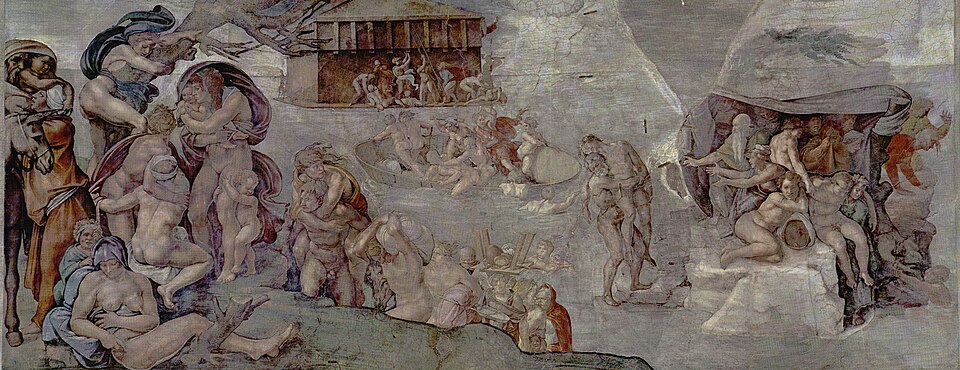
The compositional challenge of The Deluge was to organize a large number of figures across a horizontal field in a way that communicated the universal scale of the catastrophe while preserving the legibility of individual human responses to it. Michelangelo addresses this challenge by dividing the scene into three distinct spatial zones: the rising waters in the foreground where figures cling to rocks and improvised rafts, a central area where groups of survivors move toward higher ground, and a distant mountain where a small boat carries the fortunate toward safety. The figures are rendered with considerable anatomical specificity despite the complexity of their groupings, and the range of emotional responses depicted, terror, resignation, tender protectiveness, and desperate physical effort, gives the scene a breadth of human observation that transcends its scriptural subject matter. The color in this panel is somewhat more muted than in the later, more celebrated panels of the ceiling, reflecting both the early stage of the work and the influence of the damaged and repainted sections. The relative density of the figural composition in The Deluge, compared to the cleaner, more monumental arrangements of later panels, makes it a fascinating document of an evolving pictorial strategy. This panel is available as a hand-painted oil reproduction through ByMuseum, offering a chance to own a work that reveals a critical moment in the development of the ceiling program.
The story of the flood carries profound resonances within the religious culture of the Renaissance, representing simultaneously the justice of a God who punishes human corruption and the mercy of the same God who preserves a remnant of humanity for renewal. Michelangelo emphasizes the human dimension of the narrative, focusing less on the drama of Noah and the ark than on the anonymous multitude of those who are left to face the rising waters. This choice reflects a characteristic interest in the universal conditions of human experience rather than in the specific narrative details of a particular scriptural episode. The figures in the foreground who tenderly carry the elderly and the weak, who hold children above the water, and who embrace one another in the face of annihilation, speak to values of compassion and solidarity that remain compelling outside any specifically theological reading. The Deluge also resonates with the catastrophic political and military events of early sixteenth century Italy, a period of repeated invasion, plague, and civil conflict that gave the image of universal destruction a contemporary urgency. In the longer view of art history, this panel anticipates the kind of large-scale, multi-figure disaster composition that would become a major genre in nineteenth century painting, from Gericault to Turner. Bring this historically significant work into your home as a hand-painted oil reproduction from ByMuseum.
Enjoyed this story?
Save articles to your collection
Log in or create a free account, and this article will be waiting in your Private Collection.
Log in or sign up