Loading cart…
No products in the cart.

1894 · Oil on canvas · National Museum, Oslo, Norway
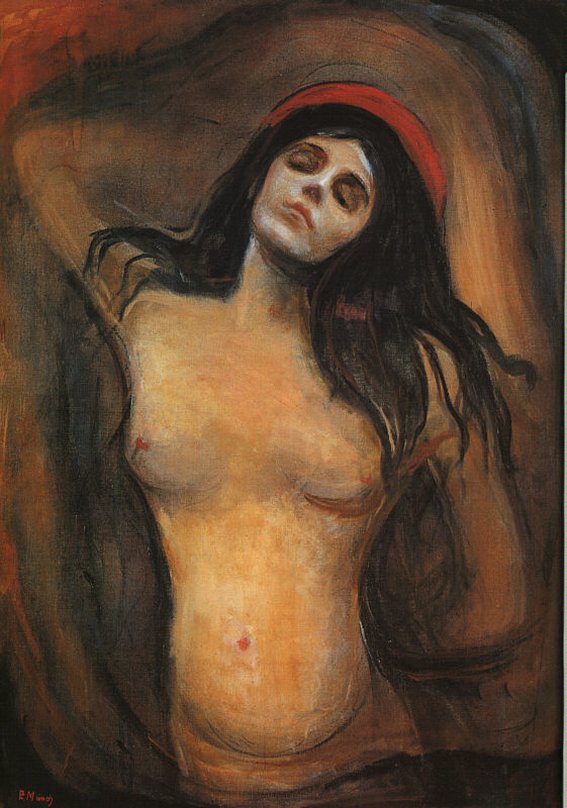
Madonna was painted in 1894 and represents one of the most provocative and debated images in the Frieze of Life cycle. The work belongs to the section of the Frieze that Munch titled The Awakening of Love, and it functions as a companion piece to other works exploring female sexuality, desire, and biological destiny. The title is deliberately paradoxical, pairing a word associated with sacred virginity with an image of unmistakable erotic intensity. Munch produced several versions of this composition in oil, and he also developed it as a lithograph in 1895, a print that added the now-famous border of spermatozoa and a fetal figure in the lower left corner. These additions, absent from the painted versions, made the symbolic program of the work even more explicit and drew both outrage and fascination from contemporary audiences. The painting was exhibited across Europe in the 1890s and was a source of considerable controversy, at a time when female sexuality was a subject of medical anxiety and moral regulation. The model for the figure has been linked to several women in Munch's life, though no definitive identification has ever been established. The work was later acquired by the National Museum in Oslo, where it has remained one of the central documents of Norwegian Symbolist and Expressionist painting. Multiple painted versions exist in other collections, including the Munch Museum, testifying to how central this image was to the artist's own sense of his project.
The compositional strategy of Madonna is one of radical centering. The female figure occupies nearly the entire picture plane, her body tilted slightly backward in a posture that reads simultaneously as surrender and transcendence. The head falls back, the eyes are closed or nearly so, and the long dark hair cascades outward into the background, dissolving the boundary between the figure and the surrounding darkness. This dissolution of outline is technically crucial to the painting. Munch uses the darkness of the background not as a neutral ground but as an active force that seems to absorb the edges of the figure, implying that the individual self is momentarily lost in something larger. The flesh tones he employs are cool and luminous rather than warm, suggesting the quality of light on marble or on skin seen in moonlight, and they sit in startling contrast against the deep crimson of the background, which shifts toward violet at the edges. A halo of light surrounds the head, one that owes nothing to Christian iconography and everything to the charged atmosphere of the Symbolist movement, evoking the aura of erotic and biological power rather than divine grace. The figure is not idealized in the academic sense. There is vulnerability in the exposed throat, in the parted lips, in the loose arrangement of the hair. Munch renders the female body as a site of genuine psychic complexity, not as an object of contemplation but as a subject in the grip of forces both personal and cosmic.
The title Madonna places this image in direct conversation with one of the most enduring traditions in Western art, the representation of the sacred feminine. Munch subverts that tradition comprehensively, recasting the Madonna not as a vessel of divine maternity but as a figure of erotic and biological power who stands at the point of conception rather than at the point of nurturing. This inversion was intentional and philosophically coherent within the framework of the Frieze of Life. For Munch, love and sexuality were inseparable from anxiety, from the awareness of mortality, and from the cycle of generation and decay that governs all living things. The figure in Madonna is simultaneously exalted and trapped by her biological role, a tension that reflects the deeply ambivalent attitude toward women and femininity that characterized much of the cultural discourse of the fin de siecle. Within the Symbolist movement, the femme fatale and the sacred woman were two sides of the same coin, and Munch was one of the most sophisticated and psychologically complex artists working within that framework. The painting continues to generate discussion among scholars of gender, sexuality, and the history of representation because it refuses easy moral categorization. It is neither straightforwardly celebratory nor straightforwardly misogynistic. It holds contradiction in suspension. If you wish to own this as a hand-painted oil reproduction, it will bring the full force of that contradiction into your living space, asking the same questions of every viewer who encounters it.