Loading cart…
No products in the cart.

1894 to 1895 · Oil on canvas · Rasmus Meyer Collection, KODE Art Museums, Bergen, Norway
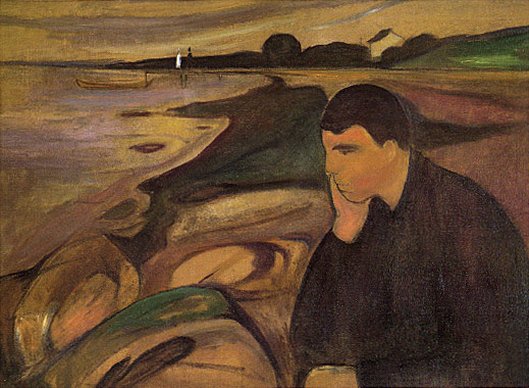
Melancholy exists in several painted versions, reflecting its importance to Munch as a distillation of a particular emotional and psychological state. The composition was first developed around 1891 and Munch returned to it multiple times through the mid-1890s, refining and deepening its formal language with each iteration. The subject of the brooding, inward-turned male figure seated at the shore was partly inspired by the personal situation of Munch's friend Jappe Nilssen, who was suffering the anguish of an unrequited or impossible love at the time. Nilssen, a Norwegian writer and critic, was himself a figure of considerable intellectual presence in the Christiania bohemian circle to which Munch belonged, and his suffering gave the painting its specific biographical starting point. However, Munch rapidly transformed the personal anecdote into something more universal: the figure of the solitary man overwhelmed by feeling, unable to act, imprisoned within his own consciousness. This was a condition Munch recognized intimately from his own experience. The versions of Melancholy were exhibited across Europe in the 1890s and were among the works shown at the 1892 exhibition in Berlin that was famously closed by outraged authorities after only a week, an event that paradoxically launched Munch's international reputation. The painting belongs to the Anxiety section of the Frieze of Life and sits in close thematic dialogue with works like The Scream, though its emotional register is quieter and more interior.
The formal structure of Melancholy is among the most elegant and psychologically precise that Munch ever devised. The picture plane is divided by a strong diagonal that separates the foreground, where the brooding male figure crouches low in the left-hand corner, from the expansive middle and background of the shoreline, the water, and the distant figures at the right who appear to be boarding or leaving a boat. This spatial division is not merely compositional. It enacts the psychological condition of melancholy itself, the experience of being simultaneously present in a shared world and entirely sealed off from it. The figure does not look outward at the scene behind him. He is turned inward, his head bowed and tilted toward the earth, occupying a space of almost physical compression in contrast to the open expanse of water and sky that fills the rest of the canvas. The brushwork in the foreground rocks and beach is short, dense, and intensely worked, while the water and sky are rendered in the long, smoothly curving strokes that are Munch's hallmark, giving the background an almost musical flowing quality. The color of the water is a deep, resonant blue-green, tinged with the reflections of a pale evening sky, and it pulses with the same undulating rhythm that appears in other major works of the Frieze. Munch uses the formal rhyme between the curves of the landscape and the contained form of the figure to suggest that the interior world of grief and the exterior world of nature are in a relationship of mutual reflection, neither subordinate to the other.
Melancholy holds a particular place in the history of Expressionism because it demonstrates that the strategies Munch developed, the use of landscape as a mirror of interior states, the isolation of the individual within a world that surrounds but does not comfort, were not dependent on violent distortion or dramatic gesture to achieve their effect. This painting achieves its emotional force through restraint, through the quiet eloquence of a man who does not scream but simply sits with his sorrow, unable to move toward or away from it. The condition it depicts, a kind of paralysis in the face of emotional pain, is one that connects across cultures and centuries. Melancholy as a concept has a rich history in Western art and philosophy, from the tradition of Saturnine melancholia in Renaissance theory to the Romantic valorization of the introspective temperament. Munch places himself squarely within this tradition while giving it an unmistakably modern inflection. His melancholic is not an aristocrat of feeling contemplating the sublime. He is a contemporary man sitting on rocks by a fjord, crushed by something too large and too specific to be named. The work also anticipates the Existentialist sensibility that would come to dominate European intellectual and artistic life in the mid-twentieth century, the sense of the individual as irreducibly alone even within a populated world. To own this as a hand-painted oil reproduction is to bring into your home one of the most quietly powerful images of human interiority in the entire modern tradition.