Loading cart…
No products in the cart.

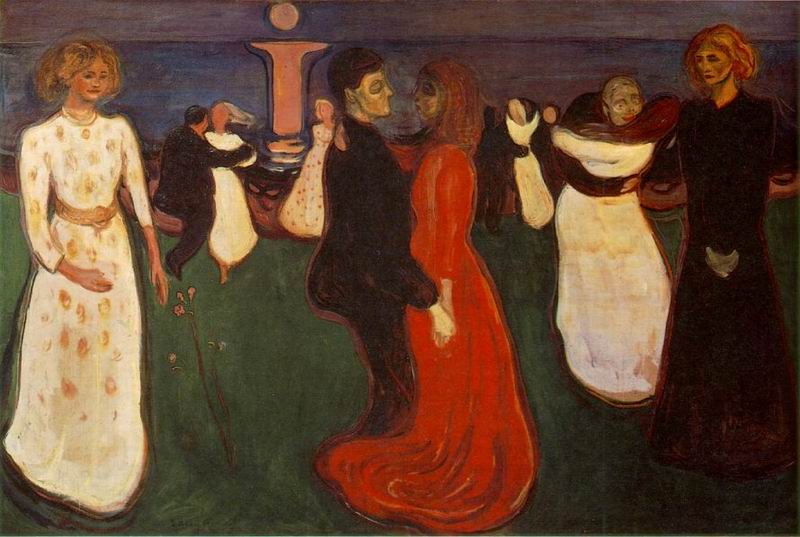
1899 to 1900 · Oil on canvas · National Museum, Oslo, Norway
Save articles to your collection
Log in or create a free account, and this article will be waiting in your Private Collection.
Log in or sign upThe Dance of Life was completed between 1899 and 1900 and represents one of the most ambitious and fully realized compositions within the Frieze of Life project. The Frieze, which Munch had been developing since the late 1880s, was conceived as a poem about life organized into four thematic chapters: The Awakening of Love, The Blossoming and Dissolution of Love, Anxiety, and Death. The Dance of Life belongs to the second chapter and serves as a kind of summary image for the themes of desire, time, and the transformation of the feminine across the arc of a human life. Munch based the setting on the midsummer celebrations that took place near the shores of the Oslofjord, festivals that were deeply embedded in Norwegian folk culture and that carried an obvious association with fertility, seasonal renewal, and the brief intensity of summer. The white-clad figure on the left is generally understood to represent young, innocent desire, while the central dancing couple embodies the consuming absorption of erotic love, and the dark-clad figure on the right has been associated with loss, age, or the aftermath of love. The painting was exhibited as part of the Frieze installation that Munch showed at the Berlin Secession in 1902, an exhibition that brought his complete thematic program before a major European audience for the first time and established his reputation as a figure of continental significance.
The compositional logic of The Dance of Life is panoramic and theatrical. The picture plane is organized horizontally, presenting a sequence of figures across a wide stage-like space that evokes the decorative friezes of antiquity while maintaining the expressive urgency of modern painting. In the foreground, the central dancing couple is tightly locked together, the man's dark suit merging almost imperceptibly with the green-brown tones of the background, so that he seems less a distinct individual than a force of gravity drawing the woman inward. Her red dress is the most saturated area of color in the entire composition, blazing against the muted tones of the midsummer night landscape and drawing the eye immediately and irresistibly. To the left, the white-clad figure turns toward the dancing couple with an expression of longing or anticipation, her form luminous and open. To the right, the dark figure stands with her arms folded, enclosed and withdrawn, her posture suggesting a closing inward that mirrors the opening posture of the white figure. Munch constructs this triptych of feminine states without narrative transition, placing them in simultaneous coexistence, as though all three phases of womanhood exist not in sequence but in parallel, like different frequencies of the same experience. The moon reflected on the water in the upper center creates a vertical axis of cool light that bisects the warm horizontal flow of the dance. This opposition of cold, still, vertical light against warm, moving, horizontal desire gives the composition a tension that operates below the level of conscious interpretation.
The Dance of Life is one of the most explicit statements of the thematic program that Munch pursued throughout his career. It presents the female experience of love and time as a cyclical rather than linear progression, one in which innocence, ecstasy, and loss are not successive stages but co-present conditions. This vision of womanhood was shaped by the Symbolist tendency to regard women as archetypes of natural forces, as embodiments of seasonal cycles and biological rhythms, rather than as social individuals. The painting has attracted considerable scholarly attention precisely because of the complexity and ambiguity of its representation. The three female figures can be read as three separate women, as three phases of a single life, or as three aspects of a single psychological moment. This refusal of a fixed interpretive frame is characteristic of Munch at his most thoughtful. The work also speaks to the experience of the male observer at the margins, the figure of the artist himself who watches the dance of life from a position of simultaneous desire and exclusion. Munch frequently positioned himself as an outsider to the experiences he depicted most intensely, and this painting can be understood as a meditation on that condition as much as on the lives of the women within it. It remains one of the most formally ambitious and thematically rich works in the Frieze of Life and one of the essential documents of European Symbolism. We encourage you to own this as a hand-painted oil reproduction and to spend time with its layered imagery in the context of your own space.
Enjoyed this story?
Save articles to your collection
Log in or create a free account, and this article will be waiting in your Private Collection.
Log in or sign up