Loading cart…
No products in the cart.

1885 to 1886 · Oil on canvas · National Museum, Oslo, Norway
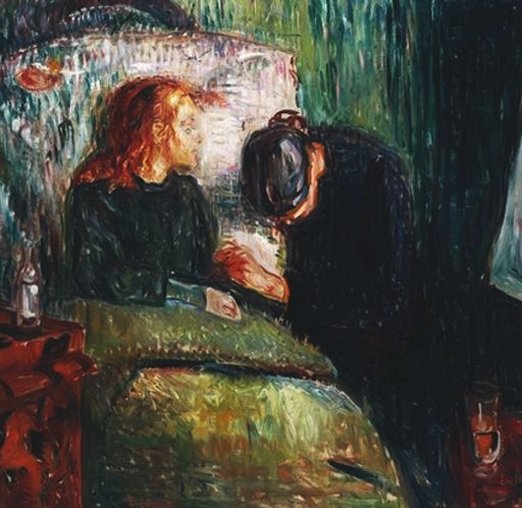
The Sick Child is widely understood to be one of the most autobiographically charged works in all of Munch's output. The painting was begun in 1885 and completed the following year, when Munch was in his early twenties. It draws directly on the death of his sister Sophie, who died of tuberculosis in 1877 at the age of fifteen. Munch had been profoundly affected by that loss, and he returned to the subject obsessively over the course of his career, producing six painted versions of the composition between 1885 and 1927. The first version, now in the National Museum in Oslo, was exhibited at the Autumn Exhibition in Christiania in 1886, where it was met with considerable hostility. Critics attacked it as unfinished, slovenly, and deliberately provocative. The accusation of incompleteness was in fact a failure to recognize that the rough, scraped, and reworked surface of the canvas was itself the meaning, a formal embodiment of grief and irresolution. Munch later wrote that he had scraped and repainted the work many times, unable to arrive at a final resolution, and that this very struggle was part of what the painting expressed. The work was also significant in Munch's development as a painter because it marked his decisive break from the naturalistic tradition of his teacher Christian Krohg, toward a more interior and emotionally driven approach to representation. It announced the direction his entire career would take.
The formal organization of The Sick Child is deceptively simple. Two figures occupy the pictorial space: the child, propped upright on a pillow in a chair, her head turned toward the light from the left, and an adult figure, presumably the mother, who bows her head into her hands in an attitude of utter devastation. The relationship between these two figures is the emotional engine of the composition. The child looks outward, perhaps toward the window and the light beyond, while the adult cannot bear to look at all. This asymmetry of gaze creates a powerful dynamic: the dying figure is more present, more alive in her orientation toward the world, than the grieving figure who has already begun to mourn. The surface of the canvas is extraordinary in its physical character. Munch scraped, scratched, and reworked the paint repeatedly, and the resulting texture is granular and unresolved in a way that feels entirely deliberate. The paint film in the area of the child's face and hair is applied in multiple conflicting layers, and vertical scratched lines traverse the surface, giving it the character of a veil or a membrane through which the scene is glimpsed rather than clearly seen. This technique, which anticipates the handling of later figurative painters by many decades, refuses the consolations of a clean, finished image. The palette is restricted and cool, dominated by the grey-green tones of sickness and the white of the pillow and nightgown, with only the faintest warmth entering from the implied light source at the left.
The Sick Child occupies a central place in Munch's personal mythology and in the broader cultural history of Symbolist painting. On the most immediate level, it is an act of mourning for Sophie, a way of holding the experience of her death long enough to understand it. Munch wrote that no other painting gave him as much trouble, and that in returning to the subject repeatedly he was attempting to complete something that remained unfinished within him. The six versions of the composition, spread across four decades of his career, suggest that the work was never truly resolved, that the grief it addressed was not something that could be laid to rest through a single artistic statement. Within the broader context of late nineteenth-century culture, the image participates in a widespread preoccupation with illness, death, and the vulnerability of the body that found expression across literature, music, and the visual arts. Tuberculosis was the great disease of the Romantic and Symbolist imagination, associated with heightened sensitivity, spiritual refinement, and untimely loss. Munch transforms this cultural cliche into something far more raw and specific, grounded in the texture of personal memory rather than aesthetic convention. The work also raises important questions about the ethics of art-making in the face of genuine suffering, questions that Munch himself seemed to grapple with consciously. To own this as a hand-painted oil reproduction is to bring one of the most emotionally honest images in the history of Western painting into dialogue with your own experience of loss and love.