Loading cart…
No products in the cart.

1902 · Oil on canvas · Dahesh Museum of Art
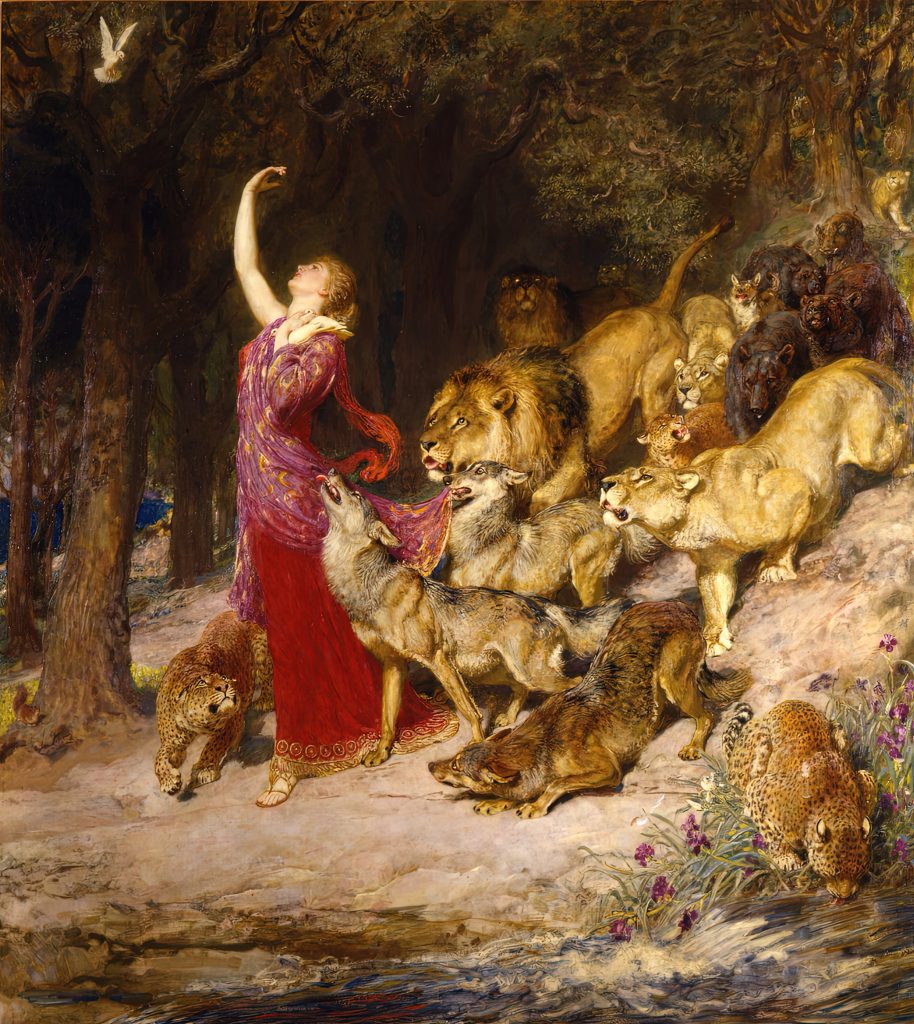
The painting begins, visually, with bodies gathered at ground level. Wolf-like animals occupy the foreground near the folds of Aphrodite’s dress; one raises its head beside her drapery while another remains low to the ground. Their proximity establishes the risk that gives the scene its force.
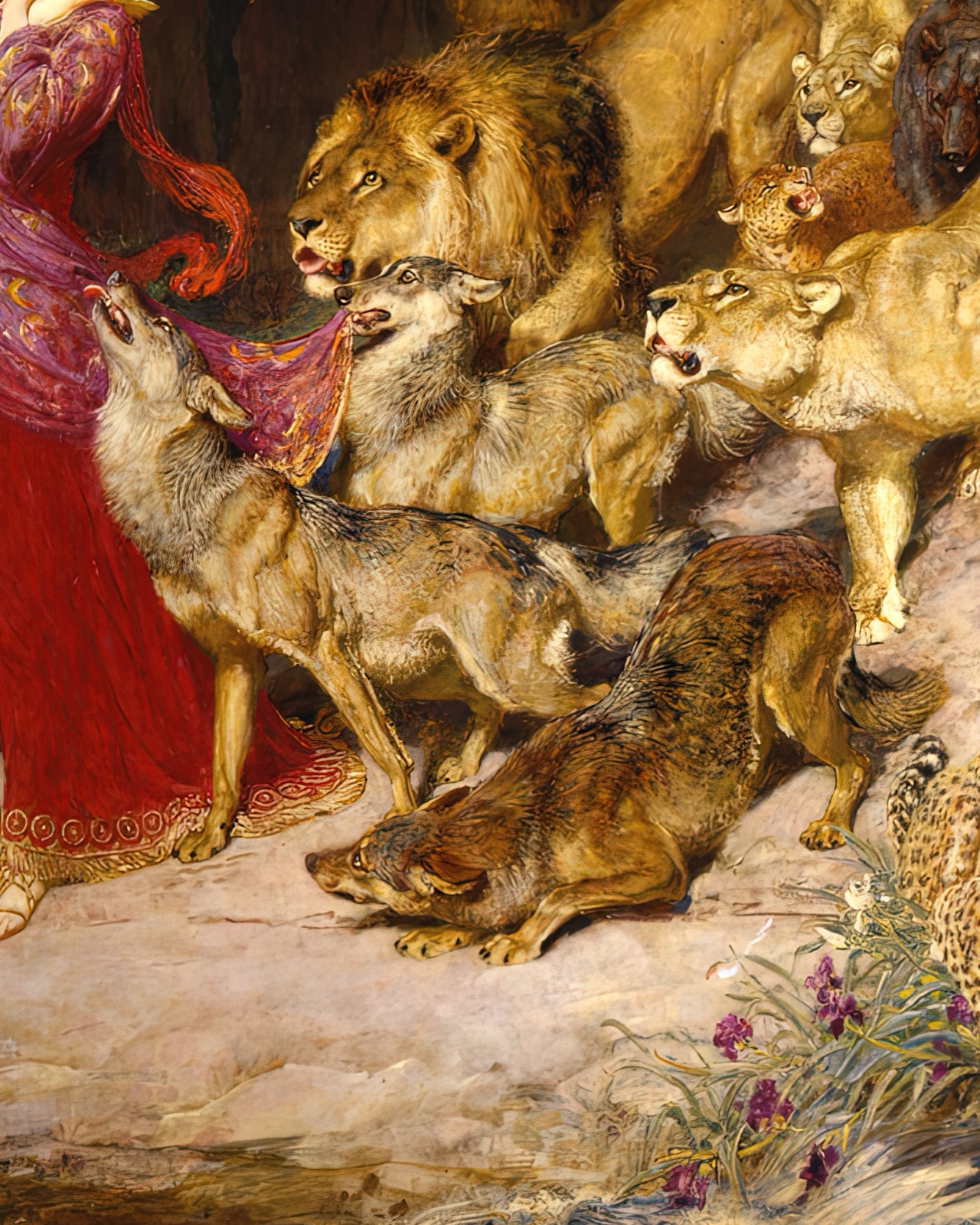
Rivière does not place the animals at a safe distance in the background. Their bodies press into the lower part of the composition, where the viewer first encounters fur, limbs, and watchful heads before looking up toward the woman. The wolf-like creatures are not presented as incidental woodland life. They are the immediate visual problem the painting asks us to consider.
Yet the image is tense rather than violent. No animal is shown attacking, fleeing, or recoiling from Aphrodite. The animals remain close enough for the possibility of violence to matter, but Rivière withholds the expected action. That restraint becomes the painting’s first argument: danger has not vanished, but it appears to have been held in place.
The woman’s dress heightens the contrast. Its deep red fabric and violet outer drapery descend into the cluster of animals, making her vertical figure distinct from their lower, crowded forms. She is not isolated from them by a wall, a throne, or a patch of open ground. Instead, the composition places her within their circle.
This is why the title matters early. Aphrodite is conventionally associated with love and desire, but Rivière’s painting initially directs attention elsewhere. The question is not simply who is looking at the goddess. It is why creatures associated with force and predation gather at her feet without attacking.
Aphrodite stands slightly left of center, enclosed by dark tree trunks and dense foliage. Her red dress and violet or magenta drapery set her apart from the brown-green forest, making her appear as the visual center around which the woodland and its animals are arranged.
Her posture creates a second structure in the picture. One hand rests near her upper chest, while the other arm is lifted overhead. Her upturned face directs attention toward a small white bird visible among the dark branches.
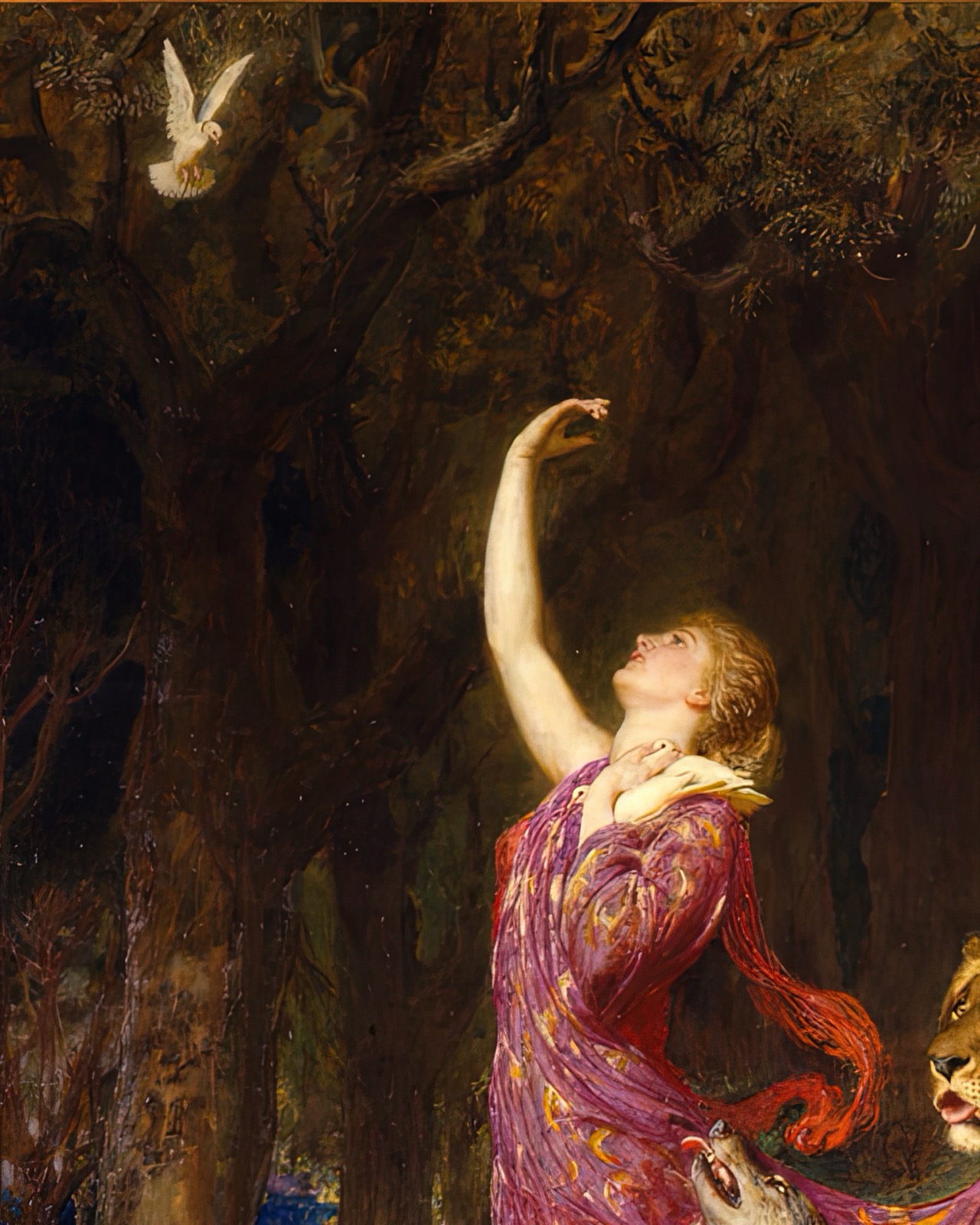
The gesture does not establish a specific ritual, command, or exchange. It may suggest attention or greeting, but the visible fact is simpler and more important: Aphrodite looks upward while most of the animals direct their attention toward her. Rivière builds two intersecting lines of sight, one reaching into the trees and the other gathering across the forest floor.
That arrangement prevents the animal group from becoming the painting’s only subject. The predators supply the tension, but Aphrodite supplies the order. Her raised arm pulls the eye up through the shadowed wood; the lion, wolves, and cats draw it back down toward her body and train. The painting’s separate elements repeatedly return the viewer to the same standing figure.
The white bird is small, but it is visually decisive. Its pale form is sharply legible against the branches, just as Aphrodite’s clothing stands out against the forest. The bird may recall associations often made with Aphrodite, but Rivière’s painting supports a more precise description: it is a white bird above her raised hand.
Aphrodite’s authority therefore remains an interpretation rather than a literal demonstration of control. Still, the composition encourages that reading. Color, posture, gaze, and the animals’ convergence all make her appear less like a figure endangered by the forest than the point around which its tensions are organized.
The Dahesh Museum of Art identifies the painting as a scene derived from a Homeric hymn. A label preserved on the reverse of the canvas quotes the passage in which Aphrodite descends from Mount Ida while the grey wolf, bear, lion, and swift-footed pard come fawning in her train.
That context changes how the animals can be read. They are not merely a dramatic entourage designed to make a goddess look impressive. The museum’s quotation connects the painting to a poetic image in which Aphrodite moves through the natural world accompanied by creatures that would ordinarily resist human closeness.
The word “fawning” should not lead viewers to overstate the painting’s claim. Rivière does not depict every animal in a single, identical posture of submission, and the canvas does not present a literal sequence from the hymn. But the source clarifies the extraordinary gathering: the animal cluster is a deliberate visualization of Aphrodite’s presence among wild beings.
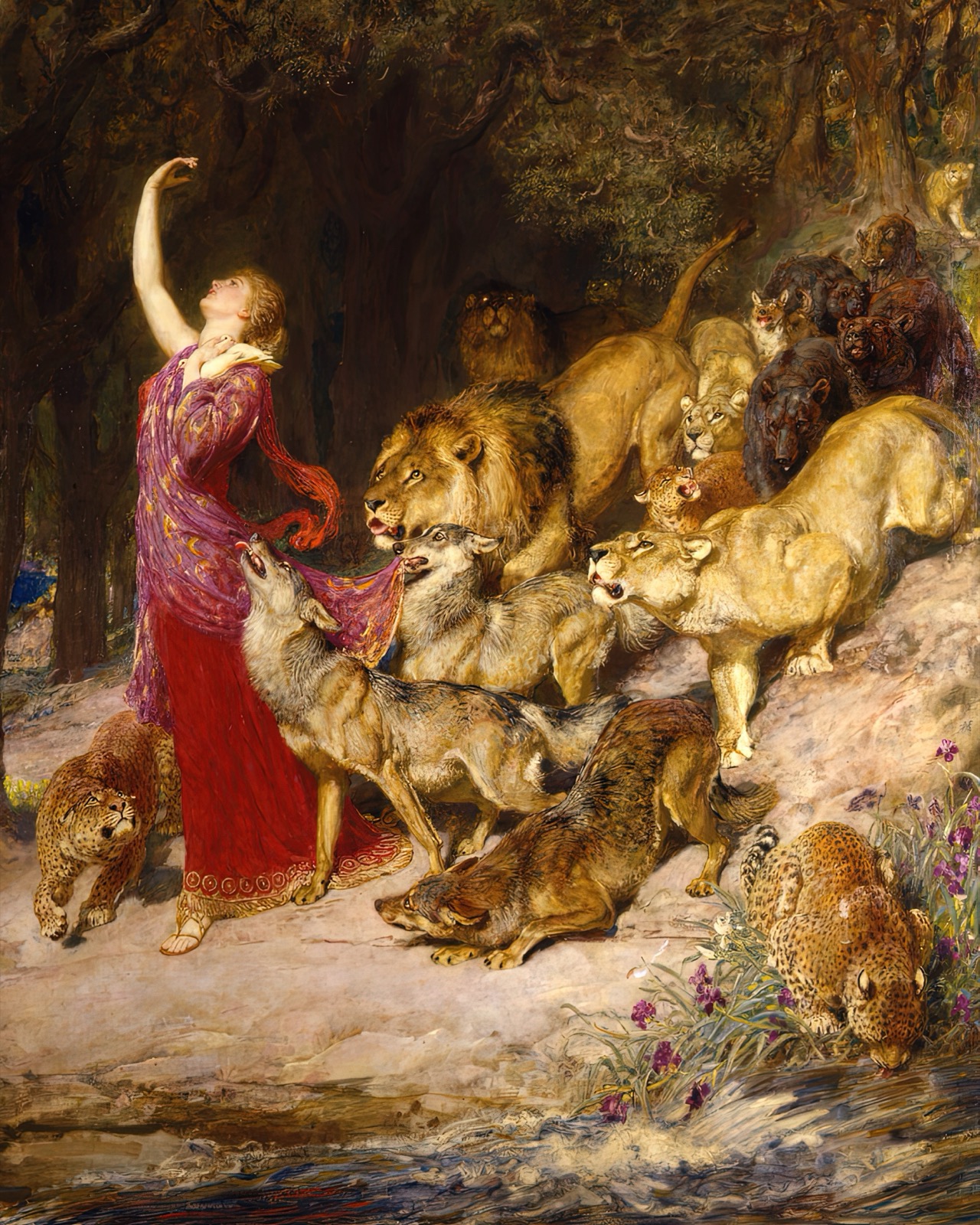
A lion stands immediately behind Aphrodite, facing outward. Large tawny cats occupy the slope to the right, while dark bear-like animals mass farther back among the shadows. Spotted cats appear at the painting’s edges, extending the impression that predators ring the clearing rather than merely pass through it.
The hymn’s animal names and Rivière’s painted creatures do not need to align species by species for the relationship to matter. The important connection is the gathering itself. Wolves, a lion, bear-like animals, tawny cats, and spotted felines give visual form to the hymn’s premise: Aphrodite’s arrival draws wild creatures into her company.
Mount Ida is named in the verse quoted on the reverse label, but Rivière does not offer a topographical account of that place. The setting is a dense forest, defined by trunks, foliage, shadow, and a narrow opening around the central figure. Its darkness allows animals to emerge gradually from the background, making the gathering feel both expansive and enclosed.
The Dahesh Museum describes Rivière as an animal painter and the successor to Sir Edwin Landseer. That context helps explain why the animals in Aphrodite carry so much of the image’s meaning. They must feel physically convincing before they can make a mythological premise persuasive.
Animals were central across Rivière’s career. The museum notes that he painted genre, classical, and biblical subjects while consistently involving animals. In Aphrodite, that lifelong concern becomes more than a technical specialty: it becomes the method through which a divine presence is made visible.
The creatures do not form a generalized mass called “nature.” They differ in scale, stance, color, and visibility. The lion has a solid, prominent presence behind Aphrodite; the wolf-like animals keep close to the ground; the cats extend the group along the right side; and the bear-like forms are partially absorbed into the woodland shadow.
This variety makes the painting more persuasive than a symbolic inventory of beasts might be. Rivière gives the animals enough distinct bodily presence that the viewer continues to register their potential danger. Their stillness matters because it is never entirely safe or sentimental.
His earlier commercial success, Circe and the Friends of Ulysses of 1871, also joined a mythological woman with animals. The comparison shows that Aphrodite belongs to a sustained interest in using animals to make myth emotionally legible. In the earlier work, animals are bound to a story of transformation; in Aphrodite, they remain recognizably wild, and the drama lies in restraint.
By the time Rivière painted Aphrodite, he was an established Royal Academician. But the most useful context is not simply his status. It is his ability to make animal bodies convincing enough that an ancient poetic image can feel immediate: no lightning, weapon, or overt miracle is needed when predators gather around one figure and hold their place.
Rivière’s Aphrodite is fully clothed in substantial red and violet drapery. That choice shifts the focus away from the body as the painting’s principal spectacle and toward her position, gesture, and relationship with the animals.
This does not mean that the painting rejects beauty or sensuality. The title brings Aphrodite’s established associations into the image, while the intensity of her clothing gives her a compelling visual presence. But the work does not make romance or seduction its main drama. The surrounding creatures do that work instead.
The forest helps sustain this emphasis. Dark trunks and foliage close in behind the figure, while water glints along the foreground. Purple flowers and pale grasses appear beside the lower-right bank, offering a quieter texture without resolving the tension created by the predators.
The painting can therefore be read as a reconsideration of Aphrodite’s power. Love is not defined here only as human romance. It can be understood as attraction, proximity, and an ordering force capable of bringing unlike creatures into the same space without erasing their difference.
That interpretation needs its limits. The painting does not prove that the animals are domesticated, grateful, or magically compelled. It leaves their animal nature intact. Rivière’s achievement is to make the absence of violence meaningful precisely because the possibility of violence remains visible.
The stream and flowers at the lower edge provide visual repose, but they do not displace the central drama. The painting concentrates a remarkable number of predators around one standing woman. Remove the animals, and the image becomes a woodland figure looking toward a bird; remove Aphrodite, and it becomes an uneasy assembly of creatures in the forest.
Together, they change one another’s meaning. The animals make Aphrodite’s authority visible, while Aphrodite changes the meaning of their presence. The lion behind her is not only a threat; the wolf at her dress is not only a wild creature. Each becomes part of a composition in which danger has been interrupted but not erased.
That is why Aphrodite remains more unsettling than a simple image of harmony. Rivière does not ask viewers to forget what these animals are. He asks them to notice the unusual order of their arrangement and to connect it with the hymn that places them in Aphrodite’s train.
Is this beauty, or power—or does the painting suggest that Aphrodite’s beauty becomes powerful because it makes predators hold back?