ByMuseum.com

USD
  • USD
  • EUR
Artist
Briton Rivière
Paintings
21 deep-dives
Artist profile
All paintings
Briton Rivière Paintings: Famous Works as Hand-Painted Oil Reproductions | ByMuseum
Victorian Realism · British · 1840 to 1920

Briton Rivière

Born14 April 1840, London, England
MovementVictorian Realism
Known forFidelity, Requiescat, Beyond Man's Footsteps
~200paintings
Victorian RealismBritish Painters
Artist guide · 21 most famous paintings

Briton Rivière Paintings: His Most Famous Works as Hand-Painted Oil Reproductions

Briton Rivière was born on 14 April 1840 in London, England, into a family with a strong artistic tradition. His father, William Rivière, was a painter and drawing master who taught at Cheltenham College, and this environment of artistic discipline…

Who was Briton Rivière?

Briton Rivière was born on 14 April 1840 in London, England, into a family with a strong artistic tradition. His father, William Rivière, was a painter and drawing master who taught at Cheltenham College, and this environment of artistic discipline shaped the young Briton from an early age. He grew up surrounded by the practical and aesthetic concerns of painting, absorbing lessons about draftsmanship, observation, and the dedicated study of form. He pursued formal education at Cheltenham College before entering Exeter College, Oxford, where he continued to develop his skills as a draughtsman. Although he never completed a formal degree at the Royal Academy Schools in the traditional sense, his sustained self-directed study and the mentorship embedded within his family upbringing gave him a rigorous technical foundation. He began exhibiting at the Royal Academy of Arts in 1858, while still a young man, and this early exposure to public exhibition sharpened his ambitions and refined his sense of what audiences valued in figurative and narrative painting.

Over the following decades, Rivière built a distinguished career centered on his extraordinary ability to paint animals with precision, empathy, and psychological depth. He became a member of the Royal Academy in 1881, a recognition that confirmed his standing among the foremost painters of the Victorian era. He was particularly celebrated for his depictions of dogs, lions, and other animals placed within emotionally resonant human contexts, creating works that spoke to the Victorian fascination with loyalty, companionship, and the relationship between humans and the natural world. He studied animals with the same seriousness that portrait painters devoted to their human subjects, making careful observations from life and conducting anatomical research to ensure accuracy. His paintings were widely reproduced as engravings during his lifetime, giving them a broad popular reach far beyond the walls of the Royal Academy. He remained a productive and respected figure in British art until his death on 20 April 1920 in London, leaving behind a body of work that continues to resonate with audiences who respond to its warmth, technical mastery, and genuine emotional intelligence.

What defines Briton Rivière style

The visual language of Briton Rivière is defined above all by a commitment to observed truth. He approached the painting of animals with the methodical care of a naturalist, yet he never allowed scientific accuracy to drain his work of warmth or feeling. His brushwork is confident and deliberate, building form through layered applications of oil paint that give his subjects a convincing physical presence. He paid particular attention to the rendering of fur and feather, achieving textures that reward close inspection without ever appearing labored or mechanical. His color palettes tend toward the warm and earthy, with rich ochres, deep browns, and soft golden light creating atmospheres that feel intimate and emotionally grounded. He understood how to use shadow to model volume and how to position light sources so that they drew the eye toward the emotional center of a composition, whether that center was the face of a faithful hound or the expression of a solitary human figure.

Beyond his technical precision, Rivière possessed a gift for narrative compression. Each of his paintings tells a story in a single arrested moment, inviting the viewer to imagine what has come before and what will follow. He placed his animal subjects in carefully constructed settings, sometimes grand and architectural, sometimes spare and atmospheric, and he calibrated every compositional element to serve the emotional argument of the work. His figures, both human and animal, are positioned with a stagecraft that owes something to the theatrical instincts of Victorian narrative painting more broadly, yet his results never feel artificially arranged. The relationship between human and animal in his canvases feels observed rather than invented, which is perhaps the quality that has kept his work appealing long after many of his contemporaries have faded from public consciousness.

Hand-painted · Not printed
Own a Briton Rivière. The real way.
Every reproduction is painted by hand in oil on canvas. The brushstrokes are real. That is the difference.
Browse Briton Rivière paintings

Briton Rivière most famous paintings

Each card links to its own article with full analysis and reproduction details.
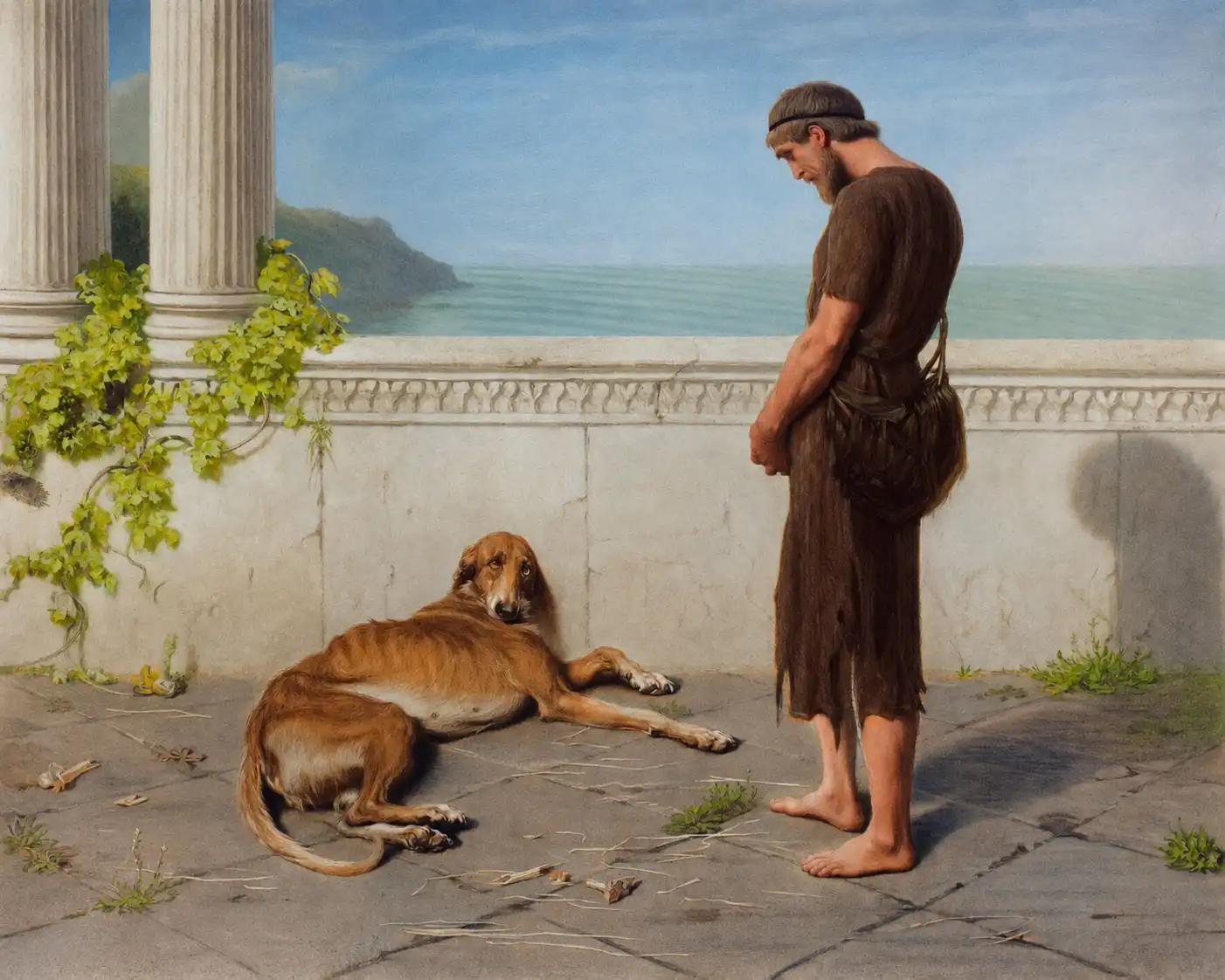
Ulysses and Argus #1
Ulysses and Argus
1885 · Private Collection
Ulysses and Argus depicts the moment from the Odyssey of Homer in which the long-absent hero, returned to Ithaca in disguise, is recognised only by his aged and faithful hound Argus, who wags his tail and then dies.
Analysis and reproduction
Requiescat by Briton Rivière, 1888 #2
Requiescat
1888 · Ashmolean Museum, Oxford, United Kingdom
Requiescat depicts a young woman lying still upon the ground while her devoted dog rests its head upon her, creating one of the most quietly sorrowful images in Victorian painting.
Analysis and reproduction
Daniel’s Answer to the King by Briton Rivière - hand-painted oil reproduction #3
Daniel's Answer to the King
1890 · Manchester Art Gallery, Manchester, United Kingdom
Briton Riviere depicts the prophet Daniel standing calm and resolute before the Babylonian king, surrounded by lions that have left him unharmed.
Analysis and reproduction
Sympathy by Briton Rivière, 1877 #4
Sympathy
1877 · Royal Holloway, University of London, Egham, United Kingdom
In Sympathy, Briton Rivière presents a small girl seated on a staircase in quiet distress, accompanied by a large dog whose attentive posture conveys a tenderness that words cannot express.
Analysis and reproduction
Aphrodite by Briton Rivière #5
Aphrodite
1902 · Dahesh Museum of Art
Explore Briton Rivière’s Aphrodite (1902), the wild animals around the goddess, and the Homeric hymn behind this painting in the Dahesh Museum collection.
Analysis and reproduction
Briton Rivière Paintings: Famous Works as Hand-Painted Oil Reproductions | ByMuseum #6
Fidelity
1869 · Lady Lever Art Gallery, Port Sunlight, United Kingdom
Fidelity presents a solitary dog standing guard beside a closed door, embodying the Victorian ideal of steadfast loyalty with quiet and deeply affecting restraint.
Analysis and reproduction
Briton Rivière Paintings: Famous Works as Hand-Painted Oil Reproductions | ByMuseum #7
Compulsory Education
1883 · Private Collection
Briton Rivière painted Perseverance in 1883 as a quietly observed study of a young boy seated at a rough wooden table, bent over a schoolbook while a faithful dog rests patiently at his feet.
Analysis and reproduction
Beyond Man's Footsteps by Briton Rivière, 1894 #8
Beyond Man's Footsteps
1894 · Tate Britain, London, United Kingdom
Beyond Man's Footsteps places a solitary polar bear in an arctic landscape of ice and pale sky, creating a meditation on wilderness, isolation, and the sublime power of the natural world.
Analysis and reproduction
Prometheus by Briton Rivière, 1889 #9
Prometheus
1889 · Manchester Art Gallery, Manchester, United Kingdom
Riviere depicts the Titan Prometheus chained to his rocky prison, his faithful eagle companions standing as silent witnesses to his eternal punishment.
Analysis and reproduction
Pallas Athena and the Herdsman's Dogs by Briton Rivière, 1876 #10
Pallas Athena and the Herdsman's Dogs
1876 · Private Collection
This large-scale work shows the goddess Athena appearing before a group of dogs who respond to her divine presence with instinctive reverence and submission.
Analysis and reproduction
Daniel in the Lions' Den by Briton Rivière, 1872 #11
Daniel in the Lions' Den
1872 · Walker Art Gallery, Liverpool, United Kingdom
Painted in 1872, this early treatment of the Daniel story shows the prophet alone in darkness with a pride of lions, his posture one of prayer and resignation rather than triumph.
Analysis and reproduction
Dead Hector by Briton Rivière, 1892 #12
Dead Hector
1892 · Lady Lever Art Gallery, Port Sunlight, United Kingdom
Riviere renders the body of the Trojan hero Hector laid out in death, accompanied by faithful hounds that mourn beside their fallen master.
Analysis and reproduction
The Last of the Garrison by Briton Rivière, 1875 to 1876 #13
The Last of the Garrison
1875 to 1876 · Guildhall Art Gallery, London, United Kingdom
A lone dog sits vigil amid the ruins of a fallen outpost, embodying loyalty and loss in one of Riviere's most affecting compositions.
Analysis and reproduction
St George and the Dragon by Briton Rivière, 1908 to 1909 #14
St George and the Dragon
1908 to 1909 · Private Collection
Riviere presents the legendary confrontation between St George and the dragon with a dynamic sense of movement and a careful attention to the physicality of both combatants.
Analysis and reproduction
An Anxious Moment by Briton Rivière, 1878 #15
An Anxious Moment
1878 · Private Collection
A group of dogs huddle together in a moment of shared apprehension, their body language communicating tension and uncertainty with remarkable naturalism.
Analysis and reproduction
Briton Rivière Paintings: Famous Works as Hand-Painted Oil Reproductions | ByMuseum #16
Apollo
1895 · Manchester Art Gallery, Manchester, United Kingdom
Briton Rivière depicted the sun god Apollo in a monumental composition that unites classical mythology with the careful naturalistic observation central to Victorian Realism.
Analysis and reproduction
The Temptation in the Wilderness by Briton Rivière, 1898 #17
The Temptation in the Wilderness
1898 · Guildhall Art Gallery, London, United Kingdom
Riviere depicts Christ alone in the wilderness at the moment of temptation, attended only by wild beasts in a stark desert landscape.
Analysis and reproduction
The King Drinks by Briton Rivière, 1881 #18
The King Drinks
1881 · Private Collection
A scene of royal festivity captures the moment of a ceremonial toast, with dogs at the feet of the revelers responding instinctively to the human energy around them.
Analysis and reproduction
In Manus Tuas, Domine by Briton Rivière, 1879 #19
In Manus Tuas, Domine
1879 · Blackburn Museum and Art Gallery, Blackburn, United Kingdom
The Latin title, meaning Into Your Hands, Lord, frames a scene of a dying or sleeping figure attended by faithful dogs whose quiet presence becomes a form of prayer.
Analysis and reproduction
Una by Briton Rivière, 1882 #20
Una
1882 · Bury Art Museum, Bury, United Kingdom
Riviere depicts the character Una from Edmund Spenser's Faerie Queene, showing the young woman accompanied by a lion in an image that combines allegorical meaning with sensitive animal painting.
Analysis and reproduction
Briton Rivière Paintings: Famous Works as Hand-Painted Oil Reproductions | ByMuseum #22
The Long Sleep
1868 · Private Collection
Briton Rivière painted The Long Sleep in 1868 as a tender meditation on the bond between a sleeping child and a faithful dog standing vigil nearby.
Analysis and reproduction

Why hand-painted, not printed

A print can reproduce colors. What it cannot reproduce is texture, depth, and the physical presence of oil paint on canvas. Briton Rivière technique depends on these.

At ByMuseum, every reproduction is painted by hand using oil on canvas. There is no inkjet, no digital print. The brushwork is real. The result looks like a painting because it is one.

Read: how our hand-painted reproductions are made

ByMuseum Editorial
Art history desk · ByMuseum

Written and fact-checked by the ByMuseum editorial team: art historians and painters who research each work from museum records and catalogues raisonnés, then explain how it is recreated by hand in oil on canvas.