Loading cart…
No products in the cart.

1885 · Oil on canvas · Private Collection
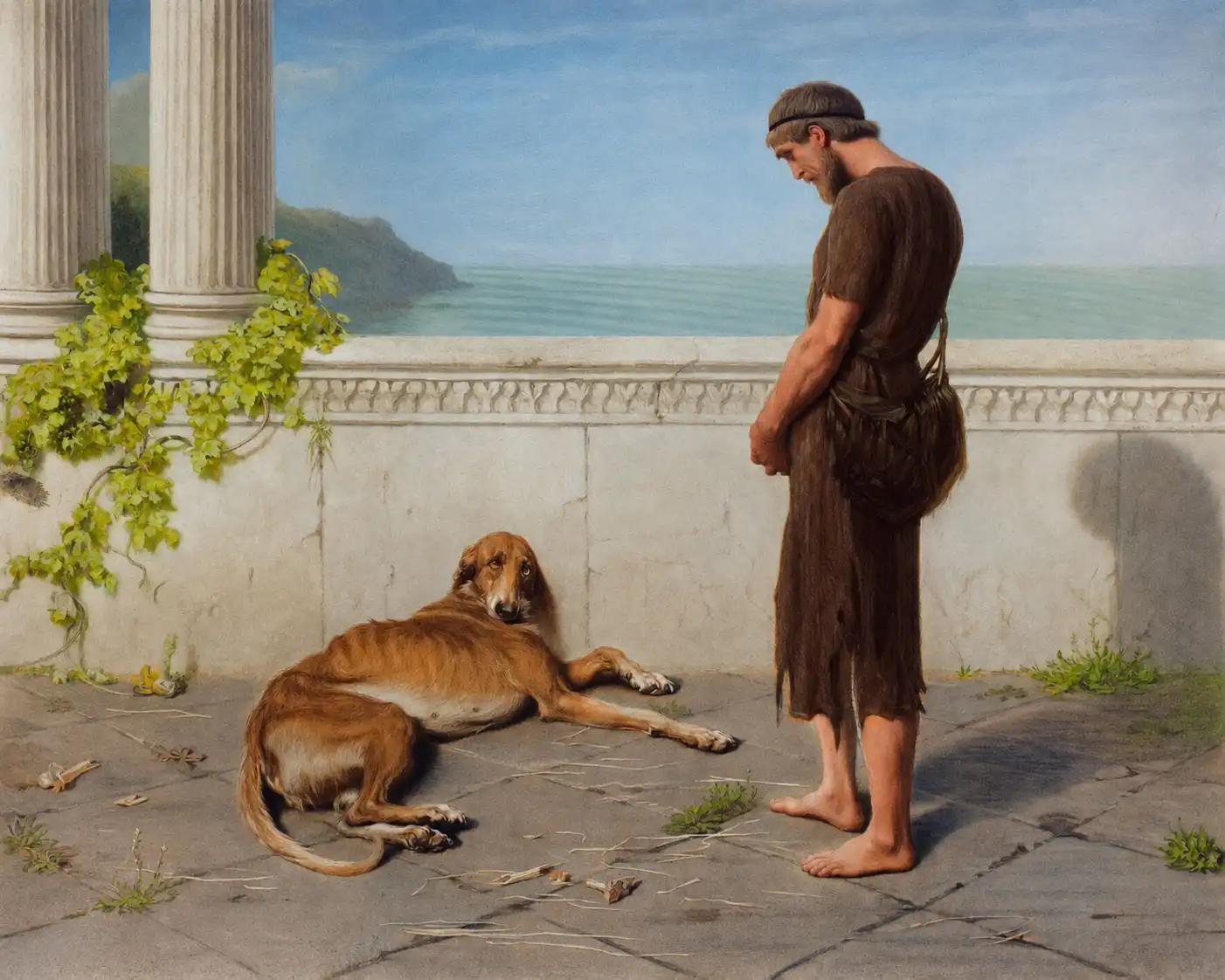
Ulysses is another name for Odysseus, the hero of Homer’s Odyssey. Argus, also spelled Argos, is his dog.
In Book 17, Odysseus returns to his household disguised as a beggar after twenty years away. Near the entrance lies Argus, once a hunting dog, now old and neglected. He recognises his master, lowers his ears and wags his tail, but is too weak to approach.
Odysseus turns aside and wipes away a tear, hiding the gesture from his companion Eumaeus. Rather than openly acknowledging the dog, he asks Eumaeus about him. Argus dies after seeing his master again.
That is the literary encounter behind Rivière’s painting. Understanding it changes the apparent simplicity of the scene: the man and dog are not strangers sharing a terrace. They are companions meeting at the end of a long separation.
For the wider journey, from departure and temptation to the difficult return home, explore our collection of paintings inspired by the Odyssey.
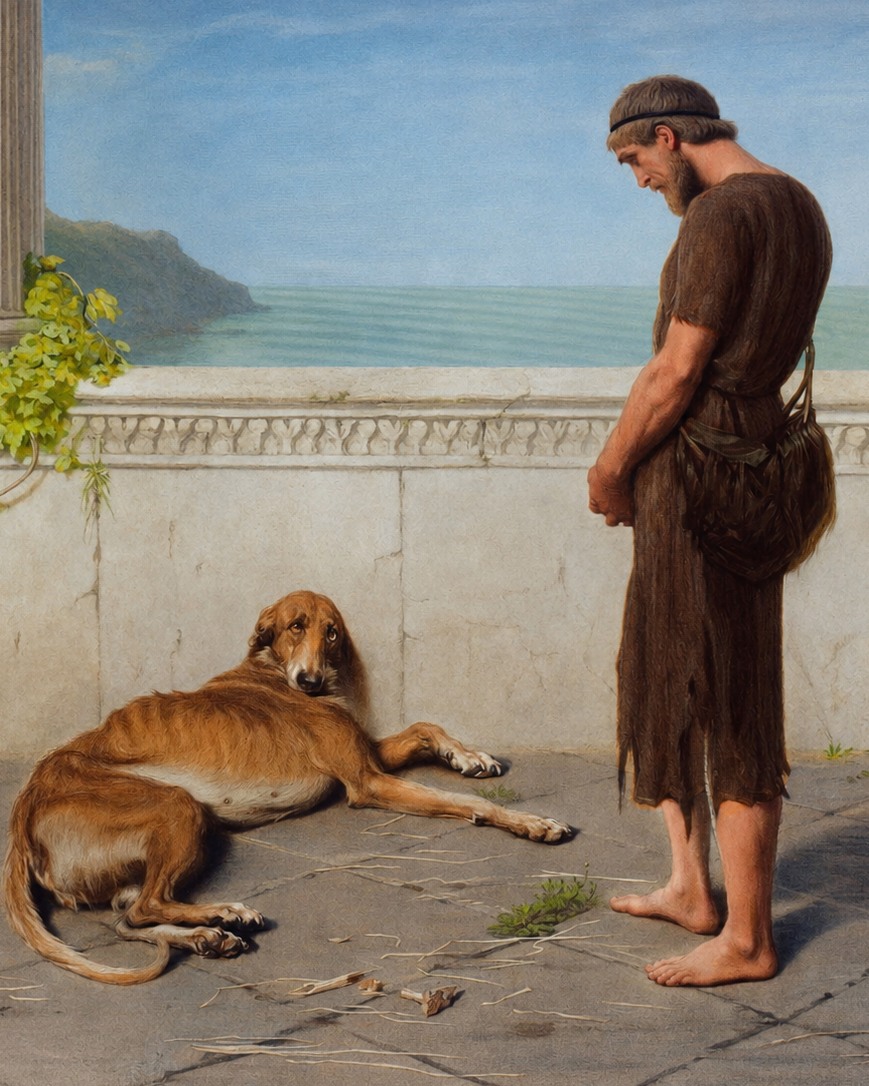
Rivière makes the relationship easy to see and difficult to resolve. The man stands; the dog remains on the ground. Their bodies occupy different levels, and their meeting takes place through attention rather than touch.
The empty stone between them matters as much as either figure. A small movement, such as an extended hand or a bent knee, would transform the scene into a familiar image of affection. Instead, Rivière holds the encounter just short of that release.
Read alongside Homer, this separation suggests the strain of maintaining a disguise. But it also works without a detailed knowledge of the poem. Anyone who has wanted to comfort an animal can feel the incompleteness of the moment.
The painting’s tenderness lies partly in the greeting it makes us imagine.
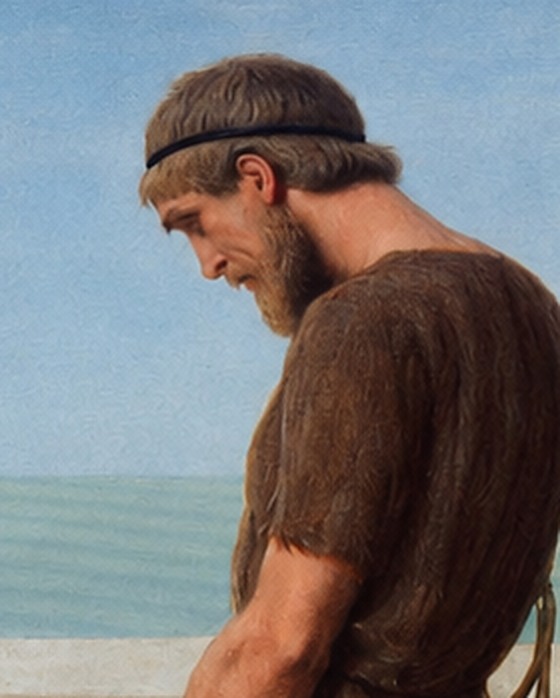
In the complete painting, Ulysses wears a simple brown garment. He is barefoot, with a dark bag hanging at his side. There is no crown or ceremonial armour to announce his identity.
His inclined head brings the standing figure into the emotional world of the dog below him. Rivière gives us no grand theatrical display; the posture invites a reading of contained feeling.
This is an important reversal of the heroic homecoming. The returning traveller does not dominate the scene through strength or status. He appears vulnerable precisely because he remains physically restrained.
The contrast between his upright body and lowered gaze gives the figure its particular expressiveness. His body stays apart, while his attention belongs to the animal.
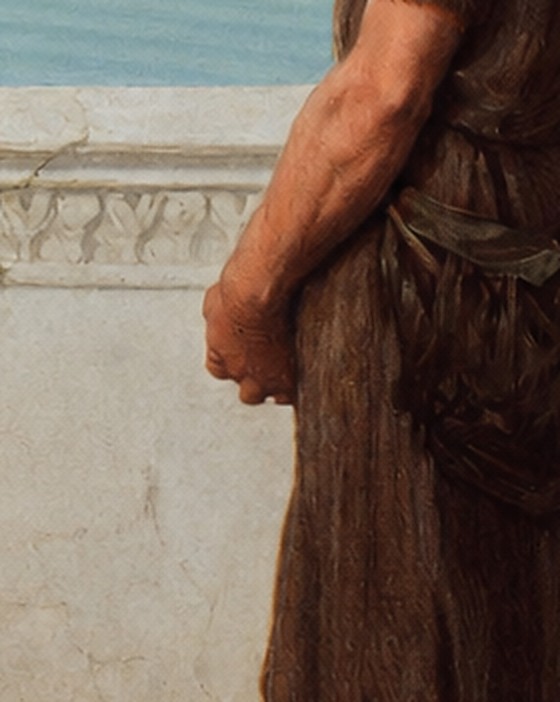
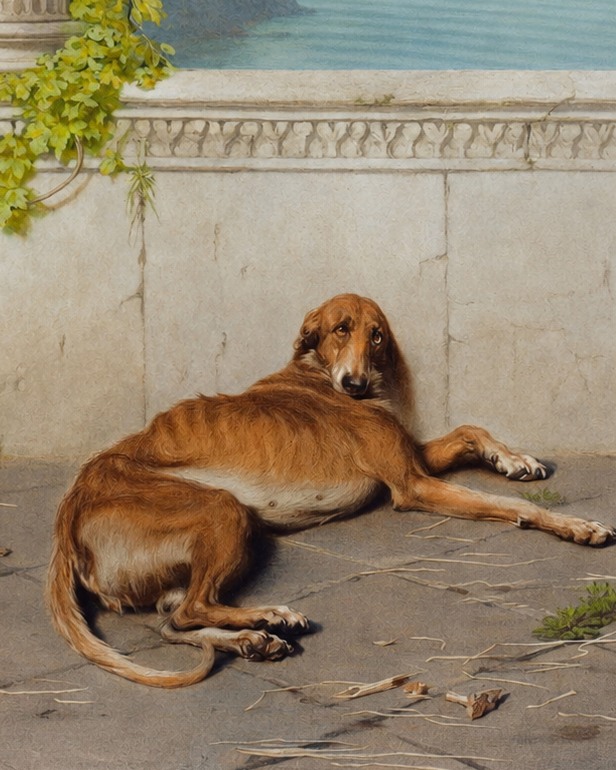
Look at the contrast between the dog’s resting body and lifted head. His weight remains on the terrace, yet his face draws our attention back toward the encounter.
The warm brown coat also gives him a visual connection with Ulysses’ clothing. Against the pale stone, the two figures belong together in colour even while they remain separated in space.
This is where close looking adds something that a plot summary cannot. The story tells us who Argus is; the painting asks us to spend time with his physical presence. His body occupies a substantial part of the foreground. He is not an accessory placed beside a human hero.
For a moment, the epic belongs to him.
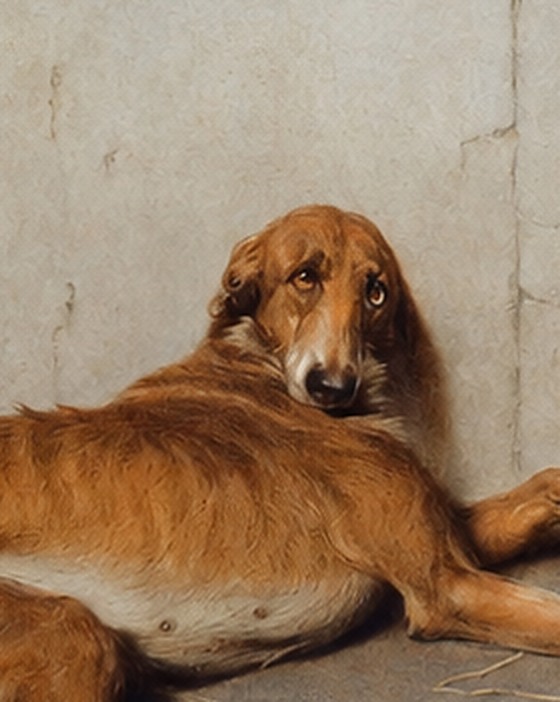
Our Famous Dog Paintings collection explores other works in which dogs become central to the story as companions, working animals and subjects worthy of attention in their own right.
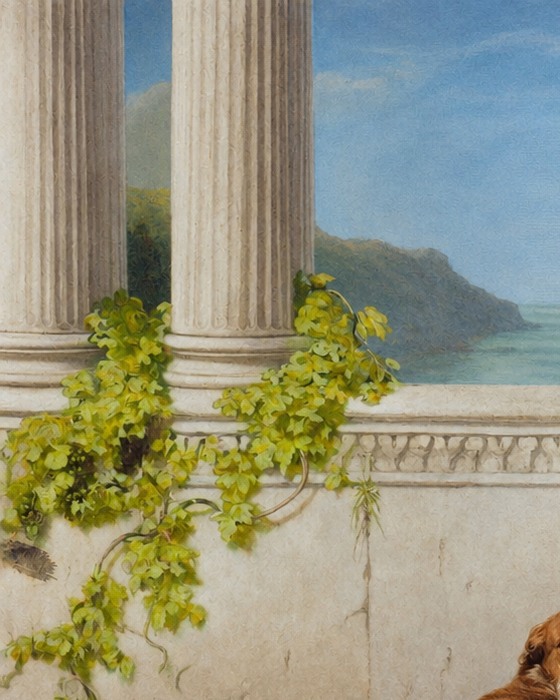
Columns, a stone balustrade and a distant sea surround the encounter. Light falls across the terrace. The world beyond the figures appears undisturbed.
That calm creates a striking contrast with the story we bring to the image. Nothing in the landscape announces that this meeting is momentous. Its significance belongs to the figures and to the viewer who understands their relationship.
The setting also reminds us that an illustration is an interpretation. Homer describes Argus lying amid neglect near the household entrance; Rivière arranges the encounter within a carefully composed architectural space. We should not expect every element of the painting to be a literal transcription of the poem.
Instead, the terrace gives the figures room to stand apart. The pale background makes their silhouettes legible, while the horizontal lines of stone and sea reinforce the scene’s stillness.
Loyalty is the painting’s most immediate theme, but recognition gives that loyalty its particular force.
Ulysses’ appearance no longer declares who he is. The clothing associated with his disguise conceals his standing in the human world. Within the encounter, however, the bond with Argus survives that changed appearance.
The painting can also be read as an image of what time does to a homecoming. Returning to a place does not restore the life left behind. Familiar relationships remain, but bodies have aged and opportunities have narrowed.
Rivière gives this idea a physical shape: the figures are close enough to meet, yet the reunion remains incomplete.
There is no need to decide that one figure suffers more than the other. The emotional weight comes from holding both experiences together: the dog’s recognition and the man’s restraint.
An institutional record provides a firm point in the work’s history: the British Museum holds a print of Ulysses and Argus made by Frederick Stacpoole after Rivière, with an associated publication date of 1885.
This establishes that Rivière’s composition existed by then. It does not, by itself, establish the exact completion date of the original oil painting.
The distinction matters when looking for the original. The British Museum record concerns a print after the painting, not the original canvas; its dimensions and collection location should not be transferred to the oil painting. A confirmed present-day location for the original is not established by the sources cited here.
The original oil painting is in a private collection. It is not on public display, and no museum currently lists it among its holdings.
This is worth stating plainly because a search for the painting usually surfaces a British Museum record. That record is for Frederick Stacpoole’s print after Rivière, not for the canvas, so its dimensions and its collection belong to the print rather than to the original.
If you are looking for the image itself rather than the object, the composition is widely reproduced, and our hand-painted oil reproduction is made from it.
Both dates circulate, which is why the painting is listed sometimes as Ulysses and Argus (1871) and sometimes as Ulysses and Argus (1885).
The firm date is 1885. That is the publication year of the Stacpoole print, documented by the British Museum, and it establishes that the composition existed by then. It is the date most catalogues attach to the work, and the one we list.
What 1885 does not establish is when Rivière finished the canvas. A print is made after a painting, sometimes years after, so the earlier date that appears in some listings may well reflect the original exhibition rather than an error. Until a documented exhibition record settles it, 1885 is the date we can support and the earlier one should be treated as unconfirmed.
Return to the complete painting after studying the details.
The brown clothing, the dog’s lifted head, the pale terrace and the distance between the figures now work together. What first appeared to be a quiet scene has become a meeting charged with history.
Rivière leaves the encounter suspended. We can look from man to dog and back again, imagining the greeting the painting never gives us.
That is what makes Ulysses and Argus linger: an enormous journey ends in a very small moment, and the smallest possible gesture suddenly seems to matter most.
Visible details, documented facts, and interpretation are kept separate throughout this article.