Loading cart…
No products in the cart.

1895 · Oil on canvas · Manchester Art Gallery, Manchester, United Kingdom
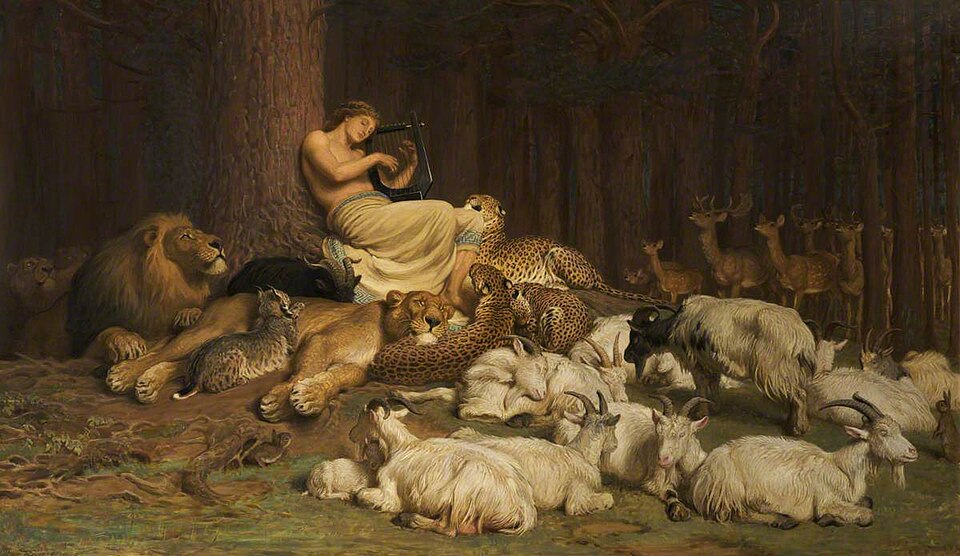
Briton Rivière exhibited Apollo at the Royal Academy in 1895, continuing his long-standing engagement with subjects drawn from Greek and Roman mythology. By this point in his career, Rivière had already demonstrated through works such as Prometheus and Pallas Athena and the Herdsman's Dogs that he was committed to exploring the ancient divine pantheon through the lens of Victorian pictorial values. Apollo, as a subject, carried enormous cultural weight in late nineteenth-century Britain, representing ideals of reason, beauty, artistic inspiration, and solar power that resonated deeply with educated Victorian audiences who had received a classical education grounded in the Greek and Latin texts. The painting was received with considerable attention upon its exhibition, as critics recognized Rivière's ability to render a mythological figure with the same convincing solidity and tonal authority that characterized his celebrated animal paintings. The work subsequently entered the collection of Manchester Art Gallery, where it has remained an important example of Victorian mythological painting. The commission and creation of Apollo fit within a broader pattern of Victorian artists returning to Apollonian imagery during a period when debates about aestheticism, the arts, and classical beauty were prominent in British cultural life. Rivière approached the subject with his characteristic scholarly care, studying ancient sculptural prototypes and literary sources to ensure that his interpretation carried genuine visual authority rather than mere decorative appeal. His training under his father, the artist William Rivière, had instilled in him a rigorous approach to drawing and compositional structure that served him well when confronting a subject as demanding as the Olympian god of light and music. The painting stands as a considered contribution to the Victorian tradition of classical mythological painting, sitting alongside works that sought to bring the ancient world into dialogue with the aesthetic aspirations of the modern era.
Rivière constructed the figure of Apollo with a commanding verticality that immediately conveys divine authority, positioning the god against a luminous background that evokes the solar associations central to Apollonian mythology. The figure is rendered with the precise anatomical observation that characterizes Rivière's figurative work throughout his career, drawing on a tradition of academic figure painting while inflecting it with the naturalistic attention to surface, texture, and light that defined Victorian Realism as a movement distinct from both academic idealism and later Impressionist tendencies. The color palette is organized around warm golden tones that radiate outward from the central figure, reinforcing the symbolic identification of Apollo with the sun and with illumination in both the literal and metaphorical senses that Victorian audiences would have recognized and appreciated. The compositional arrangement reflects Rivière's skill in balancing decorative effect with pictorial solidity. Unlike some Victorian mythological painters who allowed symbolic content to overwhelm formal coherence, Rivière maintained a disciplined attention to the structural integrity of the composition, ensuring that the figure of Apollo reads clearly and powerfully within the picture plane. The handling of drapery and the treatment of the god's attributes, whether the lyre, the bow, or the laurel crown associated with his domain, demonstrate Rivière's careful research into ancient visual sources. The painterly surface shows the confident, controlled brushwork that distinguished his mature style, with passages of finely blended tone giving way in places to more expressive handling that animates the composition without disrupting its classical gravity.
Apollo as a mythological subject carried a rich web of meanings for Victorian viewers that extended well beyond simple narrative illustration. As the god of the sun, of music, of poetry, of prophecy, and of rational order, Apollo embodied values that Victorian culture held in high regard, including the civilizing power of art, the authority of reason over chaos, and the ideal of physical and moral beauty understood as inseparable. Rivière, working within a tradition that saw classical mythology as a vehicle for the exploration of timeless human concerns, used the figure of Apollo to engage with these larger cultural conversations rather than merely producing an illustration of ancient legend. The painting thus participates in Victorian debates about the role of beauty, inspiration, and artistic authority in modern life, debates that were conducted with particular intensity during the 1890s. Within the context of Rivière's wider body of work, Apollo also represents a significant statement about the artist's own relationship to the classical tradition. Having explored figures such as Prometheus, Hermes, Pallas Athena, and Circe across his career, Rivière demonstrated a sustained commitment to classical subject matter that was both intellectually serious and visually ambitious. Apollo, standing among these works, completes a vision of the Greek divine world rendered through the careful empirical observation that Rivière brought to all his subjects, from domestic animals to ancient gods. The painting invites viewers to contemplate the intersection of mythological grandeur and human aspiration, suggesting that the values associated with Apollo, clarity, harmony, and illuminating intelligence, remain relevant beyond the boundaries of ancient culture.