Loading cart…
No products in the cart.

1869 · Oil on canvas · Lady Lever Art Gallery, Port Sunlight, United Kingdom
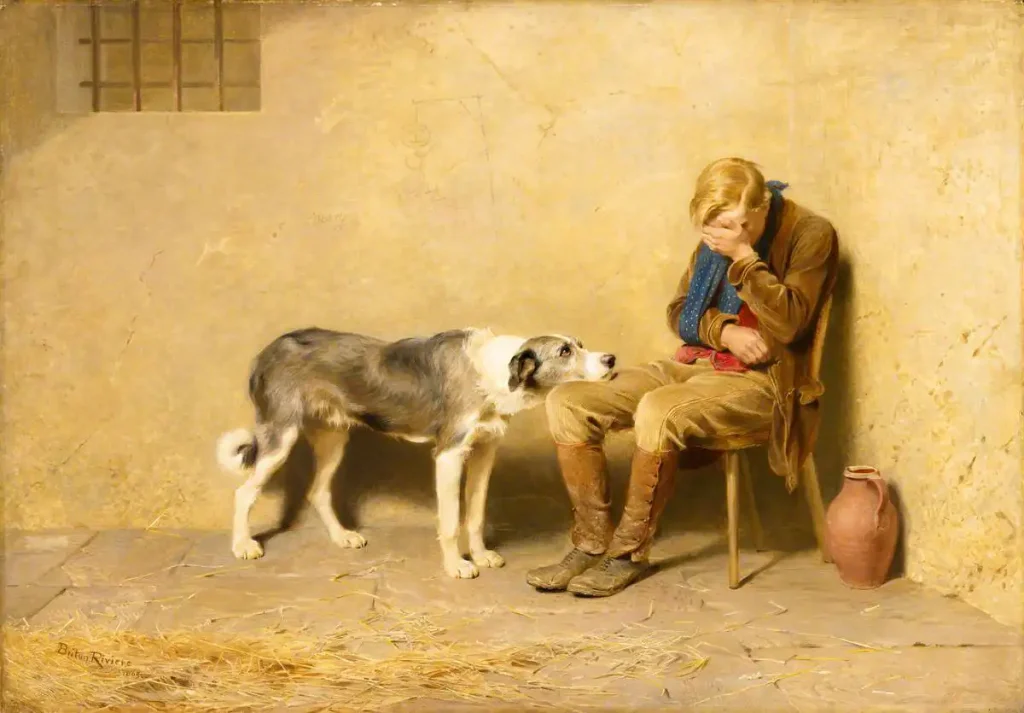
Briton Rivière painted Fidelity in 1869, during a period when he was consolidating his reputation as the foremost painter of animals in British Victorian art. The work was exhibited at the Royal Academy and attracted immediate and sustained attention from critics and the public alike. The painting belongs to a broader moment in Victorian cultural life when the theme of canine loyalty had acquired a powerful sentimental and moral charge. The era was deeply invested in the idea of the faithful dog as a symbol of uncomplicated devotion, a quality that many Victorians felt was increasingly rare and precious in a rapidly modernizing world. Rivière understood this cultural appetite and responded to it not with sentimentality but with a kind of quiet dignity that elevated the subject above mere illustration. The work was subsequently engraved and reproduced widely, reaching audiences across Britain and beyond, which accounts in large part for the enduring familiarity of the image. The painting eventually entered the collection of the Lady Lever Art Gallery in Port Sunlight, where it remains one of the most visited and admired works in the permanent collection. Its journey from the walls of the Royal Academy to a public gallery dedicated to the enrichment of working communities speaks to its broad and lasting appeal. Today, those who wish to bring this image of devotion into their own homes can own this as a hand-painted oil reproduction, crafted with the same care and attention that the original demands.
The compositional strategy of Fidelity is one of deliberate simplicity, and that simplicity is the source of its considerable power. Rivière places the dog in the center of the canvas, positioned before a closed wooden door, with the architectural setting providing a vertical structure that reinforces the animal's upright and attentive posture. The dog stands rather than sits, suggesting alertness and active waiting rather than passive rest, and this choice of pose communicates the animal's emotional state with remarkable economy. The lighting falls from the left, casting gentle shadows that model the contours of the dog with sculptural precision. The warm tones of the wooden door and the stone floor create a setting that feels domestic and specific, anchoring the animal in a real and recognizable world rather than an idealized one. Rivière renders the texture of the fur with his characteristic attention to observed detail, building the coat through layered brushwork that captures both the physical weight and the softness of the animal. The color palette is restrained, with warm browns, tawny ochres, and soft whites working together to produce an image that feels honest and unforced. The closed door behind the dog is compositionally essential, functioning as a barrier that explains the animal's posture without the need for any human figure. Those who wish to study this composition in their own space can own this as a hand-painted oil reproduction, available through ByMuseum.
The meaning of Fidelity operates on several levels simultaneously, which accounts for its enduring resonance across more than a century and a half. On its most immediate level, the painting is a portrait of loyalty: the dog waits beside the door of an absent owner, and the title makes the moral explicit. Yet Rivière resists the temptation to sentimentalize this waiting. The dog does not look mournful or distressed; instead, its posture communicates a calm and dignified faithfulness that the Victorians prized above almost any other virtue. The painting participates in a broader cultural conversation about the nature of loyalty and its relationship to love, duty, and trust, themes that were central to Victorian moral life. The absence of the human figure is a crucial choice: by removing the owner from the canvas entirely, Rivière makes the dog the sole carrier of the emotional and moral weight of the image. This forces the viewer to project their own understanding of loyalty onto the animal, creating a more personal and immediate connection than a scene involving human actors might have achieved. The painting also reflects the Victorian fascination with animals as moral exemplars, creatures whose behavior could be read as instructive for human audiences. In the contemporary moment, Fidelity continues to speak to anyone who has experienced the steadfast companionship of an animal, and its image retains a warmth and humanity that transcends its historical moment. Bringing this work into a home as a hand-painted oil reproduction from ByMuseum is a way of honoring that enduring conversation between humans and the animals they love.