Loading cart…
No products in the cart.

1879 · Oil on canvas · Blackburn Museum and Art Gallery, Blackburn, United Kingdom
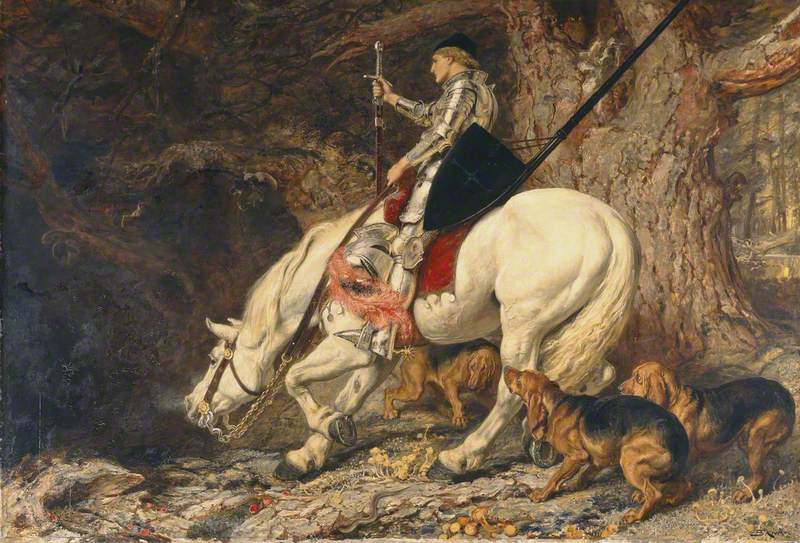
In Manus Tuas, Domine was exhibited at the Royal Academy in 1879 and was among the works that most clearly established Riviere as a painter of spiritual as well as emotional depth. The title, drawn from the final words of Christ on the cross as recorded in the Gospel of Luke and long used in Christian liturgy as a prayer of surrender and trust, lends the scene a gravity that elevates it above the level of mere sentimental animal painting. Riviere was clearly interested in exploring the capacity of animal presence to function as a form of spiritual companionship, and this work is the fullest expression of that interest in his output up to that point. The painting was acquired by Blackburn Museum and Art Gallery, where it has become one of the most admired works in the Victorian collection. Riviere's preparation for the work involved careful attention to the posture and expression of human figures in states of extreme vulnerability, as well as his habitual close study of dog behavior.
The composition centers on a recumbent human figure whose posture suggests either death or a state of profound surrender, attended by one or more dogs whose bodies curve protectively and mournfully around the form. The arrangement creates a circular visual logic that draws the eye continuously back to the central figure while the dogs provide warmth and intimacy at the margins. Riviere employs a palette of subdued, harmonious tones, avoiding the dramatic contrasts that would have made the scene feel theatrical rather than meditative. The light is soft and directionless, the kind that belongs neither to day nor night, giving the scene a timeless, liminal quality appropriate to a moment of crossing between life and death. The dogs are rendered with extraordinary tenderness, their expressions and postures conveying a depth of attachment that goes beyond mere animal instinct as the viewer is invited to perceive it.
The painting engages with some of the deepest themes in Victorian culture: the nature of a good death, the consolations available to the dying, and the meaning of fidelity in the face of loss. By choosing a devotional Latin phrase as the title, Riviere explicitly frames the scene as a religious meditation, suggesting that the presence of faithful animals at the moment of death is itself a form of spiritual grace. The dogs do not understand death in human terms, but their loyalty and attachment are presented as a kind of natural prayer, an uncalculating offering of companionship that mirrors the trust expressed in the words of the title. This reading of animal fidelity as spiritually meaningful was deeply resonant in the Victorian context, where the consolations of religion and the comforts of domestic life were frequently interwoven in cultural expression.