Loading cart…
No products in the cart.

1876 · Oil on canvas · Private Collection
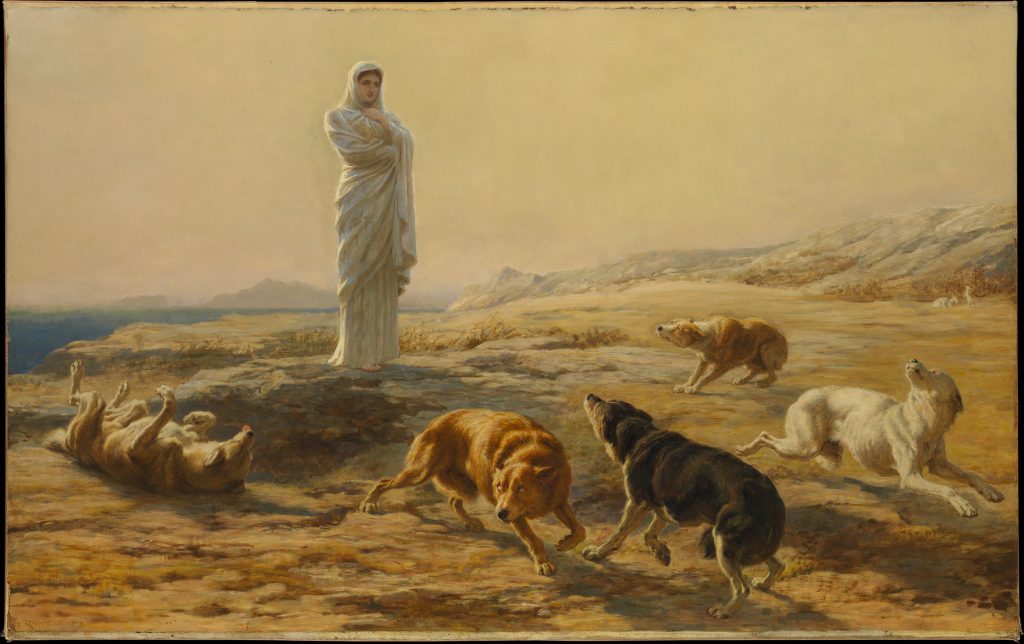
Riviere exhibited Pallas Athena and the Herdsman's Dogs at the Royal Academy in 1876, a period when he was increasingly combining his talent for animal painting with subjects drawn from classical literature. The composition draws on an episode from Homer in which dogs, capable of sensing the divine, respond to the presence of a god with immediate and unquestioning deference. The subject allowed Riviere to do what he did best: present animals as morally and emotionally perceptive beings whose instincts place them in a privileged relationship with forces beyond ordinary human understanding. The painting attracted considerable critical attention upon its exhibition, with reviewers praising the naturalness of the dog figures and the dignified bearing of the goddess. Riviere had by this point developed a thorough working method that combined academic study of the human figure with direct observation of living animals, and this painting demonstrates how effectively those two practices could be integrated into a single coherent vision.
The painting arranges its figures across a broadly horizontal foreground, with the luminous, upright form of Athena providing a strong vertical accent that anchors the composition. She is rendered in cool, silvery tones that distinguish her from the warmer earth colors of the landscape and the animals gathered below. The dogs are depicted in a variety of postures that collectively convey submission and wonder: some crouch low, others look upward with wide, alert eyes. Riviere's handling of the dog fur is particularly accomplished, capturing the texture of different coats with careful brushwork that avoids becoming merely decorative. The spatial arrangement creates a sense of depth and recession without relying on dramatic perspectival devices. The sky is open and clear, allowing light to fall evenly across the scene, which gives the work a quality of timeless stillness appropriate to a moment of divine encounter. Every element of the composition serves the central emotional and narrative purpose.
Riviere was deeply interested in the idea that animals possess a kind of perception or sensitivity that humans have lost or suppressed through civilization. By depicting dogs recognizing and honoring a goddess, he gave visual form to this belief, suggesting that the natural world exists in a relationship with the divine that bypasses rational understanding. This idea had broad resonance in the Victorian period, when anxieties about the spiritual consequences of industrialization and scientific rationalism were widespread. The painting offers a gentle counter-argument: that reverence and recognition of something greater than the self are not uniquely human capacities but are shared across the living world. The choice of Athena, goddess of wisdom and craft, adds a further layer of meaning, implying that true wisdom is not merely intellectual but encompasses an attunement to the sacred that even animals can access.