Loading cart…
No products in the cart.

1889 · Oil on canvas · Manchester Art Gallery, Manchester, United Kingdom
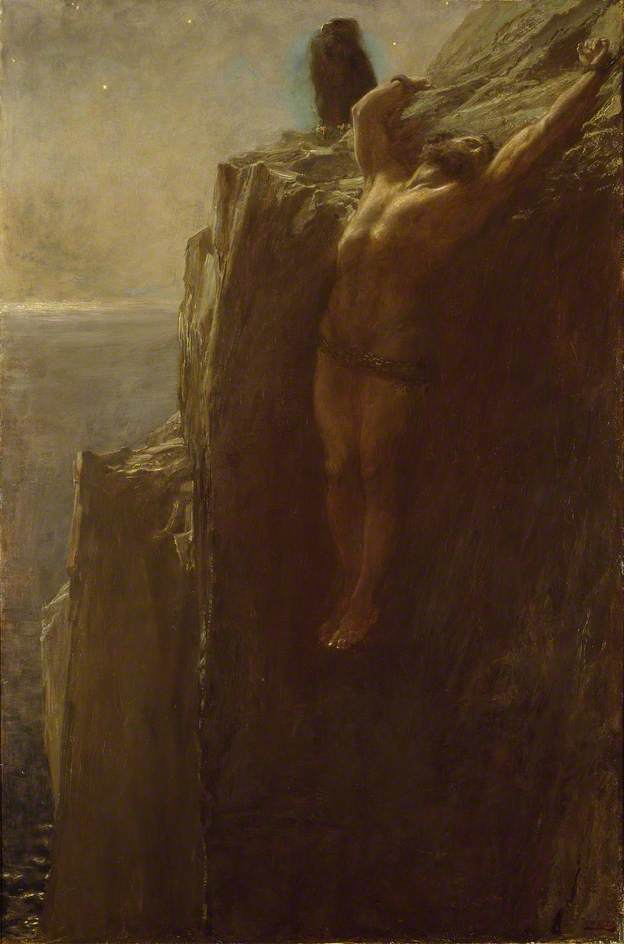
Briton Riviere exhibited Prometheus at the Royal Academy in 1889, cementing his reputation as a painter capable of uniting classical mythology with his signature talent for animal portraiture. The subject of Prometheus had occupied Western art for centuries, but Riviere approached it from an angle that was distinctly his own, placing unusual emphasis on the eagles that attend the bound Titan. Rather than showing the punishing bird in the act of tearing at the liver, Riviere chose a quieter moment, one that emphasizes isolation and resignation rather than active torment. The painting was produced during a highly productive period in Riviere's career when he was regularly contributing ambitious mythological works to the Royal Academy. His studio practice involved extensive studies from live animal models, and the eagle figures in this composition reflect that rigorous preparation. The work was acquired by Manchester Art Gallery, where it has remained an important centerpiece of their Victorian collection, appreciated by successive generations of visitors drawn to its meditative mood.
The composition is structured around a powerful contrast between the massive, inert form of Prometheus and the alert, living presence of the eagles surrounding him. Riviere positions the Titan in a near-horizontal posture across the foreground, his muscular torso rendered with careful academic precision and a paleness that conveys both cold and exhaustion. The rocky landscape recedes into a bleak, overcast sky that offers no comfort or warmth. The eagles are painted with the same attentive naturalism Riviere brought to all his animal subjects, their feathers rendered individually and their postures suggesting watchful intelligence rather than menace. The tonal palette is deliberately restrained, dominated by cool greys, muted ochres, and the steely blue of the sky, which together reinforce the sense of unending desolation. Light falls across the figure from a diffuse overhead source, modeling the anatomy without theatrical drama. The overall effect is one of sustained, quiet tragedy rather than violent action.
The myth of Prometheus carries enormous cultural weight as a story about defiance, sacrifice, and the price of bringing knowledge or power to humanity. Riviere strips the narrative back to its essential emotional core: the loneliness of punishment and the loss of freedom. By choosing not to depict the violent moment of torment, he invites the viewer to contemplate what it means to endure rather than simply to suffer. The eagles, usually symbols of divine authority and imperial power, here become ambiguous presences, neither wholly threatening nor sympathetic. This ambiguity was characteristic of Victorian mythological painting at its most thoughtful, using ancient stories to probe timeless questions about justice, sacrifice, and the relationship between human will and divine order. The painting resonated strongly with late nineteenth century audiences who were grappling with questions of progress and its costs, and it retains that capacity to prompt reflection in contemporary viewers.