Loading cart…
No products in the cart.

1908 to 1909 · Oil on canvas · Private Collection
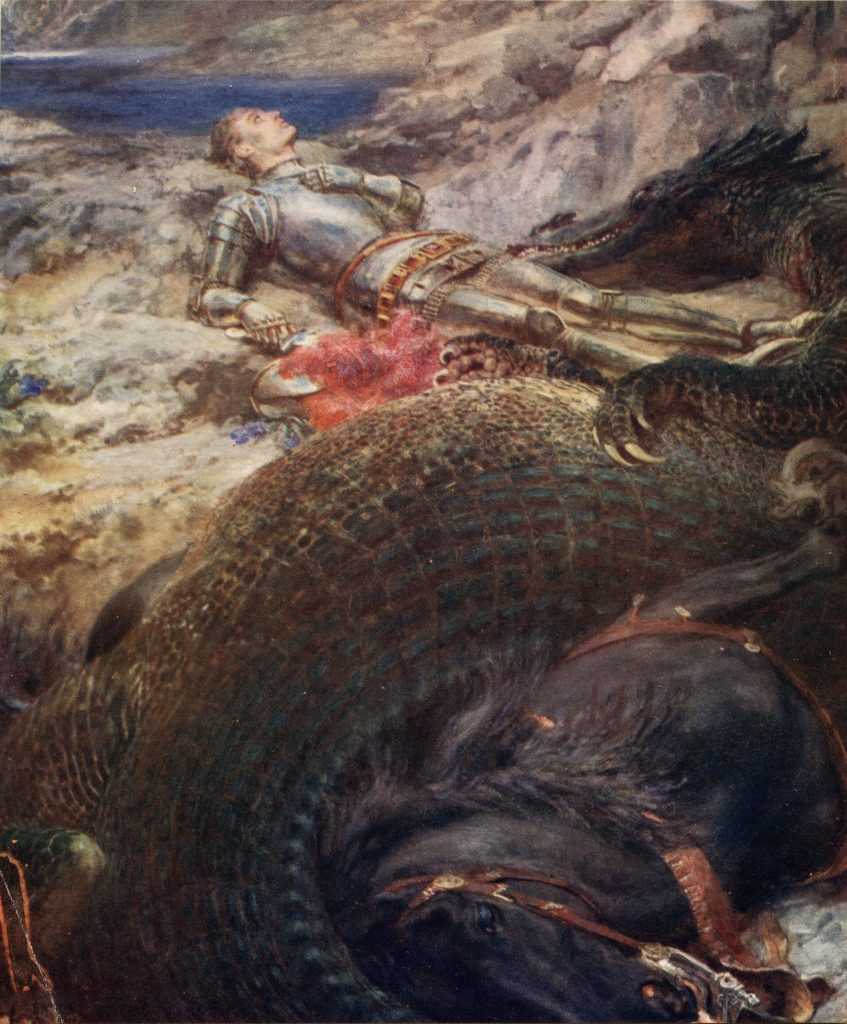
Produced between 1908 and 1909, this painting represents one of Riviere's later engagements with chivalric and legendary subject matter, a tradition that had been central to Victorian painting from the Pre-Raphaelite Brotherhood onward. The legend of St George and the Dragon held particular cultural significance in Britain, where George served as the patron saint and his story was understood as an allegory of Christian virtue overcoming evil. Riviere, working in the first decade of the twentieth century, brought to this well-worn subject his characteristic combination of naturalistic animal study and narrative clarity. The painting was produced during a period when Riviere was at the height of his public recognition, having been elected a full member of the Royal Academy in 1880 and continuing to exhibit regularly through the Edwardian period. His approach to the dragon reflects his lifelong interest in the physical reality of creatures, applying to a mythological beast the same careful attention to musculature and posture that he gave to the lions and dogs in his other works. The result is a version of the legend that feels grounded and physically credible even while depicting an entirely imaginary creature.
Riviere organizes the composition around the central conflict between the armored figure of St George and the coiled, powerful form of the dragon, placing both subjects in dynamic opposition that generates strong visual energy. The figure of George is rendered with attention to the weight and articulation of his armor, communicating the physical reality of armored combat rather than the decorative pageantry that sometimes characterized Victorian treatments of chivalric subjects. The dragon is given considerable formal presence, its body occupying a substantial portion of the canvas and its musculature rendered with the same observational rigor Riviere applied to real animals. The background landscape is relatively subordinate to the foreground action, functioning as a setting rather than a subject in its own right. Riviere uses strong directional light to model both figures clearly, separating them from the background and giving the scene a legible spatial organization. The palette balances the metallic warmth of the armor against the cooler, scaled tones of the dragon.
The legend of St George and the Dragon is one of the most layered allegorical narratives in Western Christian culture, operating simultaneously as a story of individual heroism, religious faith, and the conquest of chaos and evil by order and virtue. In Victorian and Edwardian Britain, the story carried additional nationalistic resonance as an expression of English identity and imperial confidence. Riviere's version, produced in the final decade of his active career, engages with these meanings through a visual language that prioritizes physical reality over decorative symbolism. By treating the dragon as a creature with genuine physical presence and credible anatomy, Riviere raises the stakes of the confrontation and makes the victory of St George feel earned rather than inevitable. The painting thus serves as both an illustration of the legend and a meditation on the nature of courage, which requires a real adversary to be meaningful.