Loading cart…
No products in the cart.

1875 to 1876 · Oil on canvas · Guildhall Art Gallery, London, United Kingdom
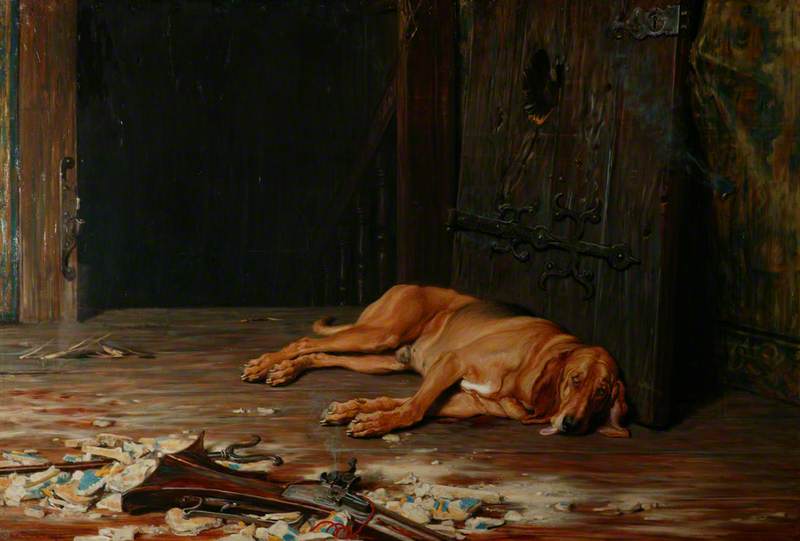
Riviere worked on The Last of the Garrison between 1875 and 1876, exhibiting it at the Royal Academy during a period when the theme of loyal animals surviving human tragedy had strong popular and critical appeal. The painting reflects the Victorian fascination with stories of animal fidelity, which were widely reported in newspapers and frequently discussed in moral and philosophical terms. Riviere was drawn repeatedly to subjects in which dogs serve as the last witnesses to human drama, and this work represents one of the most fully realized expressions of that theme in his output. The ruined setting suggests a military or colonial context, tapping into the period's intense interest in warfare, sacrifice, and the costs of empire. The Guildhall Art Gallery in London acquired the work as part of its collection of Victorian paintings, where it stands as one of the more emotionally resonant examples of the genre. Riviere's careful preparation, including studies of military architecture and close observation of dogs in various emotional states, is evident throughout the finished canvas.
The composition centers on a single dog positioned among the debris of a collapsed fortification, with architectural remnants framing the figure and directing the viewer's gaze toward the animal. Riviere's handling of the rubble is precise and varied, each stone and broken timber painted with individual attention to texture and weight. The dog itself is depicted in a posture of watchful waiting rather than grief or distress, which makes the scene all the more poignant: the animal does not understand that there is no garrison left to wait for. The tonal palette is muted and dusty, dominated by ochres, greys, and warm browns, with cooler light entering from above to illuminate the dog's coat. The absence of human figures is the composition's most powerful device, creating a silence that speaks volumes. Every spatial and tonal decision in the painting works to isolate the dog and emphasize its solitary fidelity.
The painting draws on deep cultural currents surrounding loyalty, duty, and survival. In the Victorian moral imagination, the faithful dog was a figure of uncomplicated virtue whose devotion put human inconstancy to shame. By placing such a figure in the ruins of a military post, Riviere links animal loyalty to the human ideals of courage and dedication while implicitly mourning the loss of those who embodied them. The work also participates in broader Victorian anxieties about empire and sacrifice, inviting the viewer to reflect on what is lost when garrisons fall and defenders perish. The dog becomes a living memorial, its continued presence a form of tribute that no monument could replicate. The painting was understood by contemporary audiences as both a moving animal study and a meditation on fidelity, and those two dimensions continue to give it its distinctive emotional charge.