Loading cart…
No products in the cart.

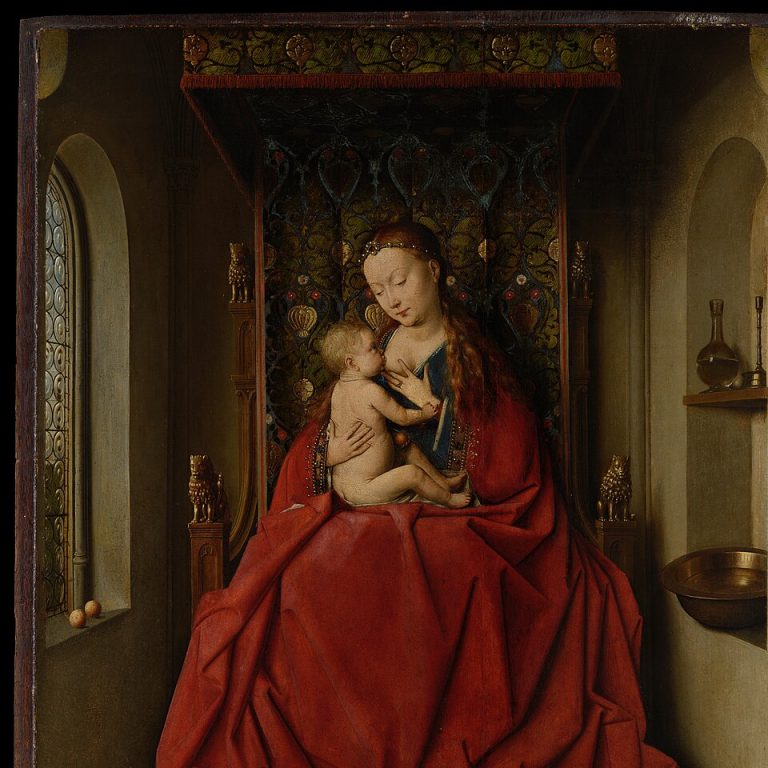
1436 · Oil on panel · Stadel Museum, Frankfurt, Germany
Save articles to your collection
Log in or create a free account, and this article will be waiting in your Private Collection.
Log in or sign upThe Lucca Madonna takes its name from the Italian city of Lucca, whose ruling family, the Guinigi, was believed to have owned the panel at some point in its early history, though the precise circumstances of its original commission remain uncertain. The painting is generally dated to around 1436 on the basis of stylistic comparison with other documented works by van Eyck from the same period, and it is thought to have been created for a private patron who desired an intimate devotional image for personal prayer. The panel entered the collection of King Lucien Murat of Naples in the early nineteenth century and was subsequently acquired by the Stadel Museum in Frankfurt, where it has remained since 1849. The work has attracted sustained scholarly attention because of the richness of its iconographic program and the extraordinary quality of its surface, which is among the best preserved in the van Eyck corpus. Technical examination has confirmed the use of van Eyck characteristic layered oil technique, with thin glazes of transparent color built up over a carefully prepared ground to achieve the luminous quality of the final surface. The panel has been the subject of numerous detailed studies examining the meaning of its symbolic elements, the identity of its patron, and its relationship to other devotional images of the Virgin produced in the Flemish Netherlands during the fifteenth century.
The composition is organized around the seated Virgin, who occupies a carved and canopied throne in what appears to be a domestic interior. She nurses the Christ Child with a naturalness and intimacy that was unusual in devotional imagery of the period and reflects a broader theological emphasis on the humanity of Christ and the tender relationship between mother and child. The throne is elaborate, its carved surfaces depicting lions on the armrests, a detail with both royal and Solomonic associations. A rich red textile canopy hangs above the Virgin head, and the floor beneath her is covered with a patterned carpet whose intricate geometry is rendered with painstaking fidelity. On the windowsill behind the throne, van Eyck placed a collection of small objects including a bronze aquamanile, a glass vessel, and a silver flask, each rendered with a precision that captures the specific reflective and refractive properties of the different materials. This accumulation of carefully observed objects on the windowsill is a characteristic feature of van Eyck interior scenes and functions both as a demonstration of technical virtuosity and as a vehicle for symbolic content. The light entering from the left creates a coherent and consistent illumination across the entire scene, unifying the varied surfaces and textures within a single, convincing spatial environment.
The devotional meaning of the Lucca Madonna is structured around the image of the nursing Virgin, a type known in Christian iconography as the Maria Lactans. This image carried a specific theological significance, emphasizing the full humanity of Christ, who depended on his mother for physical nourishment like any other human infant. In the context of fifteenth-century Flemish piety, this emphasis on the physical reality of the Incarnation was part of a broader devotional movement that sought to make the mysteries of faith accessible through imaginative engagement with the human experience of Christ and the Virgin. The objects placed on the windowsill carry additional layers of symbolic meaning. The glass vessel, which holds water without being broken or stained by it, was a traditional symbol of the Virgin purity and her miraculous conception of Christ. The bronze aquamanile, used for ritual hand-washing, may allude to the purifying function of baptism and the redemptive work of the Church. The lion finials on the throne armrests evoke the throne of Solomon and identify the Virgin as the Queen of Heaven enthroned in divine wisdom. Together these elements construct a devotional image of considerable theological density, in which the intimate domestic scene of a mother nursing her child is simultaneously a statement about the deepest mysteries of Christian faith.
Enjoyed this story?
Save articles to your collection
Log in or create a free account, and this article will be waiting in your Private Collection.
Log in or sign up