Loading cart…
No products in the cart.

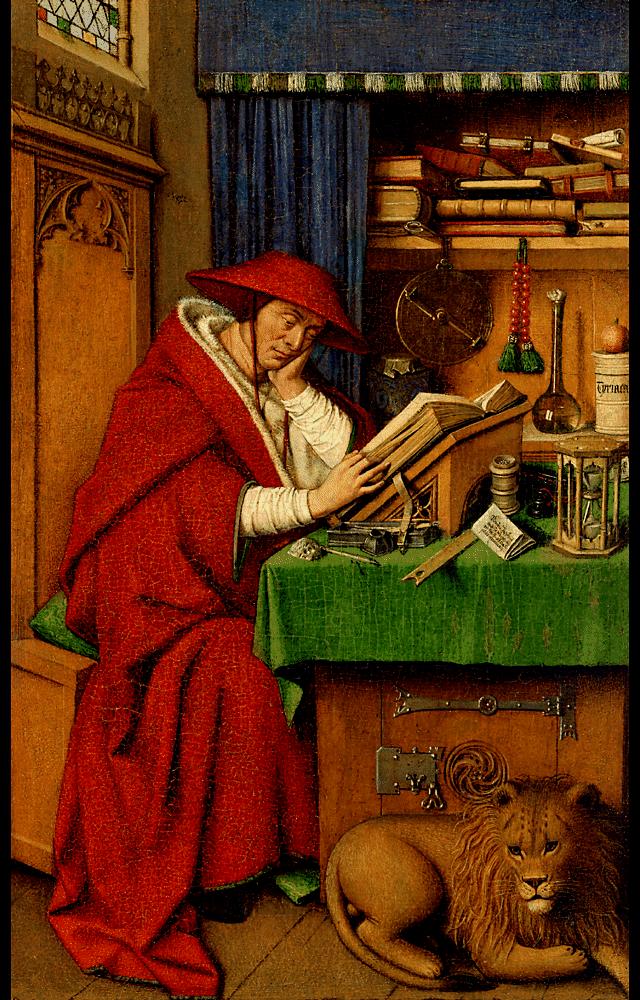
c. 1435–1437 · Oil on parchment on panel · Detroit Institute of Arts, Detroit, United States
Save articles to your collection
Log in or create a free account, and this article will be waiting in your Private Collection.
Log in or sign upSaint Jerome in His Study is a small panel painting on parchment that has attracted significant scholarly attention since its rediscovery and attribution to Jan van Eyck. The work is housed at the Detroit Institute of Arts and is considered one of the more intimate surviving works associated with the artist. The panel was likely commissioned as a devotional object for private use, consistent with the widespread Flemish tradition of creating small-format religious images for personal meditation and prayer. Jerome was among the most venerated Church Fathers in the fifteenth century, and his image as a scholar and translator of the Bible made him a popular subject for patrons who valued learning and piety in equal measure. The attribution of this panel has been discussed extensively in art historical literature. Many scholars accept it as an autograph work by Jan van Eyck based on the extraordinary level of detail in the rendering of books, manuscripts, and architectural elements within the cramped study space. The painting shares technical qualities with other confirmed works by the artist, including the precise layering of translucent glazes and the careful depiction of light falling across varied surfaces. Its small size suggests it may have functioned as a book illustration or a portable devotional image, reflecting the close relationship between manuscript illumination and panel painting that characterized Flemish art in this period.
The composition of Saint Jerome in His Study is organized around the figure of the saint, who is seated at a writing desk surrounded by an array of carefully rendered scholarly objects. Books, manuscripts, a cardinal hat, and various vessels are arranged within the confined architectural space with meticulous attention to their physical properties. The light source appears to enter from a window to the left, casting subtle shadows across the surfaces of objects and creating a sense of three-dimensional depth that is remarkable given the extremely small scale of the work. A lion, the traditional companion of Saint Jerome according to hagiographic legend, is depicted in the lower portion of the composition, its form rendered with careful attention to the texture of its fur. The handling of paint in this panel demonstrates Van Eyck characteristic technique of building up thin, translucent layers of oil to achieve luminosity and depth of color. The spines and pages of books are rendered with individual attention, and the architectural niche that frames the saint creates a sense of recession into pictorial space. The inclusion of a cardinal hat hanging on the wall references the apocryphal tradition that assigned Jerome the rank of cardinal, a convention widely accepted in fifteenth-century devotional iconography. The overall visual effect is one of concentrated scholarly calm, and the density of symbolic and textual references within such a small format reflects both Van Eyck technical discipline and the intellectual culture of his patrons.
The thematic content of Saint Jerome in His Study centers on the virtues of learned devotion, scholarly discipline, and the integration of intellectual and spiritual life. Jerome was venerated not only as a saint but as the translator of the Vulgate Bible, making him a figure who embodied the union of deep faith and rigorous scholarship. For fifteenth-century Flemish patrons, particularly those associated with humanist circles or ecclesiastical institutions, an image of Jerome in his study carried layered meaning. It affirmed the value of sacred learning, the dignity of textual study, and the belief that intellectual engagement with scripture was itself a form of devotion. The lion included in the composition carries its own symbolic weight, referencing the legend in which Jerome removed a thorn from the paw of a lion, after which the animal remained as his faithful companion. This story was understood as an allegory of Christian conversion and the taming of earthly instincts through spiritual discipline. The accumulation of books and writing instruments around the saint reinforces the idea that wisdom is cultivated through patient and sustained effort. For the original owner of this panel, meditating before this image would have encouraged reflection on the life of the mind as a path toward holiness, situating intellectual labor within the framework of religious devotion that defined Flemish piety in the early fifteenth century.
Enjoyed this story?
Save articles to your collection
Log in or create a free account, and this article will be waiting in your Private Collection.
Log in or sign up