Loading cart…
No products in the cart.

1432 · Oil on wood panel · Saint Bavo Cathedral, Ghent, Belgium
Save articles to your collection
Log in or create a free account, and this article will be waiting in your Private Collection.
Log in or sign upThe Ghent Altarpiece was commissioned by Jodocus Vijd and his wife Elisabeth Borluut for the Chapel of Saint John the Baptist in Saint Bavo Cathedral in Ghent. An inscription on the frame attributes the work to both Hubert van Eyck, who reportedly began the project, and Jan van Eyck, who completed it in 1432 after Hubert death in 1426. The precise division of labor between the two brothers remains a subject of scholarly discussion, though the majority of art historians credit the finished visual language and technical execution to Jan. The altarpiece was consecrated on 6 May 1432 and immediately drew attention from visitors across Europe, cementing the reputation of the Van Eyck workshop as a center of innovative oil painting technique. Over the centuries, the altarpiece experienced a turbulent history that reflects the broader upheavals of European political and religious life. Panels were removed and dispersed at various points, including during the French Revolutionary period when Napoleon ordered sections transported to Paris. Several panels were sold in the nineteenth century and eventually made their way to Berlin before being returned to Ghent after World War One under the Treaty of Versailles. During World War Two, the altarpiece was hidden by the Nazis in a salt mine in Austria and was only recovered by Allied forces in 1945. Today all panels are reunited in Saint Bavo Cathedral, where they remain on permanent display.
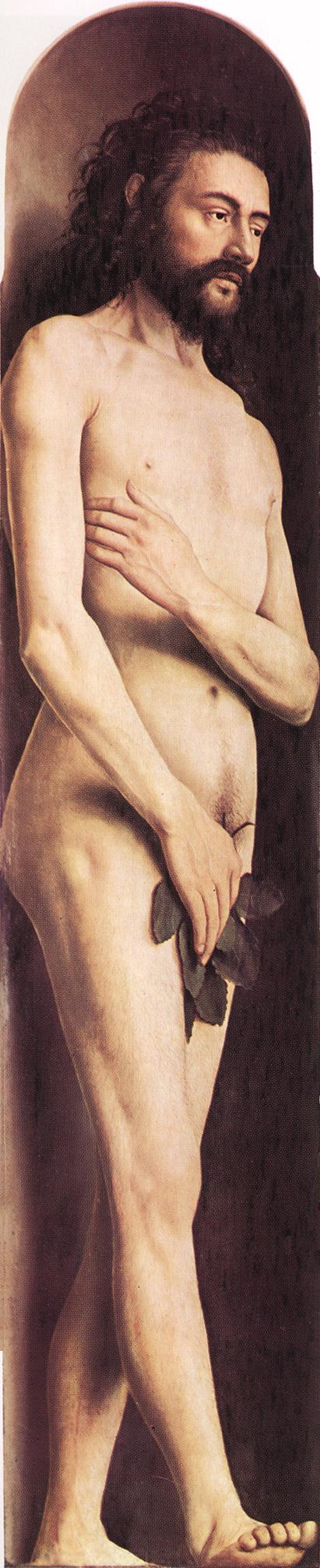
The altarpiece consists of twelve panels arranged across two registers when fully open, depicting a rich theological program that moves from the heavenly realm in the upper tier to the terrestrial world below. The upper central panels present God the Father enthroned in magnificent crimson and gold vestments, flanked by the Virgin Mary and Saint John the Baptist. To either side appear panels of angels singing and playing music, and at the outer edges stand the figures of Adam and Eve rendered with a naturalism rare for the period. The lower register centers on the celebrated Adoration of the Mystic Lamb, in which multitudes of saints, pilgrims, prophets, and knights converge on an altar supporting a lamb whose blood flows into a chalice, a direct reference to the Eucharist and the sacrificial theology of Christianity. The technical execution of the altarpiece reveals the full scope of Jan van Eyck oil painting innovation. Each figure is rendered with an extraordinary attention to surface texture, from the sheen of embroidered vestments to the individual hairs visible in portraits of saints. The landscape in the lower central panel recedes into a luminous blue distance, demonstrating an early and sophisticated use of atmospheric perspective. Light behaves consistently across all panels, suggesting a unified and carefully observed natural source. The jewels embedded in the crown of God the Father catch and refract light in a manner that prefigures later still-life traditions. The inscription on the frame, which praises the two brothers, remains the primary documentary source for the collaborative attribution.
The theological program of the Ghent Altarpiece draws deeply from the traditions of Christian eschatology and liturgical symbolism. The Adoration of the Mystic Lamb in the lower central panel is derived from the Book of Revelation, specifically the vision of the Lamb of God standing on Mount Zion while the redeemed of the earth approach in procession. The convergence of Old Testament prophets, New Testament apostles, martyrs, confessors, hermits, pilgrims, and knights represents the full breadth of Christian salvation history, all moving toward the redemptive sacrifice symbolized by the lamb. The fountain in the foreground is inscribed with a reference to the water of life from Revelation, reinforcing the Eucharistic and baptismal dimensions of the composition. The figures of Adam and Eve in the outer upper panels carry additional layers of meaning by juxtaposing human fallibility with divine grace. Rendered in a convincingly naturalistic style that was striking to fifteenth-century viewers, these two figures represent the origin of sin and the consequent need for the redemption depicted in the lower tier. The Virgin Mary, shown reading a book and crowned as Queen of Heaven in the upper register, serves as the antithesis of Eve, the new intercessor through whom grace flows to humanity. The overall program affirms the central doctrines of Catholic theology as understood in the early fifteenth century, making the altarpiece not only a visual achievement but also a sophisticated statement of faith intended to inspire devotion and contemplation in all who entered the chapel.
Enjoyed this story?
Save articles to your collection
Log in or create a free account, and this article will be waiting in your Private Collection.
Log in or sign up