Loading cart…
No products in the cart.

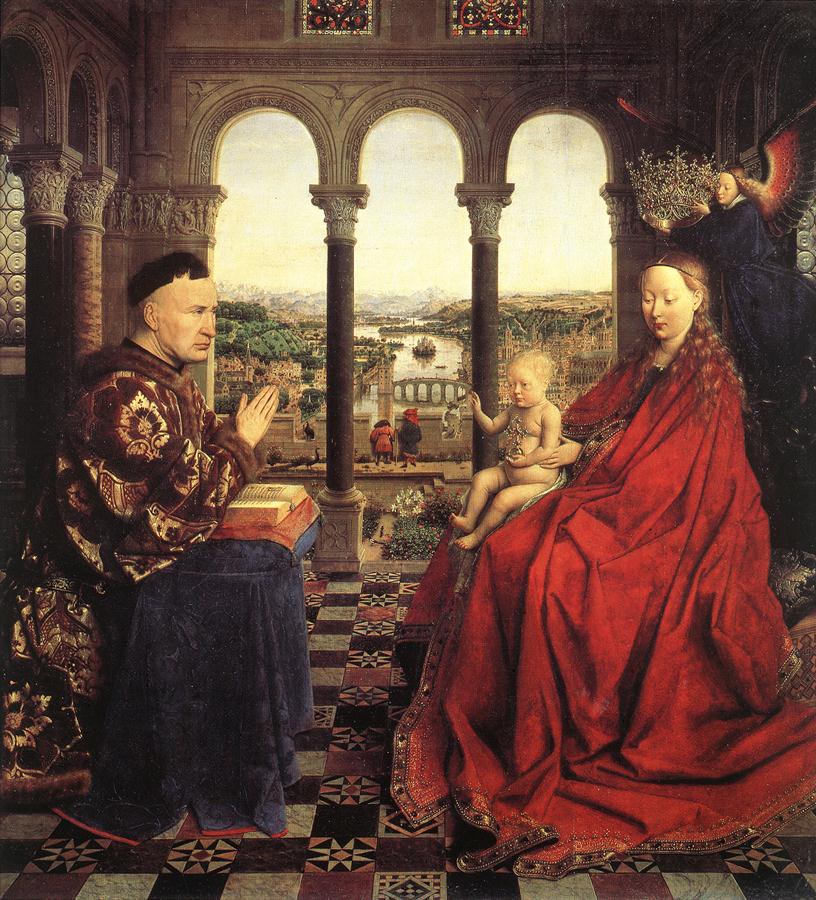
1435 · Oil on panel · Louvre Museum, Paris, France
Save articles to your collection
Log in or create a free account, and this article will be waiting in your Private Collection.
Log in or sign upCommissioned by Nicolas Rolin, the powerful chancellor of Burgundy under Duke Philip the Good, this panel painting was created around 1435 and reflects the immense personal ambition and religious devotion of one of the most influential figures in fifteenth-century northern Europe. Rolin served as chancellor for decades and accumulated extraordinary wealth and political influence, which he used to commission significant works of art as acts of piety and self-promotion. The painting was likely intended for private devotional use in Rolin personal chapel, allowing the patron to engage in prayer before an image that placed him directly in the presence of the divine. It remained in Autun Cathedral for centuries before eventually entering the collection of the Louvre in Paris following the upheavals of the French Revolution. The commission itself represents a broader cultural practice among wealthy Burgundian patrons who sought to immortalize themselves in devotional imagery. Van Eyck was the court painter of Philip the Good, and this professional connection made him the natural choice for Rolin commission. The panel has been studied extensively since the nineteenth century, and scholars have debated the precise location depicted in the background landscape, with some identifying it as a composite view of Flemish and Burgundian cities including Liege, Autun, and Maastricht. The painting stands as an important document of the relationship between artistic patronage and political power in the Burgundian Netherlands.
Van Eyck constructed the composition with extraordinary architectural precision, placing the figures within a three-arched loggia whose columns and capitals are carved with scenes from the Old Testament. The chancellor kneels at a prayer desk on the left, his richly embroidered robe rendered with meticulous attention to textile detail, while the Virgin sits at the center holding the Christ Child on her lap. An angel hovers behind her, holding a jeweled crown above her head in a gesture of coronation that blends earthly and heavenly realms. The perspective recession of the loggia floor tiles and the careful placement of figures in a coherent three-dimensional space demonstrate van Eyck remarkable command of pictorial illusionism. The background landscape visible through the three arches is among the most detailed and ambitious in all of early Netherlandish painting. A wide river winds through a city filled with towers, bridges, and spires, and tiny figures can be seen walking on the bridge and along the riverbanks. The landscape recedes into a hazy blue horizon with mountains in the far distance, demonstrating van Eyck mastery of atmospheric perspective long before it became a standard element of European painting. The light throughout the panel is clear and diffuse, illuminating surfaces with an evenness that reveals the reflective qualities of silk, gold, marble, and glass with equal fidelity.
The symbolic program of this panel operates on multiple levels simultaneously. The placement of Nicolas Rolin in the same space as the Virgin and Child is a bold act of devotional imagination, suggesting that through prayer and piety the mortal patron can achieve proximity to the sacred. This tradition of donor portraiture, in which the patron appears not as a distant observer but as an active participant in a holy scene, was well established in Flemish art, but van Eyck rendered it with a psychological intensity that gives Rolin presence particular weight. The chancellor does not look up at the Virgin but appears absorbed in prayer, his hands clasped and his expression composed, modeling the ideal posture of a devout Christian nobleman. The rich iconographic details embedded throughout the composition reinforce the theological content. The carved column capitals depict scenes of the expulsion from Eden and the story of Cain and Abel, reminding the viewer of human sin and the need for redemption. The Christ Child holds an orb surmounted by a crystal cross, symbolizing his sovereignty over the world. The peacocks visible on the balcony railing carry traditional associations with immortality and the resurrection of the soul. Together these elements construct a carefully layered visual argument about sin, intercession, grace, and the hope of salvation, themes that would have resonated deeply with a patron who was acutely aware of his own mortality despite his worldly power.
Enjoyed this story?
Save articles to your collection
Log in or create a free account, and this article will be waiting in your Private Collection.
Log in or sign up