Loading cart…
No products in the cart.

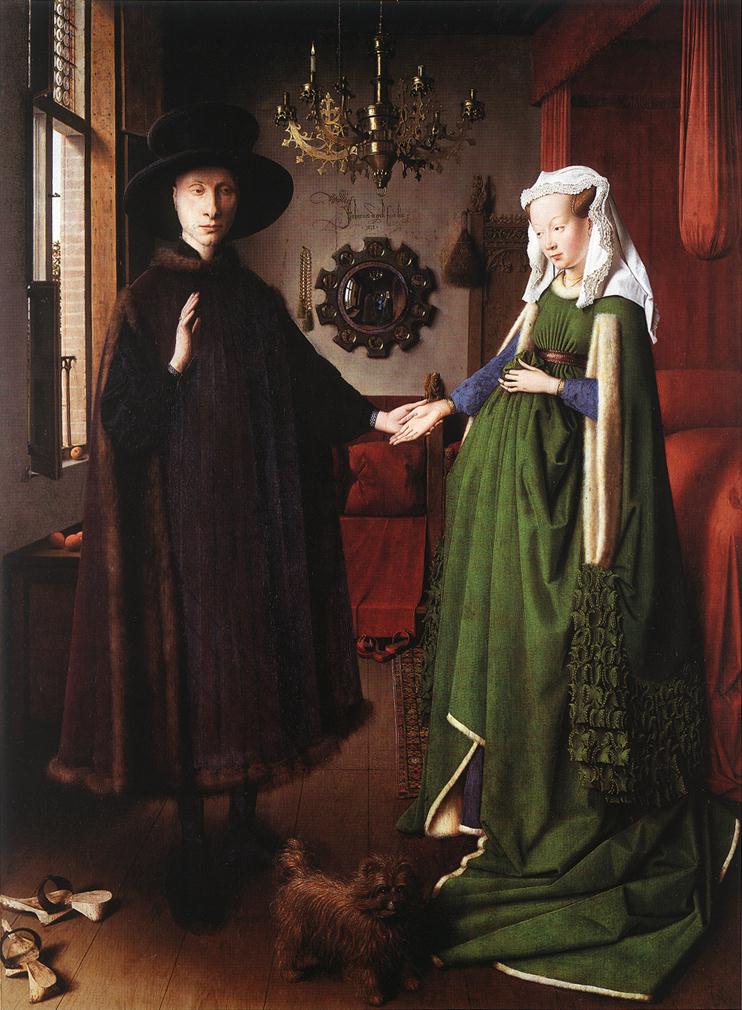
1434 · Oil on oak panel · National Gallery, London, United Kingdom
Save articles to your collection
Log in or create a free account, and this article will be waiting in your Private Collection.
Log in or sign upThe Arnolfini Portrait is signed and dated by Jan van Eyck with the Latin inscription Johannes de eyck fuit hic 1434, meaning Jan van Eyck was here 1434, a phrase that has fascinated scholars and visitors for centuries. The painting is generally identified as depicting Giovanni di Nicolao Arnolfini, an Italian merchant from Lucca who had established himself in Bruges as a representative of Medici commercial interests, and a female companion whose identity remains debated. The work entered the Spanish royal collections at some point after the sixteenth century and was acquired by the National Gallery in London in 1842 from the collection of Colonel James Hay, who had obtained it in Brussels following the Napoleonic Wars. The documentary record surrounding the painting is rich but also contested. Early inventories of the collections of Margaret of Austria, compiled in 1516 and 1523 to 1524, describe a panel showing Hernoul le Fin with his wife in a chamber, which many scholars interpret as an early reference to the Arnolfini Portrait. The identity of the woman depicted has been the subject of considerable debate, with some researchers suggesting she may be Costanza Trenta, who died before 1433, and others proposing that the work represents a later relationship of Arnolfini. Regardless of the precise identity of the sitters, the painting represents a landmark in the history of portraiture and interior painting in the Northern Renaissance tradition.
The composition of the Arnolfini Portrait is organized around the vertical axis of the two standing figures, who occupy a room furnished with objects selected with apparent deliberateness. The man raises his right hand in a gesture that has been interpreted variously as an oath, a greeting, or a benediction, while the woman gathers her green dress with her right hand. Between them, a small dog stands at the lower center of the composition, a detail that contributes to the sense of domestic intimacy. The bed with its red hangings, the wooden clogs near the window, the single candle burning in the brass chandelier, the oranges on the windowsill and chest, and the convex mirror on the rear wall all contribute to a sense of material abundance and careful symbolic arrangement. The convex mirror is perhaps the most celebrated detail in the painting, reflecting the entire room from the opposite perspective and revealing two small figures entering through the doorway, one of whom is believed to be the painter himself. Around the frame of the mirror, ten small circular medallions depict scenes from the Passion of Christ, reinforcing the sacred dimension of the domestic space. The handling of light throughout the panel demonstrates Jan van Eyck extraordinary control of oil glazes, with daylight entering through the window to the left and casting subtle shadows across every surface. The brass chandelier, rendered in meticulous detail with reflections visible on its curved surfaces, exemplifies the painter capacity to suggest the optical properties of different materials through paint alone.
Scholars have proposed numerous interpretive frameworks for the Arnolfini Portrait, with the most enduring debates centering on whether the painting records a legal contract, a marriage ceremony, a betrothal, or simply a portrait of a prosperous couple in their private space. Erwin Panofsky, writing in 1934, proposed that the work functioned as a pictorial marriage certificate, with Jan van Eyck serving as a legal witness, an interpretation supported by the unusual inscription and the reflected figures in the mirror. Later scholars including Linda Seidel and Jan Baptist Bedaux challenged this reading, arguing that the symbolic objects in the room do not carry the consistent iconographic weight that Panofsky attributed to them, and that the painting should be understood primarily as a high-status portrait. The objects within the room nonetheless carry resonances that would have been legible to fifteenth-century viewers. The single burning candle in the chandelier was associated with the presence of the divine and with the votive candles used in Marian devotion. The dog, a long-haired terrier, was a symbol of fidelity in Flemish visual culture. The convex mirror, with its Passion medallions, introduces a note of spiritual gravity into the domestic scene. The green dress worn by the woman, sometimes misread as a sign of pregnancy due to its gathered fabric, reflects contemporary Flemish fashion rather than a biological condition. Taken together, these elements suggest that Jan van Eyck was creating a work that operated simultaneously as a portrait, a record of social status, and a meditation on the relationship between the sacred and the domestic in prosperous urban life.
Enjoyed this story?
Save articles to your collection
Log in or create a free account, and this article will be waiting in your Private Collection.
Log in or sign up