Loading cart…
No products in the cart.

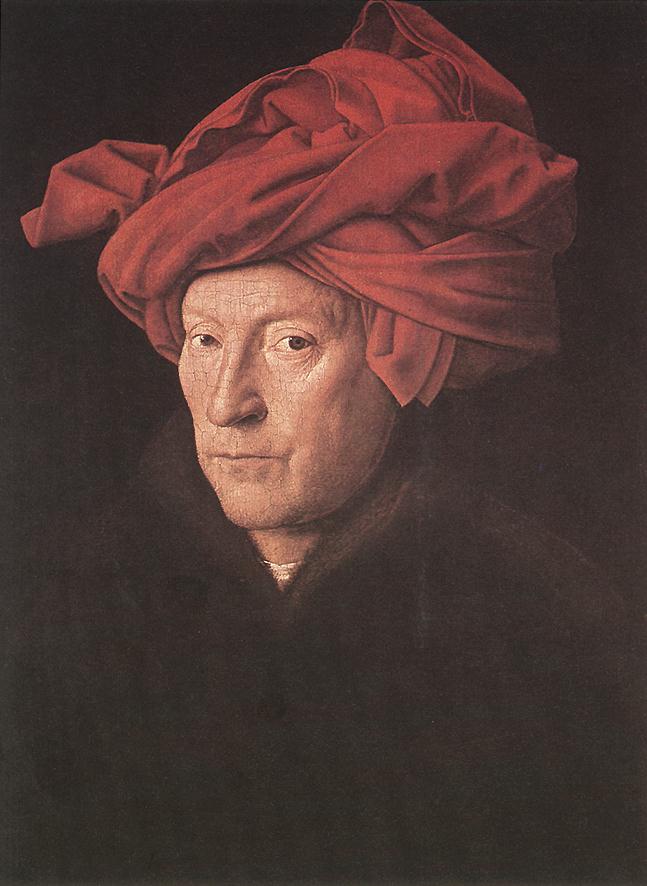
1433 · Oil on panel · National Gallery, London, United Kingdom
Save articles to your collection
Log in or create a free account, and this article will be waiting in your Private Collection.
Log in or sign upDated and signed by van Eyck on the original frame with the inscription in Latin stating that the work was completed on the twenty-first of October 1433, this small portrait panel is one of the most scrutinized works in the entire history of early Netherlandish painting. The sitter has never been conclusively identified, but the direct and unflinching gaze directed at the viewer has prompted generations of scholars to argue that the panel may represent a self-portrait, as it would be natural for a painter to look at himself in a mirror while working. The inscription on the lower frame reads in Latin and translates roughly as a reference to van Eyck act of making, which some scholars interpret as an unusually self-referential statement for a fifteenth-century artist. The panel entered the collection of the National Gallery in London in 1851 and has since become one of the most visited and reproduced works in the museum holdings. Its small scale belies the extraordinary density of observation compressed into its surface. The painting has been subjected to extensive technical analysis, including infrared reflectography and X-ray examination, which have revealed very little underdrawing, suggesting that van Eyck worked with a high degree of confidence and directness. The condition of the panel is remarkably good, and the original inscriptions on the frame are considered authentic, making it one of the few works in the van Eyck corpus whose dating can be established with precision.
The composition is spare and direct, focusing almost entirely on the head and shoulders of the sitter against a plain dark background. The red chaperon, a type of folded hood worn by fashionable men of the period, dominates the upper portion of the composition with its voluminous folds and deep crimson color. Van Eyck rendered the fabric with his characteristic precision, capturing the way the cloth catches and absorbs light differently across its various surfaces and folds. The skin of the face is handled with equal subtlety, with the stubble of an unshaved beard visible on the chin and jaw, the whites of the eyes tinged with the faint pink of real capillaries, and the lips rendered with a softness that suggests living tissue rather than painted surface. The gaze of the sitter is the compositional and psychological center of the panel. Unlike many portraits of the period, in which the sitter looks slightly away from the viewer or toward a devotional object, this figure looks directly outward with an expression that reads as alert, evaluative, and slightly challenging. The slight asymmetry of the face and the specific quality of the lighting, which comes from the left and casts the right side of the face into graduated shadow, contribute to a sense of individuality that sets this portrait apart from the more idealized conventions of earlier Flemish portraiture. Van Eyck used these formal devices to create a powerful impression of a specific person captured at a specific moment.
If the identification of this panel as a self-portrait is accepted, even provisionally, it carries significant implications for the history of artistic self-representation in Western art. A painter depicting himself looking directly outward from the picture surface would be making a statement about the nature of vision and the act of painting, since the gaze would have been achieved by looking into a mirror and therefore involves a reversal of the observed image. This reflexive quality aligns with broader intellectual currents in van Eyck work, including the famous mirror in the Arnolfini Portrait, which suggests a sustained interest in the relationship between looking, representing, and knowing. The restrained format of the portrait, with its dark background and close cropping, focuses all interpretive energy on the face and the gaze, stripping away the usual markers of status and identity that characterize donor portraits and aristocratic commissions. This creates an unusually democratic and psychologically intense image in which the viewer is invited to confront an individual human presence rather than a symbol of rank or piety. Whether or not the sitter is van Eyck himself, the painting represents an important moment in the development of portraiture as a genre capable of conveying interiority and individuality, values that would become central to European humanist culture in the following century.
Enjoyed this story?
Save articles to your collection
Log in or create a free account, and this article will be waiting in your Private Collection.
Log in or sign up