Loading cart…
No products in the cart.

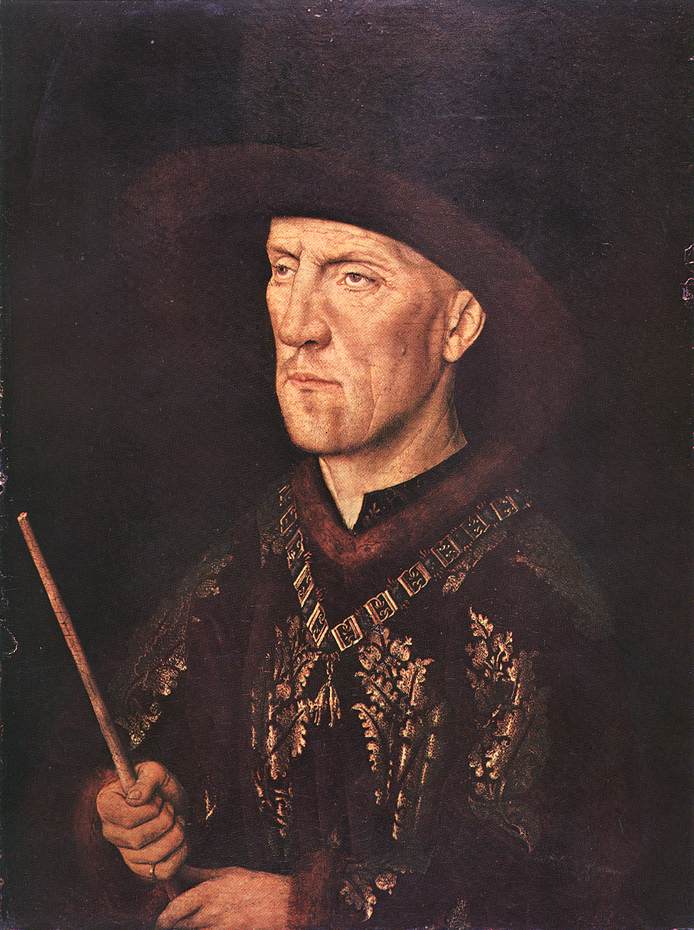
1435 · Oil on panel · Gemaldegalerie, Berlin, Germany
Save articles to your collection
Log in or create a free account, and this article will be waiting in your Private Collection.
Log in or sign upBaudouin de Lannoy was a prominent figure in the court of Philip the Good, Duke of Burgundy, serving as a knight of the Order of the Golden Fleece and undertaking diplomatic missions on behalf of the duke across Europe and beyond. He was part of the Burgundian delegation that traveled to Portugal in 1428 to negotiate the marriage of Philip the Good, a mission on which van Eyck himself participated as the court painter responsible for producing a portrait of the prospective bride. This shared experience of international diplomacy and courtly service likely explains the commission of this portrait, which served both as a personal record of the sitter appearance and as a document of his elevated status within the Burgundian nobility.
The portrait entered the collection of the Gemaldegalerie in Berlin in the nineteenth century and has since been the subject of numerous studies examining its technical qualities and its place within van Eyck broader portrait production. The identification of the sitter is supported by comparison with other representations of de Lannoy and by the presence of the staff of office, which is a standard attribute of a chamberlain or senior court official. The panel is in generally good condition, though some areas of the background have suffered minor losses over time. It remains one of the most important documents of Burgundian court portraiture in the early fifteenth century and a significant example of van Eyck ability to capture individual character through close observation.
The composition follows the standard format of van Eyck court portraits, with the sitter positioned in three-quarter view against a plain dark background, occupying the central field of a relatively small panel. De Lannoy wears a fur-lined robe of dark fabric and holds a staff of office in his right hand, an attribute that immediately signals his rank and function within the Burgundian court hierarchy. The face is depicted with van Eyck characteristic realism, capturing the slightly weathered skin of a man accustomed to travel and outdoor activity, with careful attention to the modeling of the cheekbones, the set of the jaw, and the particular quality of the eyes, which are rendered with the faint reflections and subtle coloration of actual living tissue.
The fur lining of the robe is depicted with a density of individual brushstrokes that conveys the tactile quality of the material with remarkable conviction, each hair catching the light at a slightly different angle to create an overall impression of soft, three-dimensional texture. The staff of office is painted with equal precision, its smooth surface reflecting a thin highlight that travels along its length. The dark background is handled with great subtlety, modulating slightly toward the edges to create a sense of depth without introducing any specific spatial element. The overall effect is one of concentrated, almost severe attention to the physical reality of the sitter, unmediated by idealization or flattery.
Portraits of court officials and noblemen in the Burgundian Netherlands served multiple purposes that extended well beyond simple likeness. They functioned as diplomatic gifts, as records of alliance and loyalty, and as instruments of self-presentation within the highly competitive environment of the Burgundian court. A portrait by van Eyck, as the duke official painter, carried particular prestige and signaled the sitter proximity to the center of power. For Baudouin de Lannoy, a portrait of this quality represented a form of cultural capital that reinforced his standing within the aristocratic hierarchy.
The restrained format of the portrait, with its emphasis on the face and the attribute of office rather than elaborate heraldic display, reflects a broader tendency in Flemish court portraiture toward psychological and physiognomic individuality rather than purely symbolic representation of status. This shift had important consequences for the subsequent development of European portraiture, as it established the close observation of individual features as the primary vehicle for communicating identity and character. Van Eyck treatment of de Lannoy face, with its particular combination of authority and vulnerability, creates a portrait that functions as both a record of a specific person and a meditation on the nature of human individuality.
Enjoyed this story?
Save articles to your collection
Log in or create a free account, and this article will be waiting in your Private Collection.
Log in or sign up