Loading cart…
No products in the cart.

c. 1435 · Oil on oak panel · Gemaldegalerie, Berlin, Germany
Save articles to your collection
Log in or create a free account, and this article will be waiting in your Private Collection.
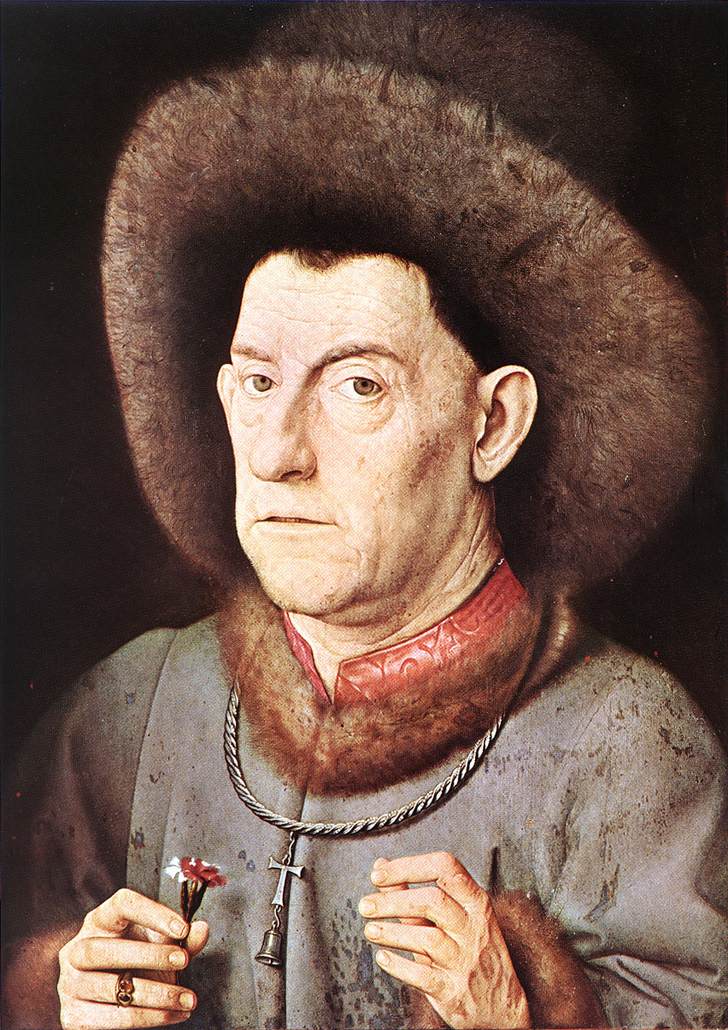
Log in or sign upThe Portrait of a Man with Carnation belongs to a group of small-scale portraits associated with Jan van Eyck and the broader Northern Renaissance tradition of intimate private portraiture. The panel entered the collections of the Gemaldegalerie in Berlin, where it has been studied and documented as part of the museum holdings for well over a century. Attribution to Jan van Eyck is supported by the quality of the oil glazing technique, the treatment of light across the face and hands, and the characteristic parapet compositional device that appears in other documented works by the painter. The identity of the sitter has not been established, and the painting carries no inscription that would allow a definitive identification. The carnation held by the sitter is a crucial iconographic detail that situates the painting within a specific cultural context. In fifteenth-century Flemish and Dutch society, the carnation, known in Dutch as a pink or gillyflower, was closely associated with love, betrothal, and marital fidelity. Portrait panels featuring a carnation were frequently commissioned to mark engagements or presented as gifts between prospective partners. The small scale of the panel is consistent with this function, as betrothal portraits were intended for private viewing rather than public display. The painting likely formed one half of a diptych, with a companion portrait of a woman now either lost or not yet conclusively identified as its pendant.
The compositional structure of the Portrait of a Man with Carnation follows the format developed by Jan van Eyck in several of his documented portrait panels. The sitter is positioned close to the picture plane, separated from the viewer by a narrow stone parapet on which the lower edge of the composition rests. The face is turned at a slight angle, allowing the painter to render both the three-quarter view of the features and the ear with its careful depiction of cartilage and shadow. The background is a neutral dark tone that concentrates attention entirely on the face, the hands, and the carnation. This reductive approach to setting was innovative in the context of fifteenth-century portraiture, which often placed sitters before elaborately painted landscapes or architectural settings. The technical execution of the panel rewards close examination. The flesh tones of the face are built up through multiple thin oil glazes, creating a sense of translucency that suggests the subcutaneous structure of the skin beneath. The eyes are rendered with particular care, with tiny reflections of light visible in the pupils that give the sitter a quality of alert presence. The fingers wrapped around the stem of the carnation demonstrate the painter ability to convey the softness of skin, the hardness of fingernails, and the delicate texture of a flower petal within the same small area of the panel. The carnation itself is painted with botanical precision, its petals distinguishable individually and its color modulated between pale pink at the edges and deeper rose toward the center.
The carnation in the sitter hand functions as the primary vehicle of meaning in this portrait, connecting the image to the broader iconographic tradition of love and devotion in Northern European visual culture. In the context of betrothal portraiture, the flower served as a pledge, a visible token of the commitment being depicted and memorialized by the painting itself. By showing the sitter actively holding the carnation rather than placing it on a ledge or table, Jan van Eyck emphasized the personal and affective dimension of the gesture, suggesting that the flower was being offered or presented to an implied viewer, likely the companion portrait sitter or the real-world recipient of the panel. Beyond its association with romantic and marital love, the carnation also carried religious connotations in fifteenth-century Flemish culture. The flower was linked in devotional literature and visual art to the wounds of Christ, its red and pink varieties echoing the imagery of the Passion. Marian imagery frequently incorporated carnations as symbols of divine love and of the Virgin grief at the Crucifixion. In a portrait context, these religious associations would have added a layer of spiritual gravity to the image, framing the human relationship being commemorated within the larger Christian understanding of love as participation in divine charity. The small scale of the panel, appropriate for private devotional as well as personal use, reinforces the intertwining of the sacred and the intimate that characterizes much of Jan van Eyck work in portraiture.
Enjoyed this story?
Save articles to your collection
Log in or create a free account, and this article will be waiting in your Private Collection.
Log in or sign up