Loading cart…
No products in the cart.

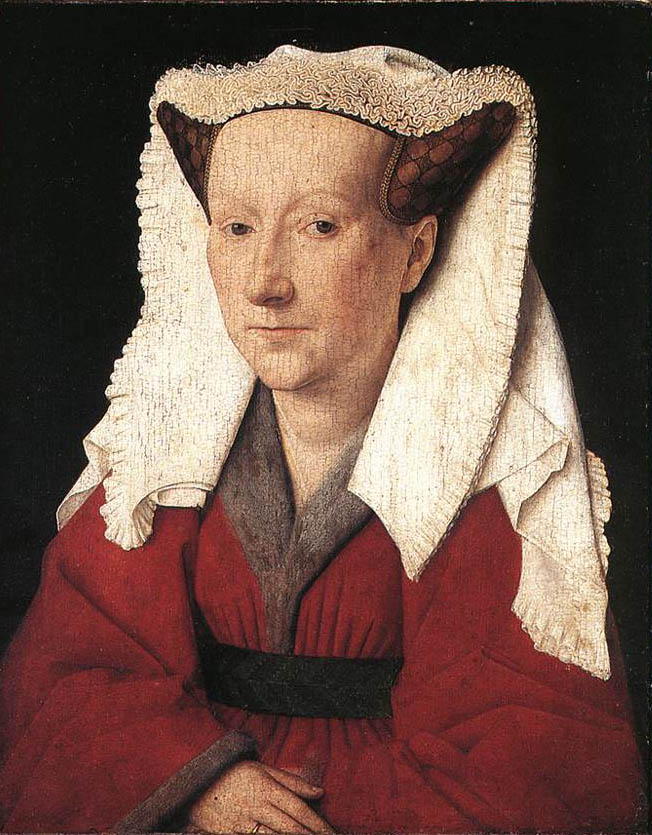
1439 · Oil on oak panel · Groeningemuseum, Bruges, Belgium
Save articles to your collection
Log in or create a free account, and this article will be waiting in your Private Collection.
Log in or sign upThe Portrait of Margareta van Eyck is signed and dated by Jan van Eyck with an inscription on the original frame that reads Johannes de Eyck me fecit anno 1439 33 etatis sue, meaning Jan van Eyck made me in the year 1439 at the age of 33. This inscription establishes the identity of the sitter as Margareta, Jan van Eyck wife, and provides a precise date that makes the painting one of the last securely dated works in the Van Eyck catalogue, as Jan died in 1441. The panel has been in the collection of the Groeningemuseum in Bruges for an extended period and is displayed there alongside the Virgin and Child with Canon van der Paele, forming a significant concentration of authenticated Van Eyck works in a single institution. Margareta van Eyck is an otherwise sparsely documented figure in the historical record, and this portrait represents the primary visual evidence of her existence. She appears to have been of similar social standing to her husband, and the guild records of Bruges indicate that after Jan death she received a payment from the city in recognition of his services, suggesting that the couple were regarded as a recognized household within the civic and artistic community of the city. The decision to paint a formal portrait of his wife places Jan in a tradition of conjugal portraiture that, while not unprecedented, was relatively uncommon for a professional painter of the period, and it speaks to the social and personal dimensions of his relationship with Margareta.
The composition of the Portrait of Margareta van Eyck follows the conventions that Jan van Eyck had established and refined across his career of portraiture. Margareta is depicted at close range, turned slightly to her right, with her face occupying the upper portion of the panel and her folded hands presumably cut off by the lower frame. She wears a white linen headdress of a type fashionable in Flemish bourgeois society in the 1430s, its starched folds rendered with the same meticulous attention to textile structure that characterizes the drapery in Van Eyck more elaborate devotional compositions. Her expression is composed and direct, meeting the implied gaze of the painter and viewer with a quality of calm attentiveness that is characteristic of Van Eyck portrait subjects. The handling of light across the face of Margareta demonstrates the full maturity of Jan van Eyck oil glazing technique. The flesh tones are constructed through multiple transparent layers, with warmer underlayers visible through the cooler surface glazes in the shadows around the eyes and beneath the chin. The white of the headdress is modulated from near-pure white in the areas of direct illumination to soft grey and blue in the shadowed folds, with each crease and tuck recorded individually. The lips are rendered with a subtlety of color that distinguishes the warmer center from the cooler edges, and the eyes carry the tiny reflective highlights that bring life to every Van Eyck portrait. The frame inscription, painted as part of the original composition, reinforces the intimate and commemorative function of the work.
The Portrait of Margareta van Eyck carries a significance that extends beyond its considerable technical qualities, functioning as a document of the painter regard for his wife and as a statement about the social status of the artist household in fifteenth-century Bruges. By applying to Margareta the same formal conventions and technical resources that he brought to portraits of wealthy merchants, aristocrats, and ecclesiastical patrons, Jan van Eyck affirmed the dignity of his domestic life and the equality of his wife status as a subject worthy of serious artistic attention. The decision to record her precise age in the inscription, as he had done for the Portrait of a Man in a Red Turban, suggests that the painting was conceived as a paired or companion work, though no male pendant of comparable date has been conclusively identified. The religious dimensions of the Portrait of Margareta van Eyck are subtler than in the devotional panels but nonetheless present. The white linen headdress worn by Margareta was associated in Flemish visual culture with purity, modesty, and domestic virtue, qualities that overlapped with the Marian ideals promoted in the devotional literature of the period. The composed and dignified bearing of the sitter, combined with the formal conventions of the portrait format, positions Margareta as a woman of moral as well as social standing. For later viewers and historians, the painting represents a rare moment of biographical intimacy in the Van Eyck corpus, offering a glimpse of the painter personal life that is otherwise inaccessible through the formal and commissioned works that constitute the majority of his surviving output. It remains a quietly affecting testimony to a life and a relationship documented only in paint.
Enjoyed this story?
Save articles to your collection
Log in or create a free account, and this article will be waiting in your Private Collection.
Log in or sign up