Loading cart…
No products in the cart.


A young woman sits alone in a wooden boat drifting along a river, her body turned slightly as she gazes out at the viewer with an expression caught between resignation and quiet defiance. Threads of a great tapestry trail from…
A young woman sits alone in a wooden boat drifting along a river, her body turned slightly as she gazes out at the viewer with an expression caught between resignation and quiet defiance. Threads of a great tapestry trail from her hands and tangle in the water around her. Autumn leaves float at the edge of the frame, and in the dim distance, the spires of Camelot rise through mist. The scene is saturated with color and charged with longing, a world on the threshold of transformation and loss. This is The Lady of Shalott, painted in 1888 and now among the most celebrated works in the Tate Britain collection. The painter who gave this scene its haunting emotional life was John William Waterhouse, a British artist who spent his career channeling the myths, legends, and literary traditions of the ancient and medieval world into vivid, luminous canvases that continue to captivate audiences more than a century after his death.
Waterhouse was born in Rome in 1849 to artist parents, and his early years were immersed in the classical world. His family returned to England when he was still young, and he trained at the Royal Academy Schools in London, exhibiting there from 1874 onward. His early works showed the influence of Alma-Tadema and the academic classical tradition, but by the mid-1880s he had developed the richly narrative, figure-centered style for which he is best remembered. Unlike the founding members of the Pre-Raphaelite Brotherhood, Waterhouse came to that aesthetic tradition from the outside, absorbing its love of literary subject matter, jewel-like color, and attention to natural detail while retaining his own deeply personal visual sensibility. He was elected an Associate of the Royal Academy in 1885 and a full Academician in 1895, and he exhibited consistently throughout his life. His work drew repeatedly on the figures of powerful or imperiled women from classical mythology and Arthurian legend, including Circe, Medea, Ophelia, and the Lady of Shalott, exploring themes of desire, fate, enchantment, and the tension between freedom and confinement. He died in London in 1917, leaving behind a body of work that bridges the Victorian academic tradition and the romantic symbolism of the late nineteenth century.
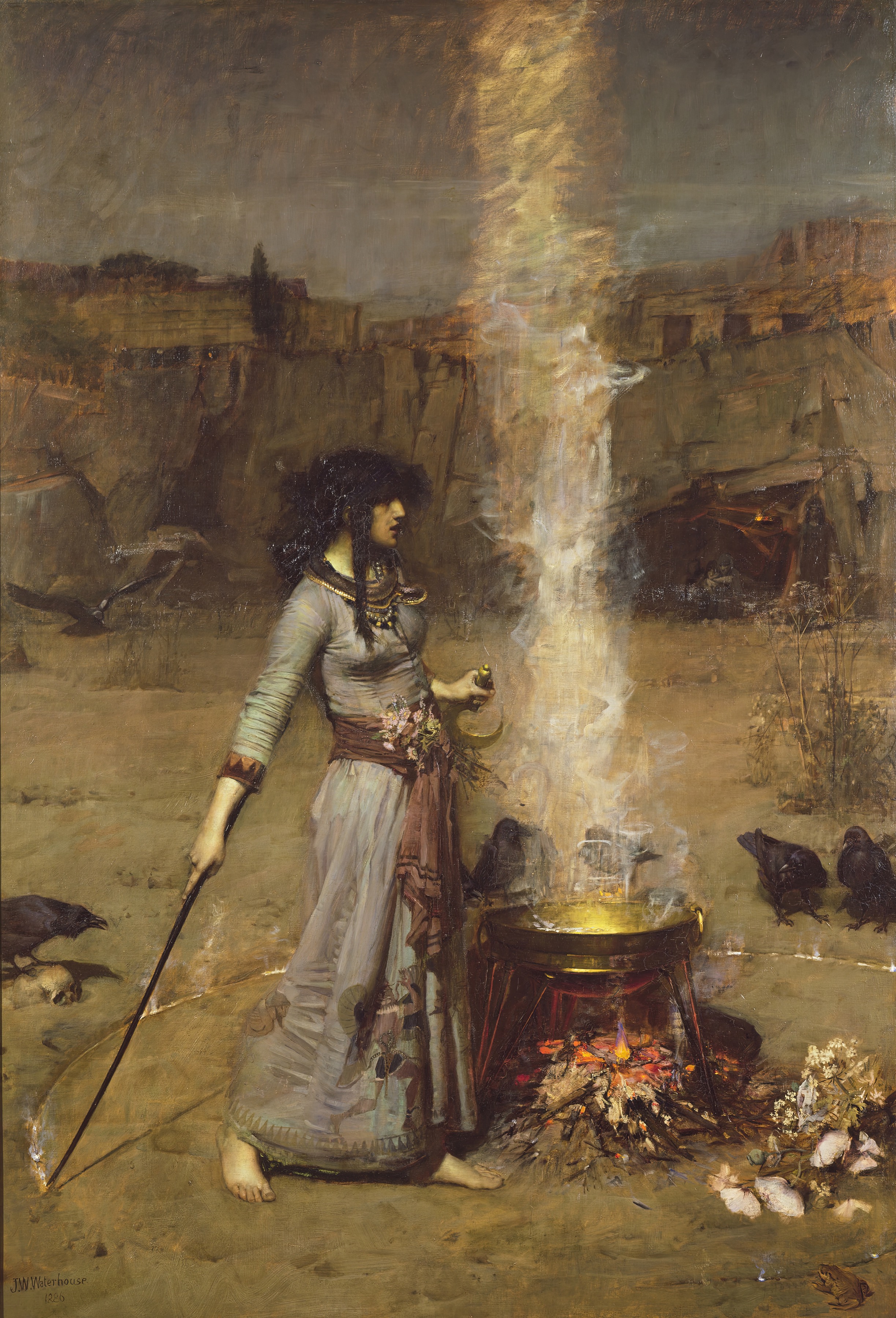
The technique of Waterhouse is grounded in the rigorous academic training of the Royal Academy, yet it carries a warmth and atmospheric immediacy that sets it apart from the cooler precision of many of his contemporaries. He worked primarily in oil on canvas, building his surfaces with confident, fluid brushwork that shifts register depending on what he is describing. Fabric and water receive long, directional strokes that suggest movement and translucence, while foliage and landscape backgrounds are handled with a looser, more impressionistic touch. His figures, by contrast, are rendered with careful attention to anatomy and expression, achieving a quality of psychological presence that anchors even the most fantastical scenes in felt human experience. His palette tends toward warm golds, deep greens, rich crimsons, and the particular blues and silvers of water and sky, arranged with a compositional confidence that rewards close looking. He had an exceptional ability to organize complex figure arrangements without allowing the image to feel crowded or static.
The visual language of Waterhouse is defined by a sustained engagement with the female figure as both protagonist and symbol. His women are rarely passive, even when they are depicted in states of vulnerability or entrapment. They hold their ground within the picture plane, meeting the viewer with gazes that are contemplative, searching, or quietly defiant. He borrowed compositional strategies from Renaissance painting, particularly in his use of architectural framing and diagonal movement through the picture space, while inflecting these structures with a distinctly Victorian emotional intensity. His backgrounds, whether the reed-lined banks of Arthurian rivers or the rocky shores of ancient Greece, function as psychological environments that amplify the inner states of his figures. This integration of landscape and character remains one of the most distinctive qualities of his work and one of the reasons his paintings continue to resonate with viewers across different cultural contexts.
Each card links to its own article with full analysis and reproduction details.
 #0
#0
 #1
#1
 #2
#2
 #3
#3
A print can reproduce colors. What it cannot reproduce is texture, depth, and the physical presence of oil paint on canvas. John William Waterhouse technique depends on these.
At ByMuseum, every reproduction is painted by hand using oil on canvas. There is no inkjet, no digital print. The brushwork is real. The result looks like a painting because it is one.