Loading cart…
No products in the cart.

1892 · Oil on canvas · Art Gallery of South Australia, Adelaide
Save articles to your collection
Log in or create a free account, and this article will be waiting in your Private Collection.
Log in or sign up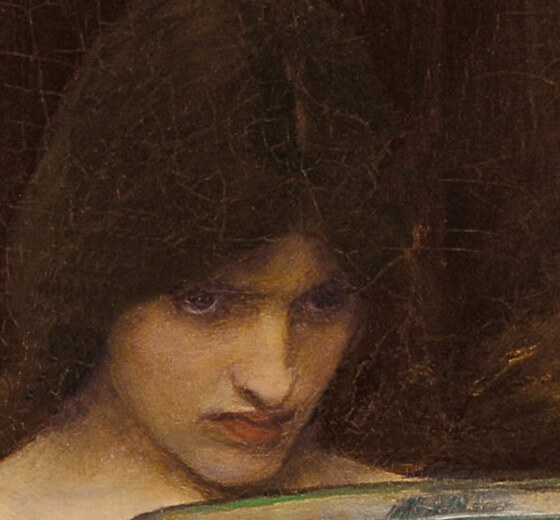
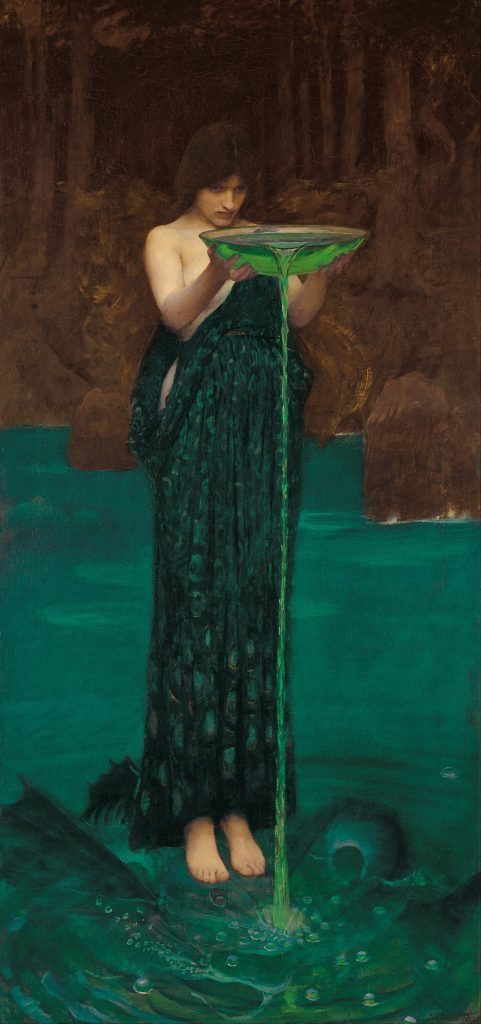
Most women in Waterhouse paintings look dreamy, lost or sad. This one is angry. Her brows are pulled down, her mouth is tight, and she stares into a bowl of glowing green liquid as she tips it over the edge. She does not look at us once. She is concentrating, the way you concentrate on something you have decided to do and do not want to think about too much.
Her name is Circe, the enchantress of Greek myth, and the title Waterhouse gave the picture in 1892 tells you her state of mind in one Latin word: Invidiosa. Envious. Jealous. Someone else has what she wants, and the green in that bowl is what she is going to do about it.
The story comes from the Roman poet Ovid, in Book 14 of the Metamorphoses. It begins with Glaucus, a fisherman who ate a strange herb on the shore and was turned into a sea god, with a green beard and a fish's tail. Glaucus fell in love with a young woman called Scylla, who liked to walk and bathe along the coast. She took one look at him and ran.
So Glaucus swam to Circe's island to ask for a love spell. Circe listened, and fell in love with him herself. Forget Scylla, she told him: love someone who wants you. Glaucus gave her the most romantic, and most dangerous, answer in the poem:
Leaves will grow in the sea and seaweed on the tops of the mountains before my love changes, while Scylla lives.
Ovid, Metamorphoses 14, our translation
Notice the last three words. While Scylla lives. Circe noticed them too.
Circe could not bring herself to hurt Glaucus. She loved him. So she turned her anger on the girl he loved instead. Ovid says she crushed evil herbs with terrible juices, mixed them with the spells of Hecate, goddess of witchcraft, and set out across the sea. And she did not swim. She ran across the top of the waves, with her feet dry.
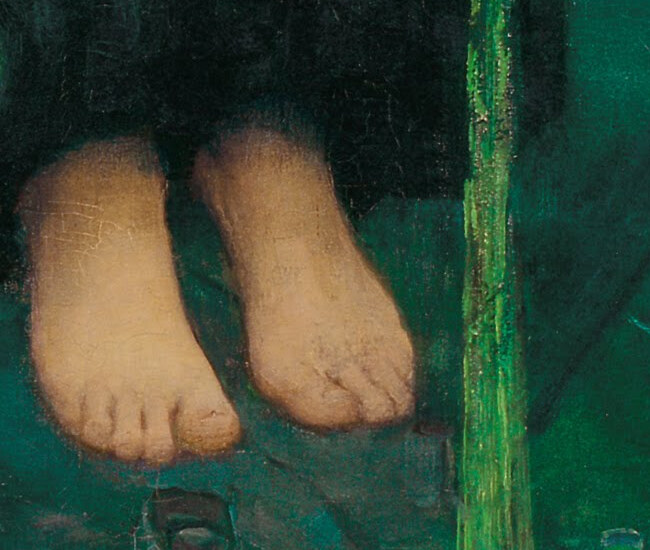
That is the detail Waterhouse kept. Circe stands in the middle of the sea, and her bare feet rest above the surface, on the water or on something dark just beneath it. She does not get wet. What she is about to do to the water is not meant for her.
Ovid describes the place exactly: a small, quiet bay curved like a bow, where Scylla came to rest in the heat of the day, when the sun was highest and the shadows shortest. Circe got there first.
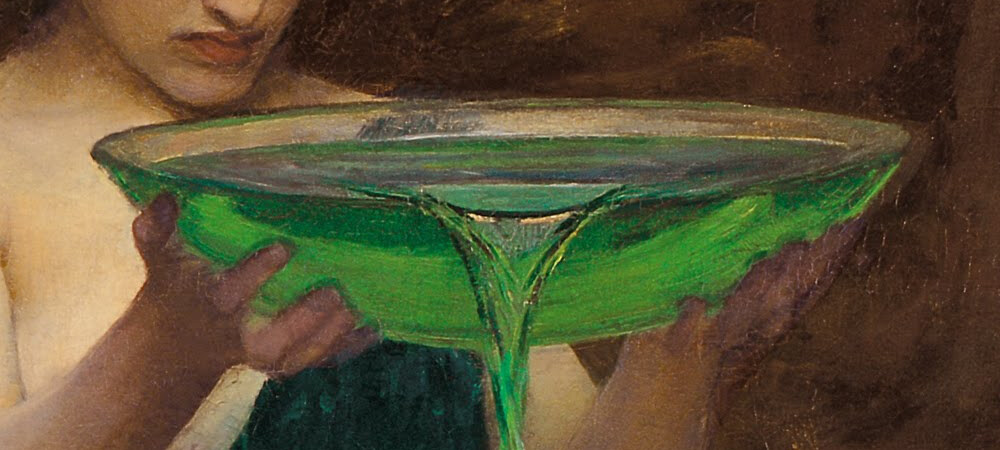
She fouls the pool before Scylla comes and stains it with monster-making poisons. She sprinkles juices pressed from a harmful root, and three times nine she murmurs a dark spell of strange words with her magic lips.
Ovid, Metamorphoses 14, our translation
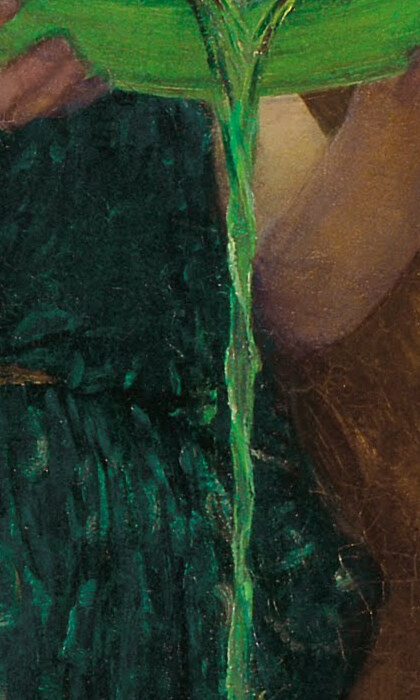
Waterhouse paints the poison as a single green thread running from the lip of the bowl all the way down the canvas, past her dress, into the sea. Follow it down. Where it lands, the water breaks into a crown of bubbles, and the green starts to spread.
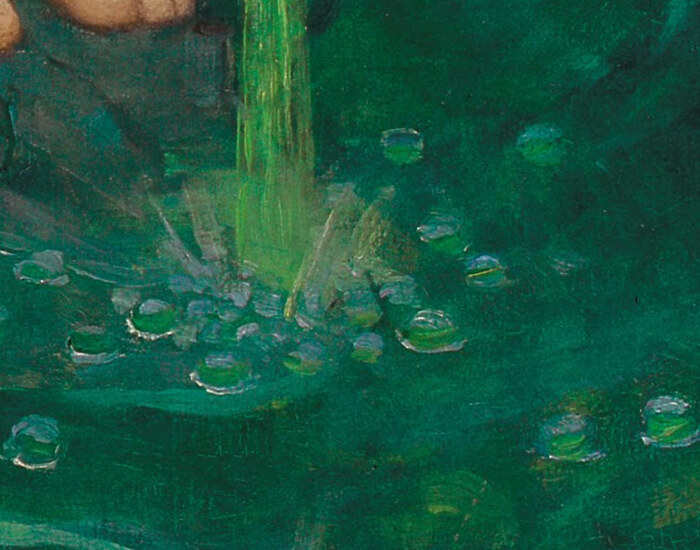
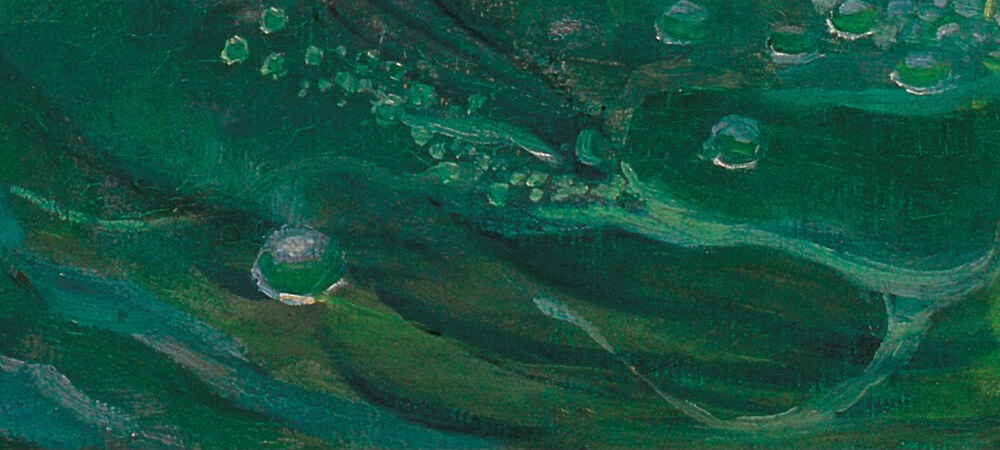
Now look at the bottom of the painting, where the water is darkest. Something is there. On the left, a spined fin cuts up out of the sea like the wing of a bat. On the right, a thick dark coil turns under the surface. These are not waves.
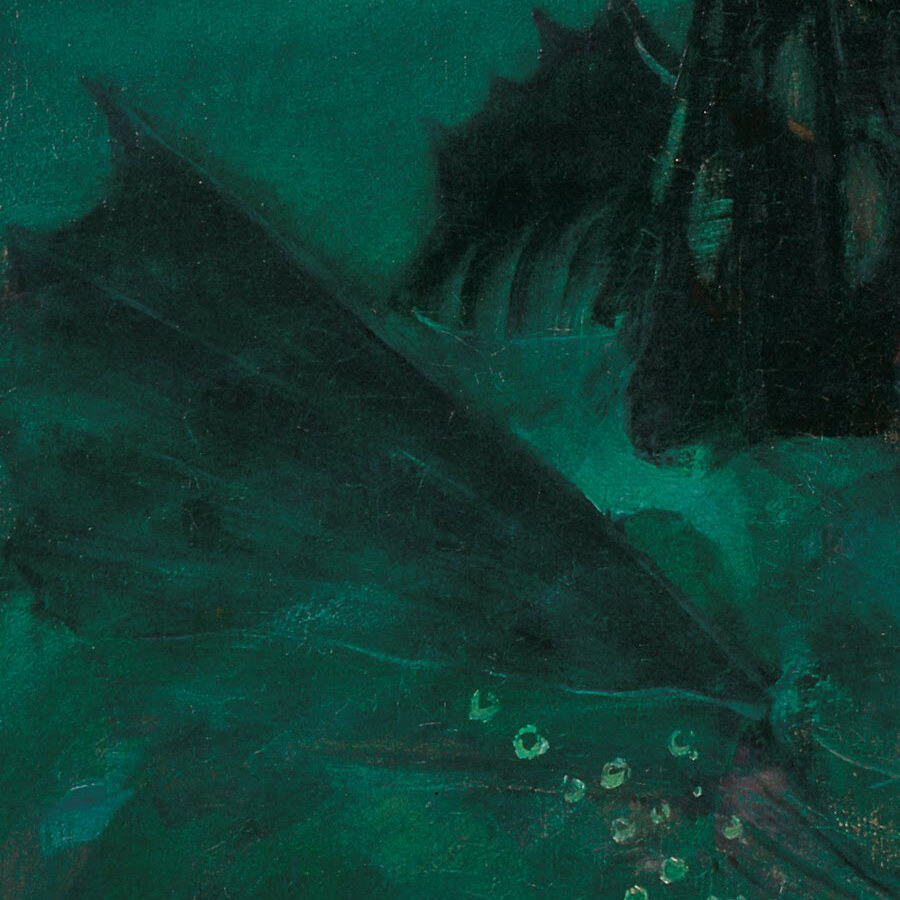
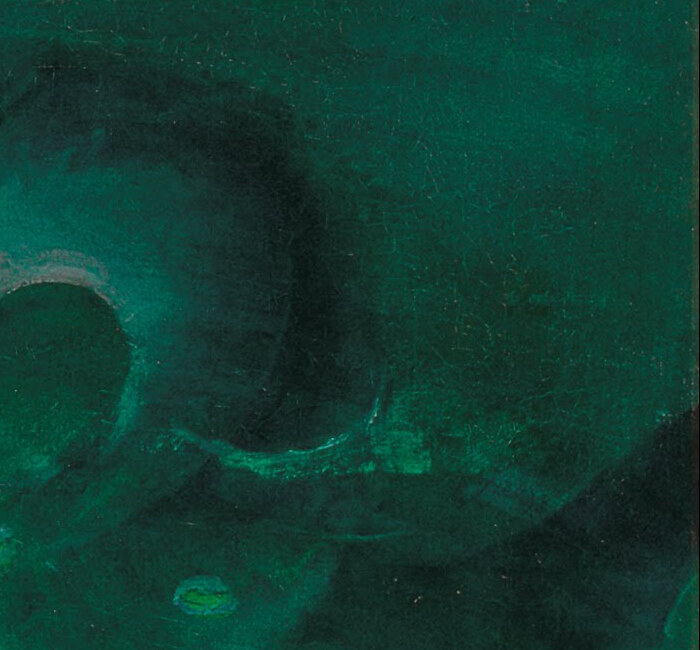
In Ovid, Scylla arrives, wades in up to her waist, and sees her body changing into a ring of barking dogs. She runs from them, and they run with her, because they are her. Waterhouse does not show any of that. There is no Scylla anywhere in the picture. The monster is only starting to take shape under the water, and the girl has not even arrived yet. Everything terrible is still a few minutes away.
Green is the colour of envy, and Waterhouse soaked the whole lower half of the canvas in it: the poison, the sea, the bubbles, the dress. Shakespeare had given jealousy its colour three centuries earlier:
O, beware, my lord, of jealousy;
William Shakespeare, Othello, Act 3, Scene 3
It is the green-eyed monster which doth mock
The meat it feeds on.
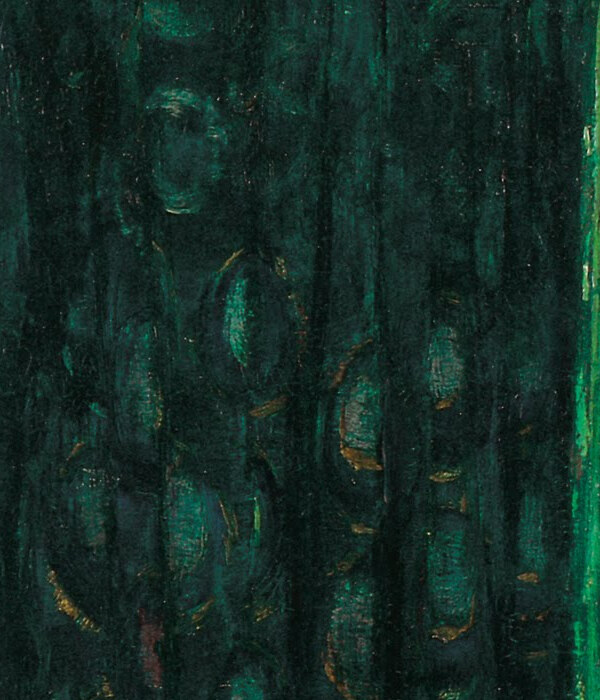
Look again at the dress. The pattern on it, gold-edged ovals on dark green, reads like peacock feathers, and peacock feathers are covered in eyes. The green-eyed monster, stitched into her clothes. And the canvas itself is tall and thin, more than twice as high as it is wide, so the eye has to travel all the way down from her face to the poison to the dark coils at the bottom, the same journey the envy makes.
Glaucus wept when he saw what had been done, and fled from Circe. Scylla stayed where she was, rooted to the spot, a monster ringed with barking dogs. But Ovid adds one last line that changes the whole story. Out of hatred for Circe, Scylla later took her revenge: when a ship came through the strait carrying the companions of Ulysses, she seized them.
Ulysses, the hero of the Odyssey, had been Circe's lover. So Circe's envy made a monster, and the monster came back for the men of the next man Circe loved.
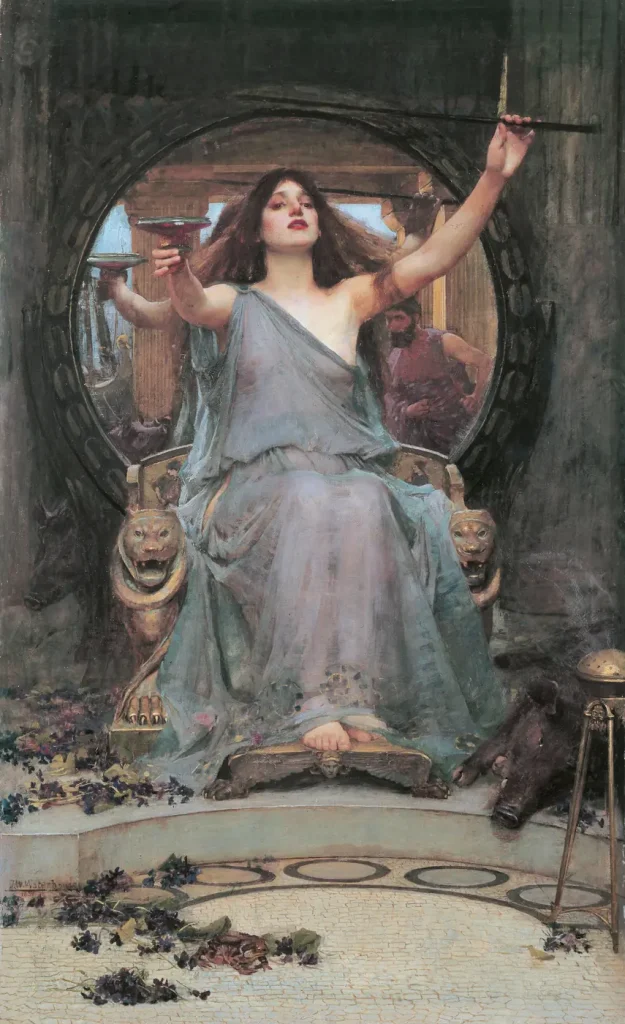
Waterhouse knew that story well. The year before, in 1891, he had painted Circe holding out her cup to Ulysses. Circe Invidiosa was his second Circe, and the darker one. In 1911 he returned to her a third time, in The Sorceress. You can follow the rest of the voyage in Circe, the Sirens and Calypso: The Odyssey in Paintings, Part 2.
Waterhouse painted Circe Invidiosa in London in 1892, and it was sold almost at once to a gallery on the other side of the world. The Art Gallery of South Australia bought it that year with a government grant, on the advice of three of the most powerful artists in Victorian London: Frederic Leighton, Edward Poynter and Hubert von Herkomer. It left Southampton on the steamship Orient in February 1893.
Adelaide already knew Waterhouse. In 1883 the gallery had bought his Favourites of the Emperor Honorius, the first Waterhouse to enter any public collection. But Circe was a harder sell. A newspaper review in 1893 said the new painting
repels rather than attracts the average sightseer.
The Daily Telegraph, 1893, quoted by the Art Gallery of South Australia
Today it is one of the most loved and most copied pictures in the gallery.
Circe Invidiosa hangs in the Art Gallery of South Australia in Adelaide. It is oil on canvas, 180.7 by 87.4 centimetres, signed and dated lower right: J.W. Waterhouse / 1892.
We paint Circe Invidiosa by hand in oil on canvas, in its tall format, with the glowing green poison, the feather-patterned dress and the dark shapes under the water. See the hand-painted reproduction.
Enjoyed this story?
Save articles to your collection
Log in or create a free account, and this article will be waiting in your Private Collection.
Log in or sign upA note from the studio
Our studio is working through an exceptional number of commissions, so we have paused new orders for a short time. We will start taking orders again on 1 October.
Every painting is made entirely by hand, and we would rather pause than rush one. Thank you for your patience and your trust.
Leave your details and we will reserve your place: we will write to you as soon as orders reopen.
Thank you
Your request is saved. We will write to you on 1 October, and a confirmation is on its way to your inbox.