Loading cart…
No products in the cart.

1888 · Oil on canvas · Tate Britain, London, United Kingdom
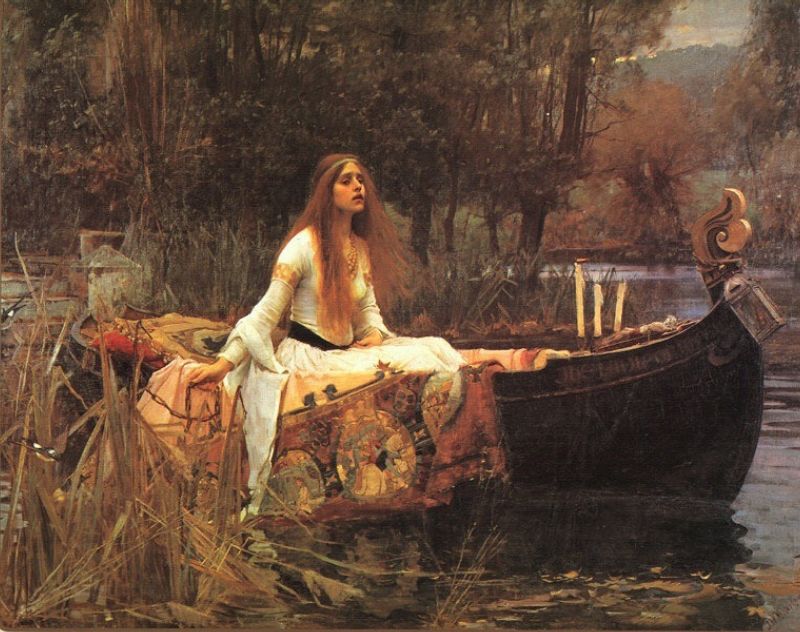
The Lady of Shalott was exhibited at the Royal Academy in 1888, the same year it was acquired by Henry Tate, whose collection would form the foundation of what is now Tate Britain. The painting was based on the celebrated poem of the same name by Alfred Lord Tennyson, first published in 1832 and substantially revised in 1842. By the 1880s the poem had become one of the most beloved literary works in Victorian England, and Waterhouse was not the first artist to respond to it. However, his interpretation differed significantly from those of his predecessors. Where earlier artists such as William Holman Hunt had focused on the moment of the curse itself, Waterhouse chose instead to depict the lady already in her boat, the tapestry unraveling around her, the candles at the prow already lit. This is the point of no return, the moment after the fatal decision has been made, and it is charged with quiet drama. Waterhouse worked the composition carefully, integrating the figure of the lady into a landscape that feels at once autumnal and timeless. The reed-lined river, the falling leaves, and the receding spires of Camelot in the background were all conceived as part of a single emotional environment. The painting was an immediate success and established Waterhouse among the leading figure painters of the Royal Academy. He returned to the subject twice more, in 1894 and 1915, demonstrating the depth of his investment in the story and its central figure.
The composition of The Lady of Shalott is organized around the central figure of the lady herself, whose pale form and flowing white dress create a luminous focal point within the warmer, darker tones of the surrounding river and foliage. Waterhouse positioned her slightly off-center, seated in the boat with her body turned so that she faces the viewer while her gaze drifts somewhere just past the picture plane. This subtle displacement gives the figure a quality of interior absorption, as though she is already partly elsewhere. The tapestry threads that trail from her hands and pool in the water around the boat function as a compositional device that links the figure to her environment, binding her to the surface of the painting even as the narrative implies she is moving beyond it. The three candles at the prow of the boat are a detail of particular compositional ingenuity: two have been extinguished by the movement of the boat through the water, while the third still burns, introducing a note of fragile persistence into a scene otherwise defined by loss and release. The treatment of the water is especially accomplished, with long reflective strokes suggesting both stillness and slow movement. Waterhouse balanced the warm red of the woven cloth against the cool silver-green of the water and reeds, creating a color tension that carries emotional weight. This is a painting that rewards sustained attention, and owning this as a hand-painted oil reproduction brings that sustained attention into everyday life in a deeply personal way.
The figure of the Lady of Shalott carries a cluster of meanings that were particularly resonant for Victorian audiences and that have continued to generate interpretation in the decades since. In the Tennyson poem, the lady is cursed to weave continuously and to view the outside world only through a mirror, never directly. When she sees the reflection of Sir Lancelot and turns to look at him, the mirror cracks and the curse begins its work. Waterhouse chose not to depict either the moment of temptation or the moment of death, but rather the interval between them, the threshold moment in which the lady has accepted her fate but not yet encountered it. This choice gives the painting a psychological complexity that distinguishes it from more dramatic narrative approaches. The lady does not appear terrified or despairing. She is calm, self-possessed, and inward, a figure who has moved beyond the struggle and into a kind of tragic acceptance. For Victorian viewers, the painting engaged with urgent contemporary debates about the constraints placed upon women and the tension between social obligation and individual desire. The lady weaving in her tower was an easy metaphor for the domestic confinement of women in Victorian England, and her fatal act of looking outward resonated as a gesture of defiance as much as of self-destruction. For contemporary audiences, the painting continues to speak to questions of agency, sacrifice, and the cost of stepping beyond the boundaries that society assigns. It is among the most culturally layered works of the Victorian era, and owning this as a hand-painted oil reproduction is to bring one of the defining images of that period directly into your space.