Loading cart…
No products in the cart.

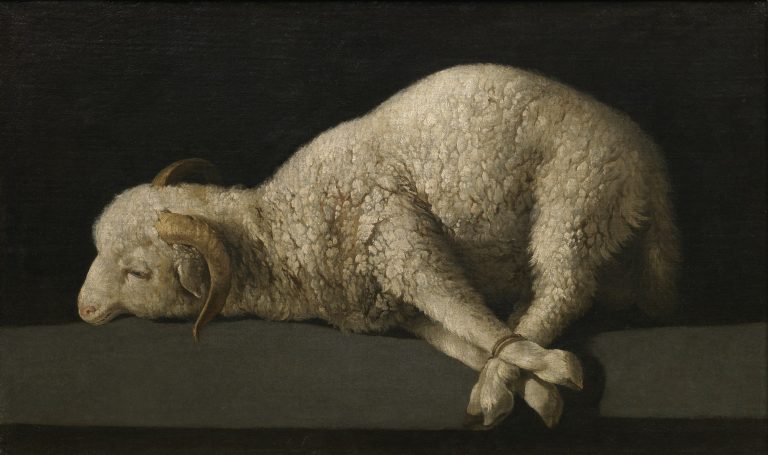
c. 1635-1640 · Oil on canvas · Museo del Prado, Madrid
Save articles to your collection
Log in or create a free account, and this article will be waiting in your Private Collection.
Log in or sign upA young lamb lies on a grey stone ledge against a dark background, its four legs tied together with a cord. Its head rests on the stone, its eyes are half closed, and the light falls on its thick white fleece. That is all. There is no shepherd, no altar, no landscape and no blood.
The title is Latin for "Lamb of God". It comes from the words of John the Baptist in the Gospel of John, when he sees Jesus coming towards him: "Behold the Lamb of God, which taketh away the sin of the world." For Christians the lamb stands for Christ, who accepts his death the way a sacrificial lamb goes quietly to the altar. Zurbarán paints the symbol and nothing else, and lets the animal itself carry the whole meaning.
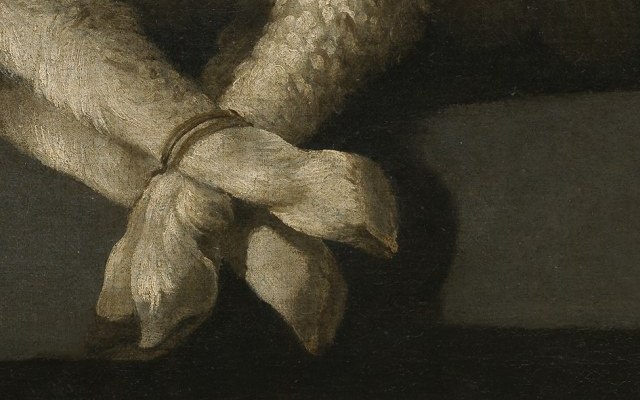
Because this is a lamb ready for sacrifice. In ancient Jewish ritual, and in the farms of seventeenth-century Spain, a lamb was bound by its legs before it was killed. The cord turns a sleeping animal into a victim, and tells anyone who knew the Bible exactly what they are looking at.
Zurbarán places the bound feet at the front edge of the stone, nearest to us, where we cannot miss them. They are the only sign of violence in the whole picture, and he paints them with the same care as the wool.
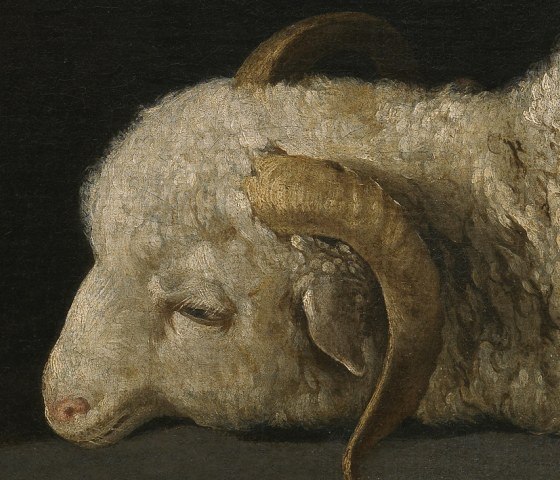
Look at the face. The lamb is not afraid and not struggling. Its eyes are half closed and its head lies on the stone as if it were asleep. This calm is the heart of the painting. The Bible describes Christ going to his death "as a lamb to the slaughter" without resistance, and Zurbarán gives the animal exactly that quiet acceptance.
The lamb also has small curling horns, the beginnings of a young ram's horns, painted in a warm golden colour against the white fleece.
What you can see, and what is interpretation: the bound legs, the stone ledge and the calm, half-closed eyes are all in the painting. The reading of the lamb as Christ comes from the title and from Christian tradition, which every viewer in Zurbarán's Spain would have shared. Whether the stone is meant as an altar is less certain: it is never shaped as one.
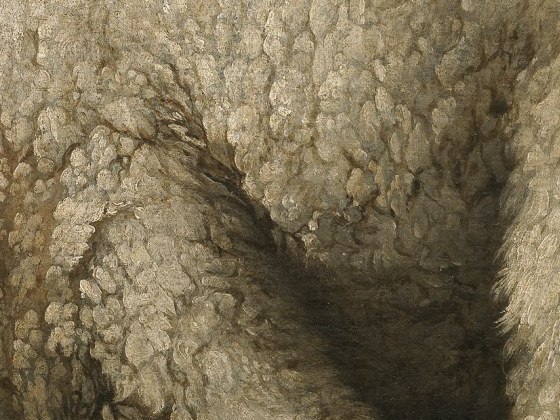
Up close, the fleece is a field of tiny curls, each one a small stroke of thick white and cream paint, with greyer touches in the shadows and warmer ones where the light falls. The paint itself has texture, so that the wool almost seems soft to the touch. It is the same mastery of white that made Zurbarán famous for the habits of his monks.
Against it, the background is almost black and the ledge is a flat grey. The contrast makes the lamb seem to glow, and it is one reason the painting feels so much larger than it is. It is in fact quite small, about the size of a sheet of newspaper.
Zurbarán and his workshop painted the bound lamb several times, and around half a dozen versions are known. Some include a halo and a Latin inscription, which make the religious meaning explicit. The version in the Prado has neither. It is the simplest of them, and for many people the most moving, because it trusts the viewer to understand.
The painting has become one of the most famous animal images in European art. It shows how Zurbarán could turn the plainest subject, a lamb on a stone, into something close to a prayer.
Read more about the painter and his other masterpieces in our guide to Francisco de Zurbarán.
This version of Agnus Dei is in the Museo del Prado in Madrid. It is oil on canvas, 37.3 by 62 centimetres, painted around 1635 to 1640.
We paint Agnus Dei by hand in oil on canvas, at the original size or larger, with the white fleece built up in thick strokes the way Zurbarán built it. See the hand-painted reproduction.
Enjoyed this story?
Save articles to your collection
Log in or create a free account, and this article will be waiting in your Private Collection.
Log in or sign upWhat can be seen in the painting, what is documented, and what is interpretation are kept separate throughout this article.