Loading cart…
No products in the cart.

c. 1894 · Oil on paper mounted on board · Courtauld Gallery, London, United Kingdom
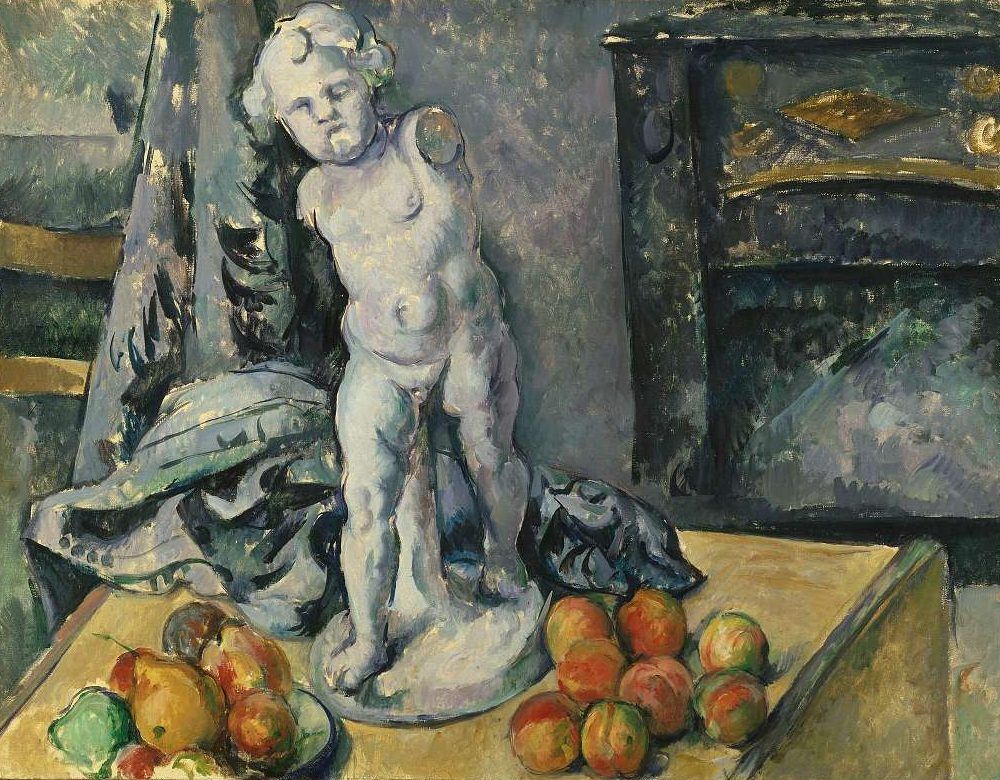
Still Life with Plaster Cupid is among the most intellectually provocative works Cezanne produced in the 1890s, a decade that saw his painting achieve a new level of formal and conceptual ambition. The plaster cast of a cupid that anchors the composition is believed to have been kept in his studio and appears in at least one other of his paintings. The work is held at the Courtauld Gallery in London, which possesses one of the finest collections of Impressionist and Post-Impressionist paintings in the world, assembled largely through the philanthropy of Samuel Courtauld in the early twentieth century. Courtauld was among the first major British collectors to recognize the significance of Cezanne and acquired several key works that shaped how his reputation developed in Britain. The painting was produced during a period in which Cezanne was working intensively at his studio in Aix-en-Provence, surrounded by the accumulated objects, casts, and canvases that furnished his working environment. By incorporating a painted canvas within the composition, visible in the background of the work, he created a layered pictorial space that plays with different orders of representation simultaneously. This kind of self-referential complexity was relatively unusual in still life painting before Cezanne, and it would become a significant point of departure for Cubist and later Modernist approaches to the relationship between representation and reality. The Courtauld holding has ensured that this work has been consistently available to scholars and students, making it one of the better documented of his studio still lifes.
The composition is built around the white plaster cupid, which occupies the upper center of the picture and is surrounded by a carefully arranged group of fruits, onions, and a folded cloth in the lower portion of the canvas. Behind the cupid, a painted canvas is visible, and within that painted canvas another arrangement of forms can be partially discerned, creating a vertiginous layering of representational spaces. The floor on which the objects rest tilts upward in defiance of conventional perspective, so that the apples and onions appear to advance toward the viewer rather than receding naturally into pictorial depth. Cezanne treats the surfaces of the plaster cupid and the real fruits with a similarly complex handling of color, using reflected tones from neighboring objects to enliven what might otherwise be dead white plaster. The cupid takes on touches of green, blue, and warm ochre from its surroundings, becoming part of the overall chromatic dialogue rather than a neutral anchor within it. The cloth beneath the fruits is rendered with loose, rhythmic strokes that suggest fabric folds without laboring over their precise description. The overall organization of the composition demonstrates Cezanne's method of building a coherent pictorial structure from multiple simultaneous viewpoints, a practice that disrupts spatial unity while creating a different kind of visual wholeness based on chromatic and structural relationships.
The introduction of a plaster cast into a still life arrangement opens up a set of reflections on the nature of representation that are central to understanding Cezanne's intellectual ambitions as a painter. The plaster cupid is itself a copy, a cast taken from a sculptural original, and by placing it alongside real fruits and within a painted image, Cezanne creates a chain of representations in which the boundaries between original and copy, between real object and pictorial sign, become productively blurred. This is not merely a formal game but a serious meditation on what it means to make an image and on the relationship between the visual world and its pictorial reconstruction. The presence of the canvas within the canvas reinforces this dimension of the work by making the act of painting itself visible as a theme. The viewer is invited to think about the process of representation rather than simply consuming its product, to notice how the same plaster object appears differently depending on whether it is seen directly or rendered in paint, and to consider what is gained and lost in each transformation. For Cezanne, who spoke repeatedly of the difficulty of realizing his sensations in paint, this reflexive dimension was not incidental to the work but was bound up with his deepest concerns about the relationship between visual experience and pictorial form. The painting thus stands as one of his most philosophically alert works, a still life that thinks about what still life painting is and what it can do.