Loading cart…
No products in the cart.

c. 1886-1890 · Oil on canvas · National Gallery of Art, Washington D.C., USA
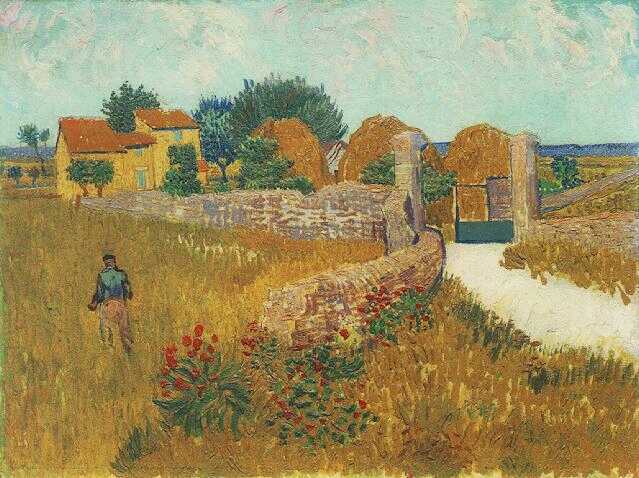
Cezanne spent much of his adult life in and around Aix-en-Provence, the town where he was born in 1839, and the landscapes of that region provided him with an enduring source of pictorial investigation. House in Provence belongs to a group of works in which he focused on the built environment as it existed within the broader natural landscape, treating farmhouses, walls, and stone structures as geometric forms in dialogue with trees, hills, and sky. The National Gallery of Art in Washington holds this canvas as one of the stronger examples of his mid-period landscape practice, when his technique was becoming increasingly systematic.
The painting was produced during a period of significant personal and professional transition for Cezanne. His father had died in 1886, leaving him financially comfortable and free to pursue his painting without the commercial pressures that had troubled him in earlier years. This stability allowed him to work with greater consistency in the Provencal countryside, developing the analytical approach to landscape that would become his most influential contribution to modern painting. The work was later acquired as part of the broader institutional effort in the twentieth century to recognize Post-Impressionism as a foundational movement in the history of art, and the National Gallery holding reflects its importance within that critical reassessment.
The composition is organized around a strong horizontal axis anchored by the house at its center, with flanking vegetation and a receding path that draw the eye inward toward the built structure. Cezanne does not use conventional one-point perspective to create depth but instead stacks planes of color one above another, suggesting recession through tonal and chromatic shifts rather than through diminishing scale. The result is a landscape that feels simultaneously flat and deep, structured and vibrant. The rooftops are rendered in warm orange-red tones that contrast sharply with the cool greens of surrounding trees, making the house assert itself as a solid geometric presence.
The handling of foliage in this work is particularly revealing of Cezanne's method. Rather than painting individual leaves or branches, he builds up the mass of each tree through interlocking patches of green, yellow, and ochre that read collectively as volume and texture. Each brushstroke is directional and deliberate, contributing to a larger patchwork of marks that define form through accumulation. This technique, sometimes referred to by later critics as his constructive stroke, gives the surface of the painting a rhythmic quality that is both systematic and expressive. The sky is treated with equal economy, using pale blue and white tones that hold the upper register of the composition in quiet balance with the more active lower half.
The presence of a house within a natural landscape carries a set of meanings in Cezanne's work that are deeply connected to his sense of place and permanence. For him, the architecture of Provence was not merely incidental to the landscape but was part of its essential character, shaped by the same geological and climatic forces that formed the hills and valleys around it. By treating the house as one geometric form among others, he implies a continuity between human construction and natural formation that dissolves the conventional hierarchy placing culture above nature.
There is also a contemplative dimension to this painting that invites reflection on the relationship between observation and understanding. Cezanne famously spoke of wanting to redo nature according to the cylinder, the sphere, and the cone, and works like this one demonstrate how that ambition operated not as an abstraction but as a lived visual practice carried out in front of actual landscapes. The painting asks the viewer to slow down and see the world as an arrangement of underlying forms, to look past surface appearances toward the structural logic that Cezanne believed governed all visual experience. This commitment to a deeper order beneath appearances gave his landscapes a meditative quality that resonated strongly with later generations of painters and critics.