Loading cart…
No products in the cart.

Art Guides · Scary Paintings
Some paintings are famous because they are beautiful. These are famous because people cannot stop looking at them and wish they could. We ranked the fifteen scary paintings that people search for most, from Goya's cannibal god to a flea's ghost, and for each one we tell you what you are looking at, why it was painted, and where it hangs. Every one is available as a hand-painted reproduction, if you are that kind of person.
For the full experience, with candles, walk our Haunted Gallery, where these and thirty more hang in the dark.

The most searched frightening painting in the world was never meant to be seen. Goya, seventy-three, deaf and living alone in a farmhouse outside Madrid, painted it directly on the plaster of his dining room, along with thirteen other pictures that are now called the Black Paintings. Nobody commissioned them and he never mentioned them. They were cut off the walls fifty years after he died.
The subject is the old myth of the god who ate his children so that none could overthrow him, and Rubens had painted it a century earlier with a plump baby and a sorrowful god. Goya's Saturn is a giant with mad eyes crouched in the dark, already halfway through the body, which has no head. The horror is not the eating. It is his face, which looks caught.
Read the full story of Saturn Devouring His Son · hand-painted reproduction
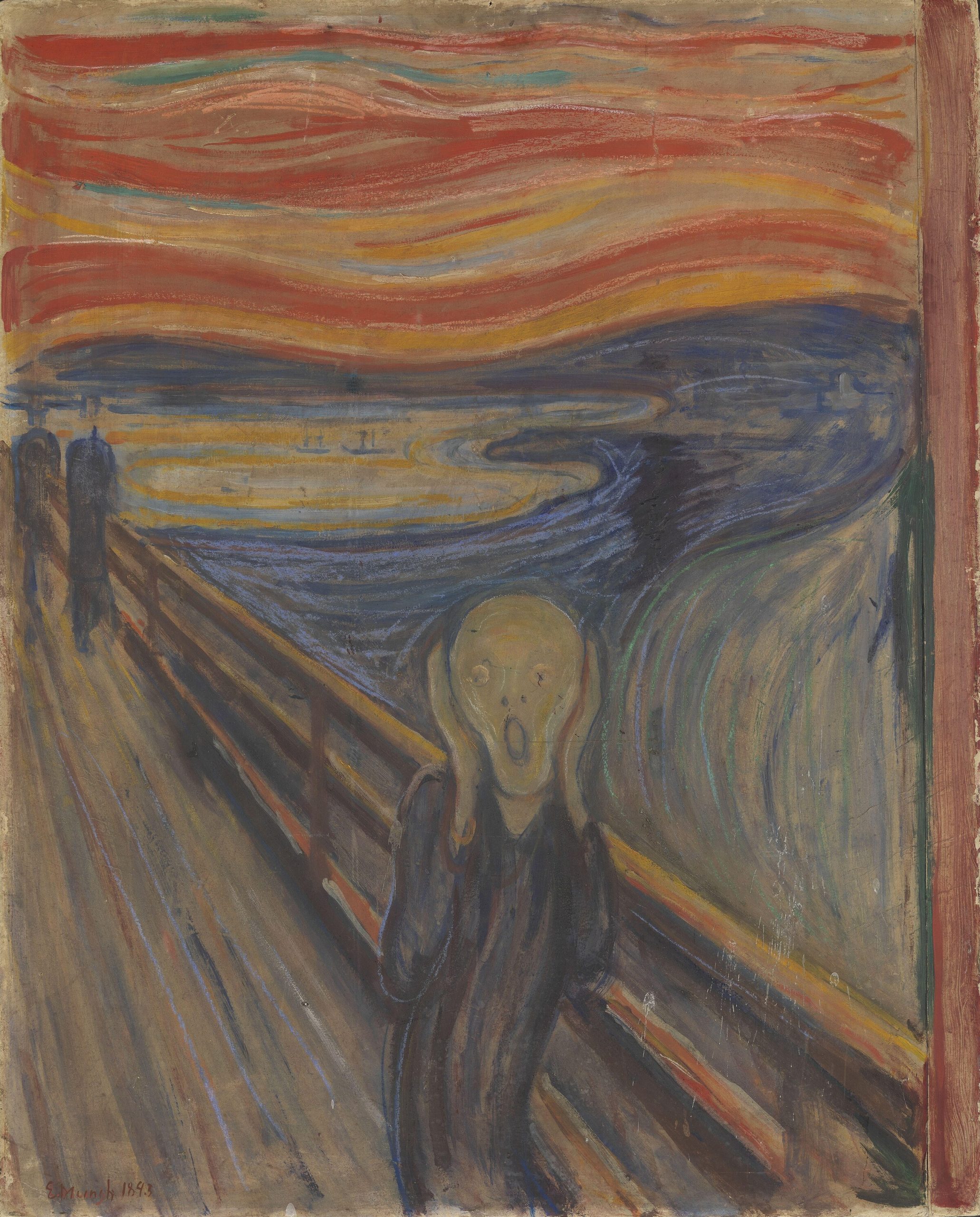
Munch wrote down where it came from: a walk above Oslo with two friends at sunset, when the sky turned red and he felt, in his words, a great scream pass through nature. The figure on the bridge is not screaming. It has its hands over its ears. The friends walk on.
It has been stolen twice, once on the morning the 1994 Winter Olympics opened, and a pencil line in the sky reads could only have been painted by a madman; in 2021 the museum confirmed Munch wrote it himself. It is also the only painting on this list that is an emoji.
Read the full story of The Scream · hand-painted reproduction
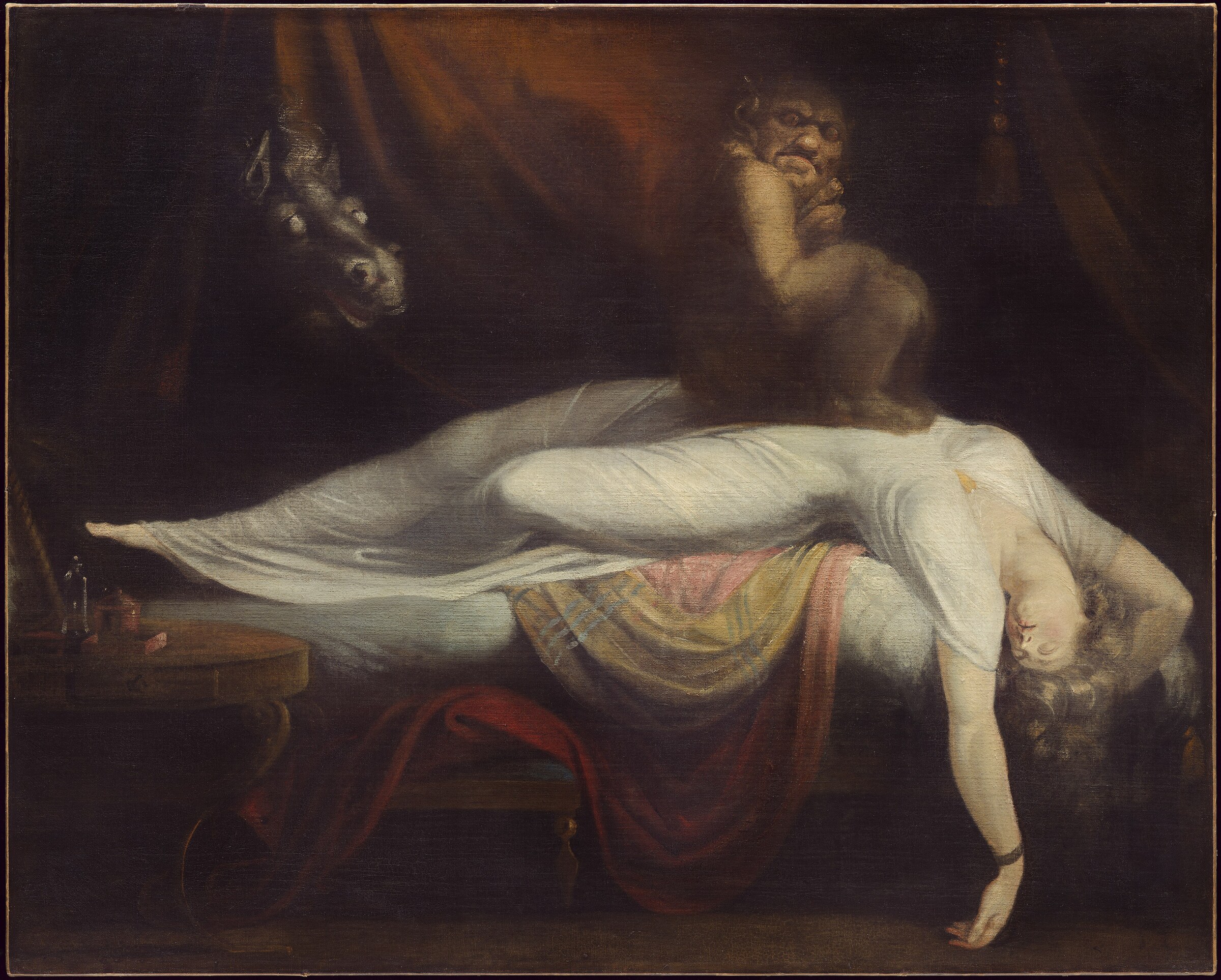
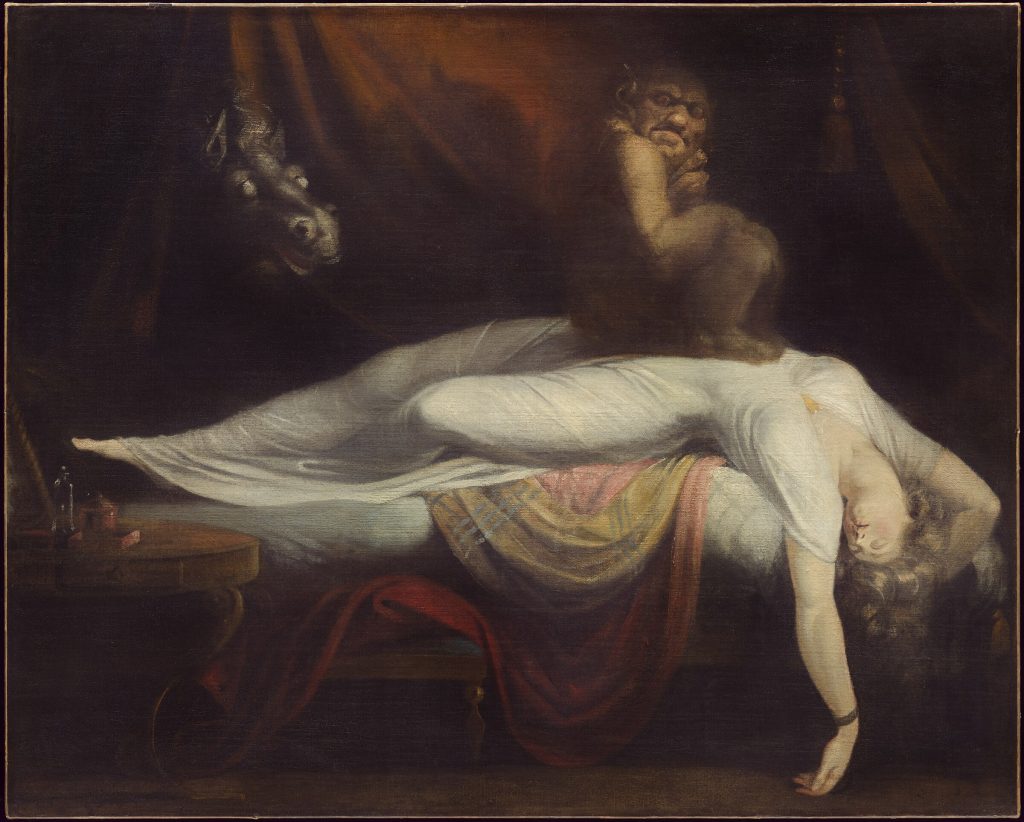
A woman asleep across a bed, a squat demon sitting on her chest, and a horse with white eyes pushing through the curtain. Fuseli invented the scene from folklore about the incubus, the creature that sat on sleepers and gave them what we now call sleep paralysis, and added the horse for no reason anyone has explained.
It shocked the Royal Academy in 1782, sold in thousands as an engraving, and a copy of the print hung in Freud's flat in Vienna. It is the first great painting of a bad dream and the source of most of the ones since.
Read the full story of The Nightmare · hand-painted reproduction

Three panels: Eden, a garden of naked people and giant fruit, and hell. The hell panel is what makes this a scary painting. A bird-headed creature on a throne swallows sinners and passes them out below; a man is crucified on a harp; a pair of enormous ears advances with a knife between them; and in the middle a pale figure with a tree for legs and a broken egg for a body turns to look at you, and is generally thought to be Bosch himself.
Nobody knows what it was for. It hung in a nobleman's palace in Brussels, where visitors described it with a mixture of delight and alarm, and it has been doing the same to visitors to the Prado ever since.
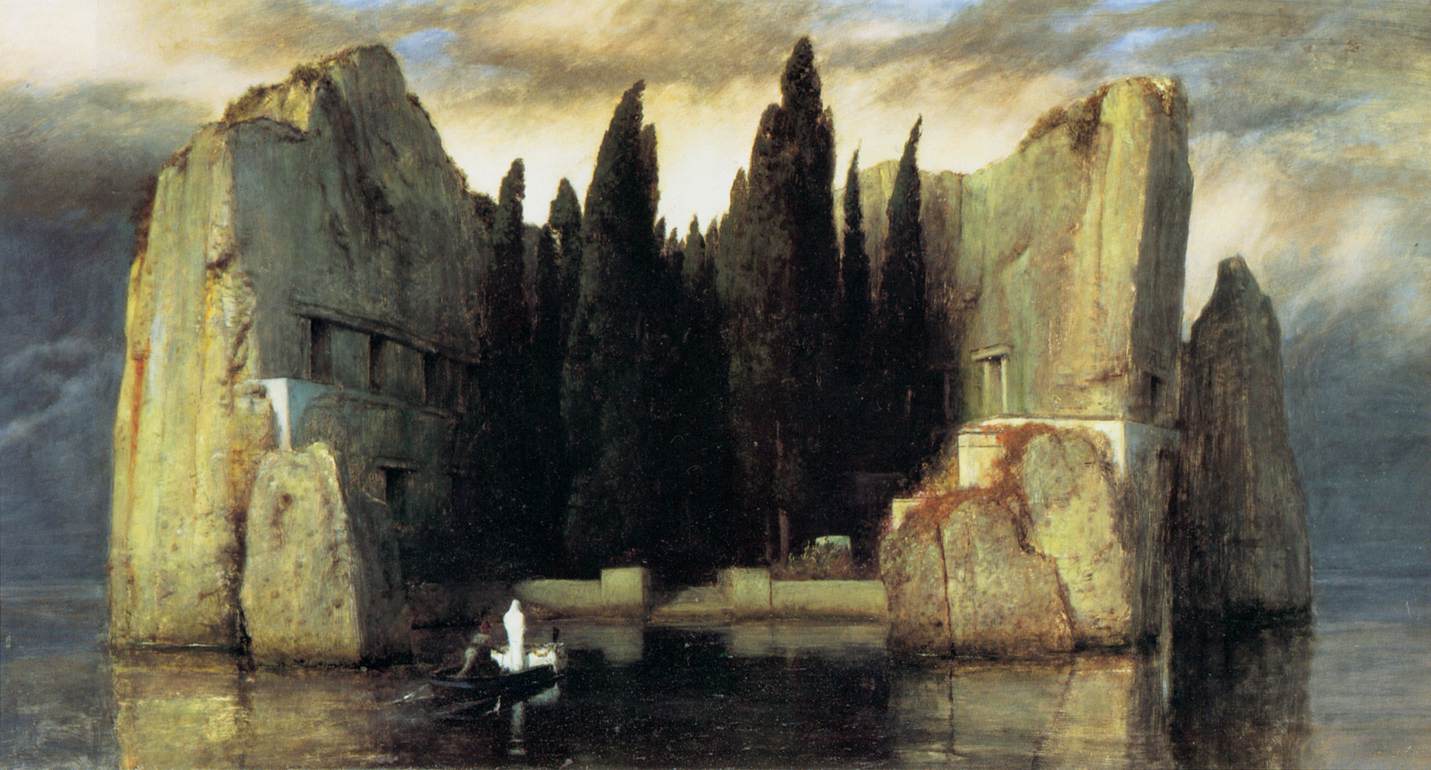
A small boat approaches a rock island in still water. In the boat, a coffin and a figure in white. On the island, cypresses and doors cut into the cliff. Böcklin called it a picture for dreaming over and painted it five times for five buyers; one version hung in Hitler's office, Freud had a print, and Rachmaninoff wrote a symphonic poem about it.
There is nothing violent in it and it is one of the most unsettling images in European art, because it is entirely silent. It is the picture of arriving somewhere you do not come back from.
Read the full story of Isle of the Dead · hand-painted reproduction
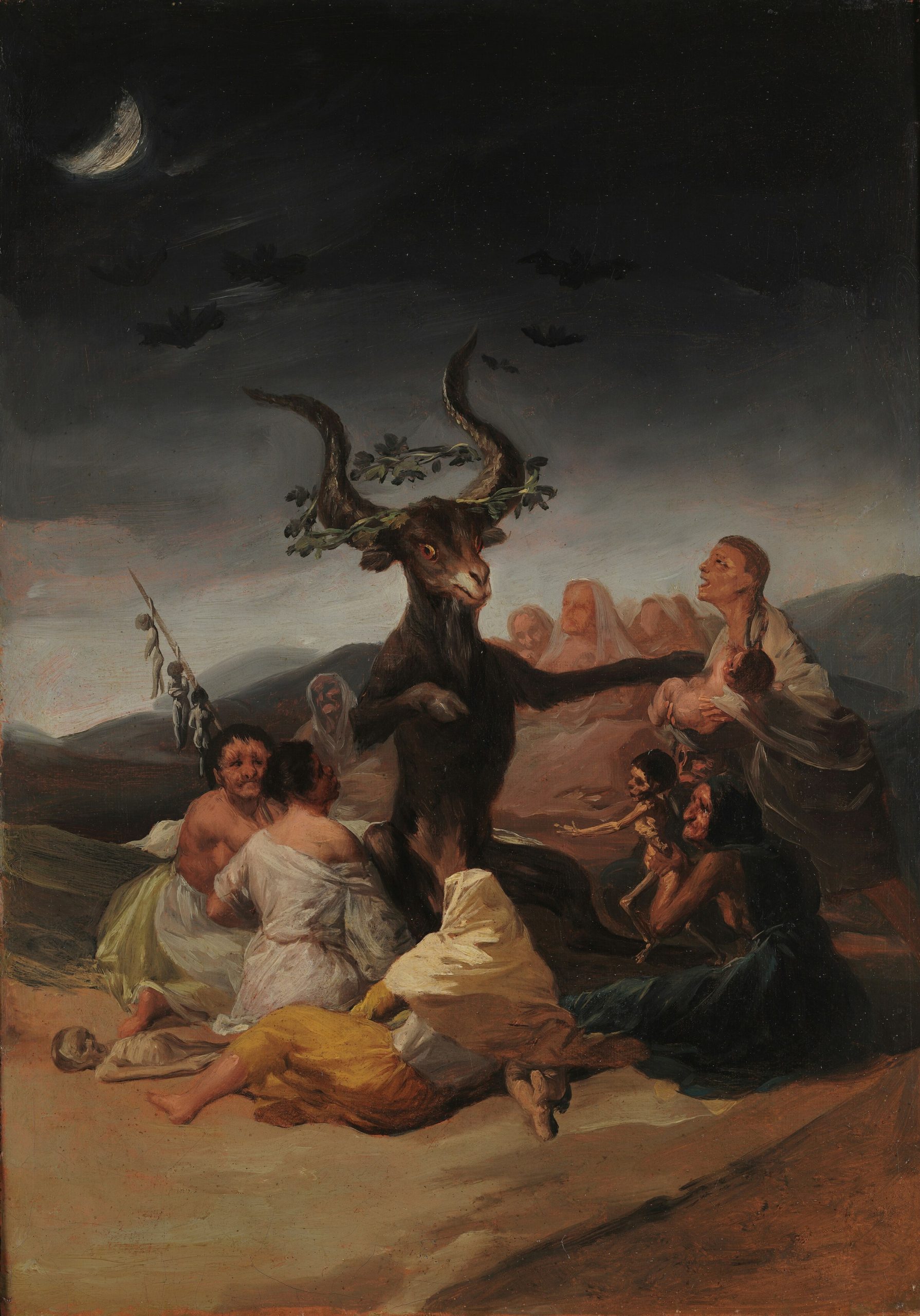
Twenty years before the Black Paintings, Goya painted six small scenes of witchcraft for a duchess's country house, as an educated joke about country superstition. This is the one that stopped being a joke: the Devil as a huge black goat with vine leaves in his horns, a young woman holding up her plump baby to him, an old one holding up a starved one, and on a stick at the left, the babies from last time.
The witches are not hags. They are the ordinary women of Goya's Madrid, sitting in a circle on a hillside under a crescent moon, and that is the point he was making about who the Inquisition burned.
Read the full story of Witches' Sabbath · hand-painted reproduction
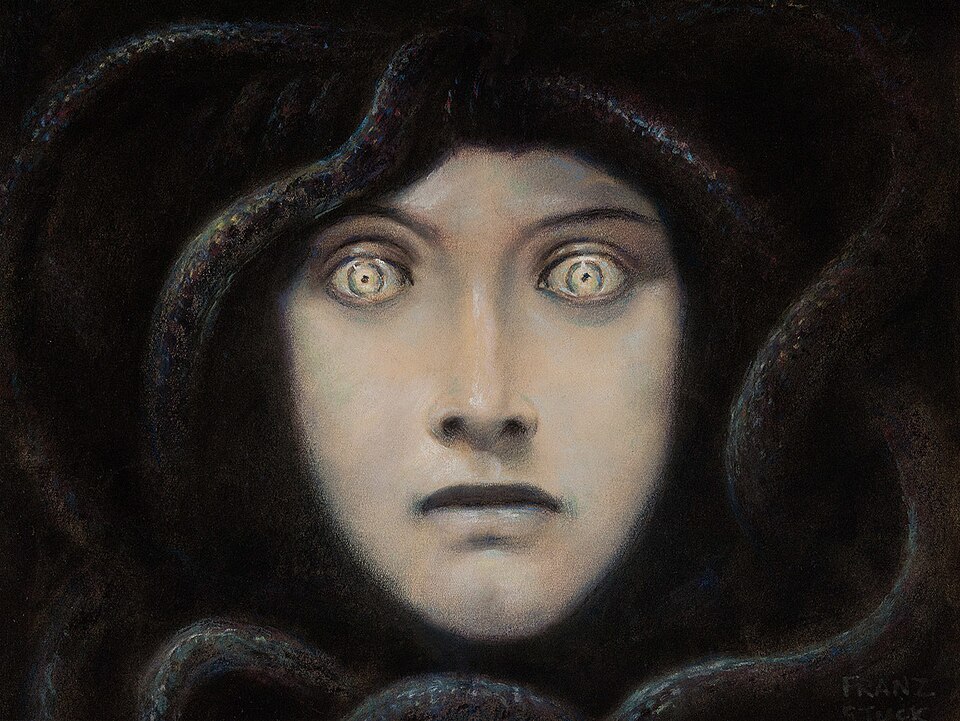
Caravaggio painted Medusa screaming on a shield; Rubens painted her severed head crawling with snakes; Franz von Stuck, the great Symbolist of Munich, painted only her eyes. A pale face with snakes for hair, lit from below, looking straight out of the panel at whoever stands in front of it. In the story, meeting that look turns you to stone.
It is one of the most direct frightening images in painting because it does nothing except look back. Stuck sold versions of it for years to people who wanted exactly that on their wall.

An army of skeletons has come over the hill and is killing everyone: the king with his gold, the cardinal, the soldier, the peasant, the lovers with their lute who have not noticed yet. Ships burn, bells ring, and the living are driven into a huge box with a coffin lid for a door. Bruegel painted the medieval Dance of Death as a battle, with the dead winning.
It is the great picture of catastrophe, painted under the shadow of plague and religious war, and it has been borrowed by everyone from Bosch's heirs to heavy metal album covers. It is also, in a way nobody quite likes to admit, fun.
Read the full story of The Triumph of Death · hand-painted reproduction
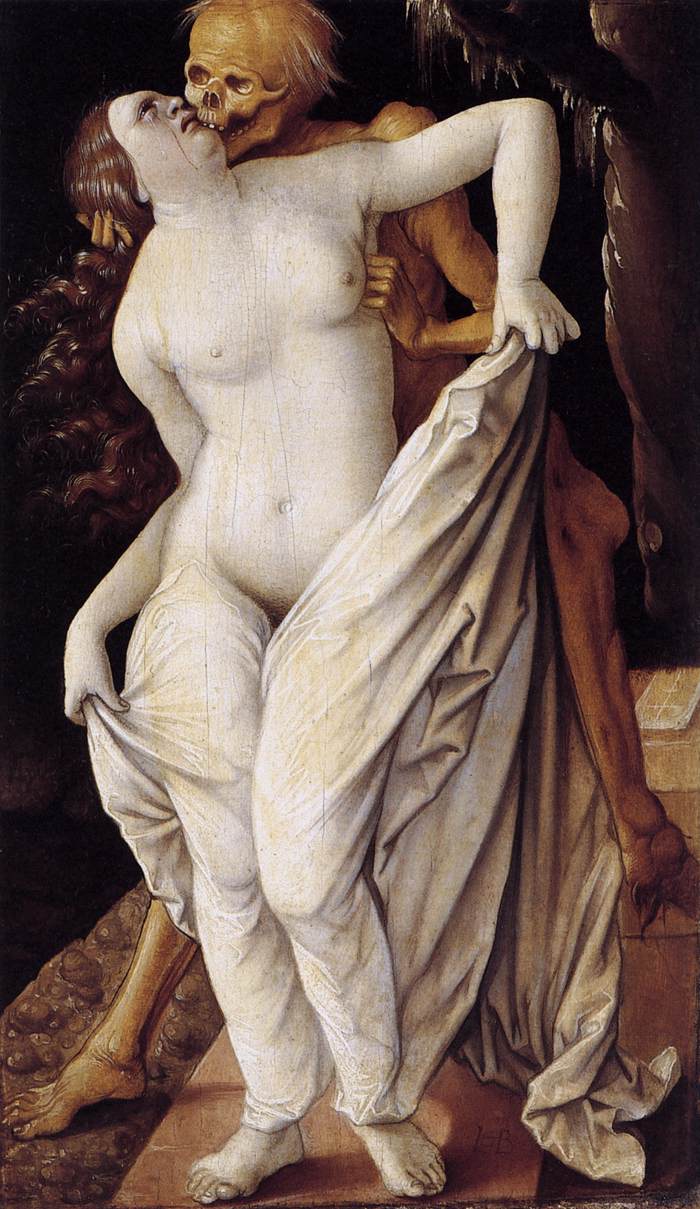
A young woman, naked, with a corpse behind her holding her by the hair and pointing down at the open grave. She is not fighting. Baldung, a pupil of Dürer, painted the subject again and again for buyers in Strasbourg who wanted beauty and death in the same frame, and this is the most brutal of them.
Five hundred years later it is the source of a whole tradition, from Schubert's quartet to Schiele's painting, and of the way horror films pair the girl and the monster.
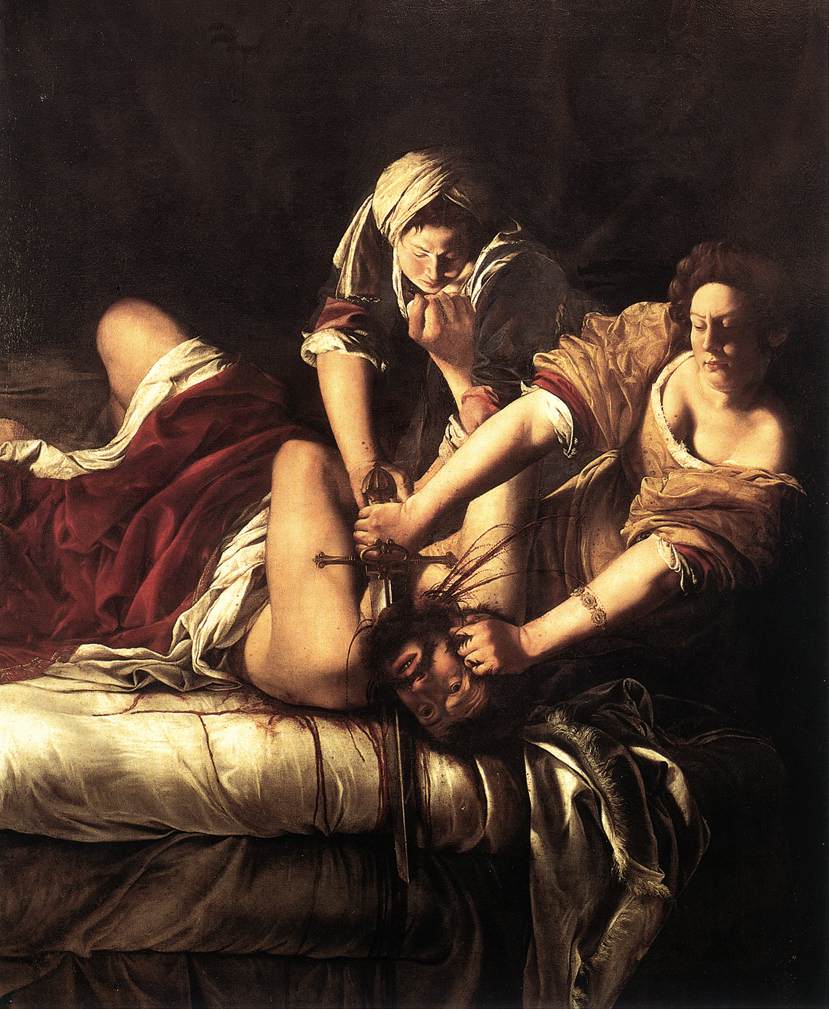
Caravaggio painted Judith cutting off the general's head as if she were slightly disgusted by it. Artemisia, who had been raped by her teacher and put through a public trial in which she was tortured to test her evidence, painted it as work: two women holding a man down and sawing, with the blood running in lines down the sheet. Judith has her face. Holofernes, it is usually said, has her teacher's.
The Uffizi hung it in a dark corner for centuries because visitors complained. It is now one of the most visited paintings in the building.
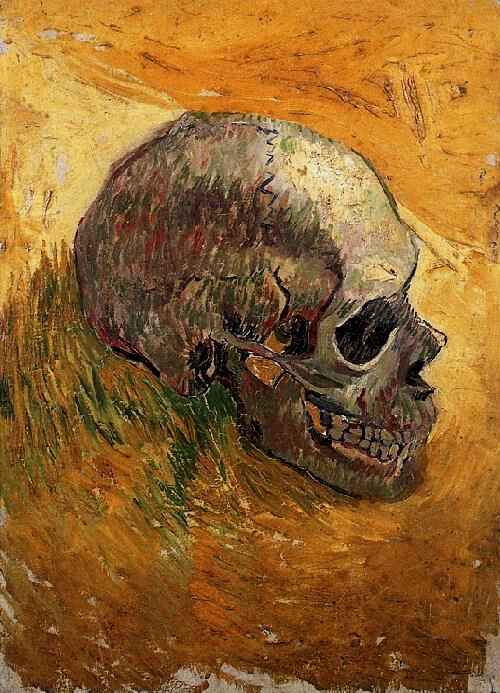
Van Gogh painted two skulls in Paris in 1887, as exercises, in the same thick, bright strokes he was using for flowers and self-portraits. The famous one has a lit cigarette in its teeth and was painted a year earlier in Antwerp as a joke at the academy's expense. This one is plainer and stranger: a skull treated like a face, with the same care.
The skull on the table is the oldest device in painting, the memento mori that told the buyer they would die. Van Gogh, who would die three years later, painted his with no table and no moral, just the object, looking back.
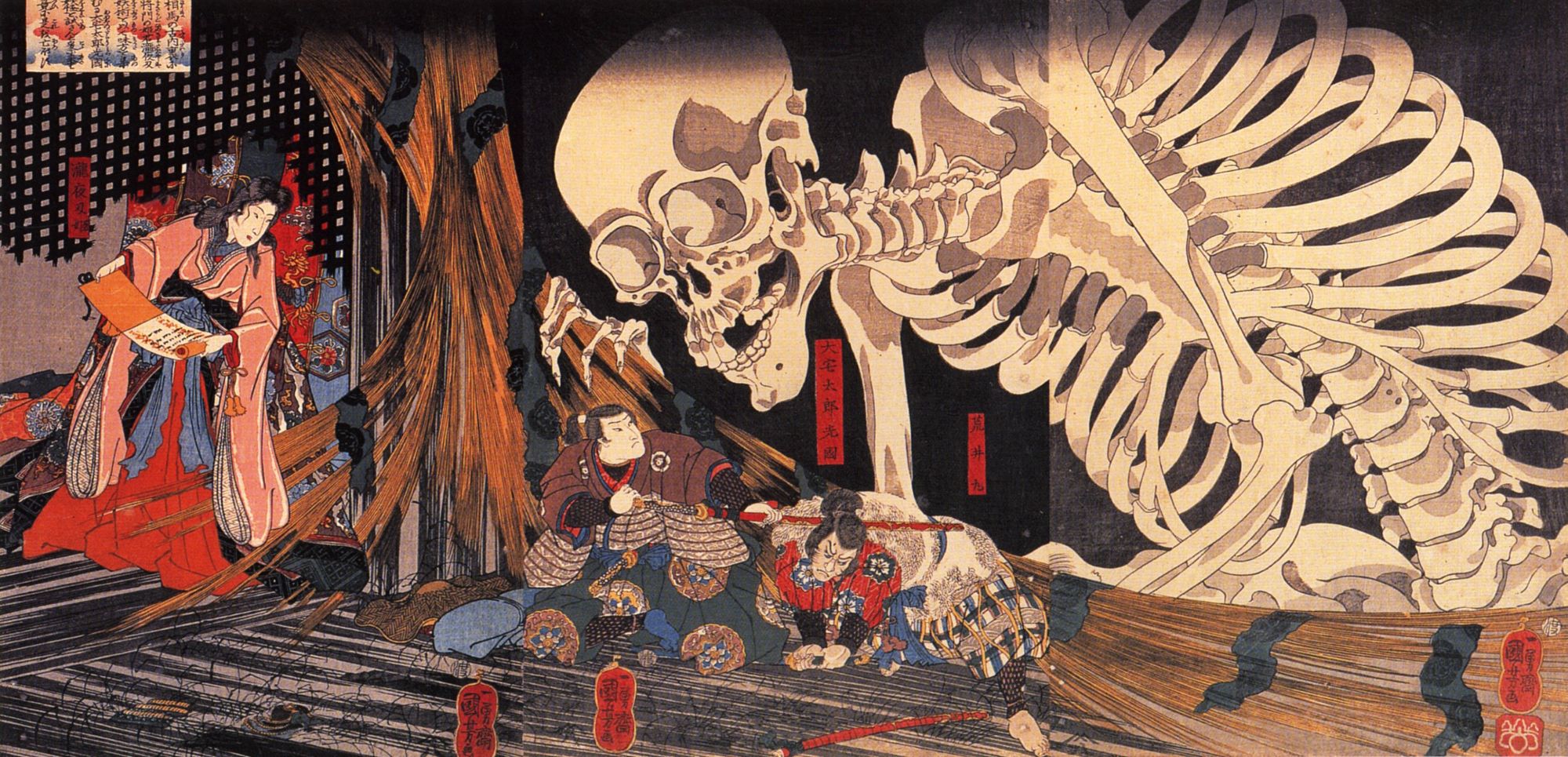
A princess reads a spell from a scroll, and a skeleton the size of a building pushes aside the curtain of the palace to look in at the warrior sent to arrest her. Kuniyoshi drew the skeleton from a Dutch anatomy book, bone by bone, which is why it is so much more frightening than the usual Japanese ghost: it is correct.
Japanese prints are full of ghosts, and Kuniyoshi made the best of them, but this one, spread across three sheets, is the image that has crossed into every culture. It is the grandfather of every giant monster in every film.
Hand-painted reproduction of Takiyasha the Witch and the Skeleton Spectre

A tall woman in a breastplate and helmet, sword in one hand and a basket of loot in the other, strides toward the mouth of hell, which is a giant face with a bridge for a tongue, while an army of housewives beats up devils behind her. Dulle Griet, Mad Meg, was a Flemish proverb about a woman who could plunder in front of hell and come back unharmed.
It is Bruegel at his most Bosch-like and his funniest, and the monsters are still frightening, because he believed in the grammar of them even when he was joking.
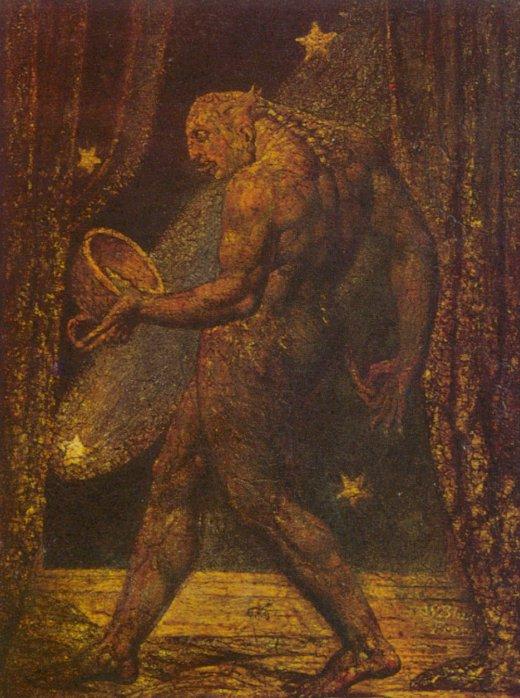
Blake told his friend John Varley that the ghost of a flea had appeared to him one night and explained that fleas were inhabited by the souls of bloodthirsty men, which was why they were kept small. He drew it while it posed. The painting is the size of a hand: a muscular, scaled creature walking between curtains with a bowl for blood and its tongue out.
It is one of the strangest objects in British art, and the strangeness is the fear: Blake was entirely serious.
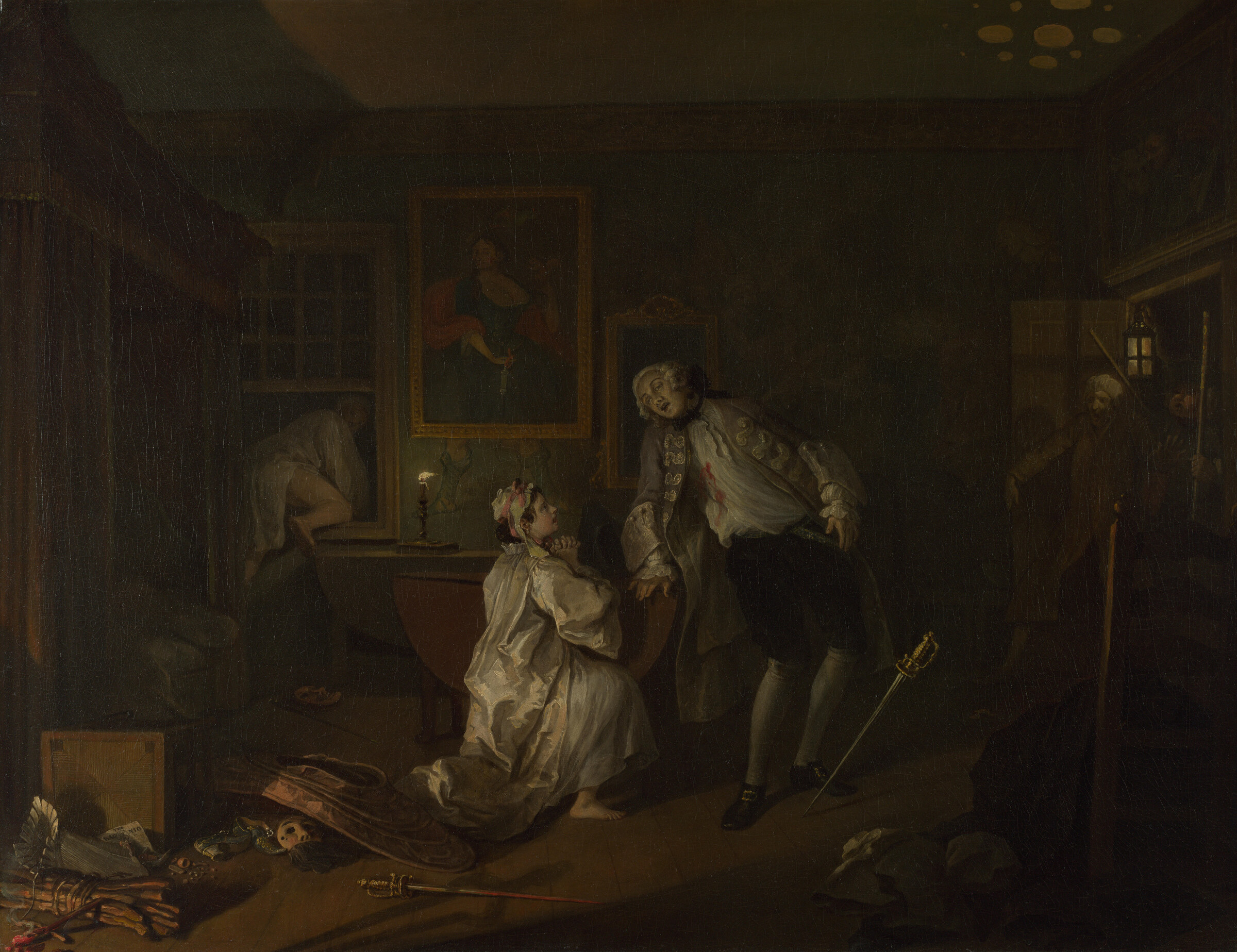
The fifth scene of Hogarth's Marriage A-la-Mode is the only one lit by a candle. A husband has followed his wife and her lover to a rented room, drawn his sword, and lost; he falls with the blood spreading on his shirt while the lover climbs out of the window in his nightshirt and the watch bursts in at the door. On the floor, the masks from the masquerade.
It is not a horror painting; it is a story painting at the moment the story turns into one, which is what makes it frightening. It is the last door in our Six Rooms of a Bad Marriage.
Read the full story of The Bagnio · hand-painted reproduction
What is the scariest painting in the world? By search volume, Goya's Saturn Devouring His Son, by a wide margin, with Munch's Scream second and Fuseli's Nightmare third. By the reaction of people standing in front of it, most museum guards will tell you it is Saturn.
Why did Goya paint the Black Paintings? Nobody knows. He was old, deaf and living alone, and he painted them on the walls of his own house without telling anyone. The best guess is that they were for himself.
Are these paintings good for Halloween? They are the reason Halloween decorations look the way they do. The skeleton army, the demon on the bed, the witches round the goat and the giant skeleton behind the curtain were all painted centuries before anyone sold a plastic version.
Where can I see them? The Prado in Madrid has Saturn, the Triumph of Death and the Garden of Earthly Delights in one building; Oslo has The Scream; Detroit has The Nightmare; London has The Bagnio and the Ghost of a Flea. The rest are listed above, and all of them are in our Haunted Gallery.
Ranking follows monthly search interest in the paintings' names; we do not publish the figures.