Loading cart…
No products in the cart.

1542 to 1545 · Fresco · Cappella Paolina, Vatican City
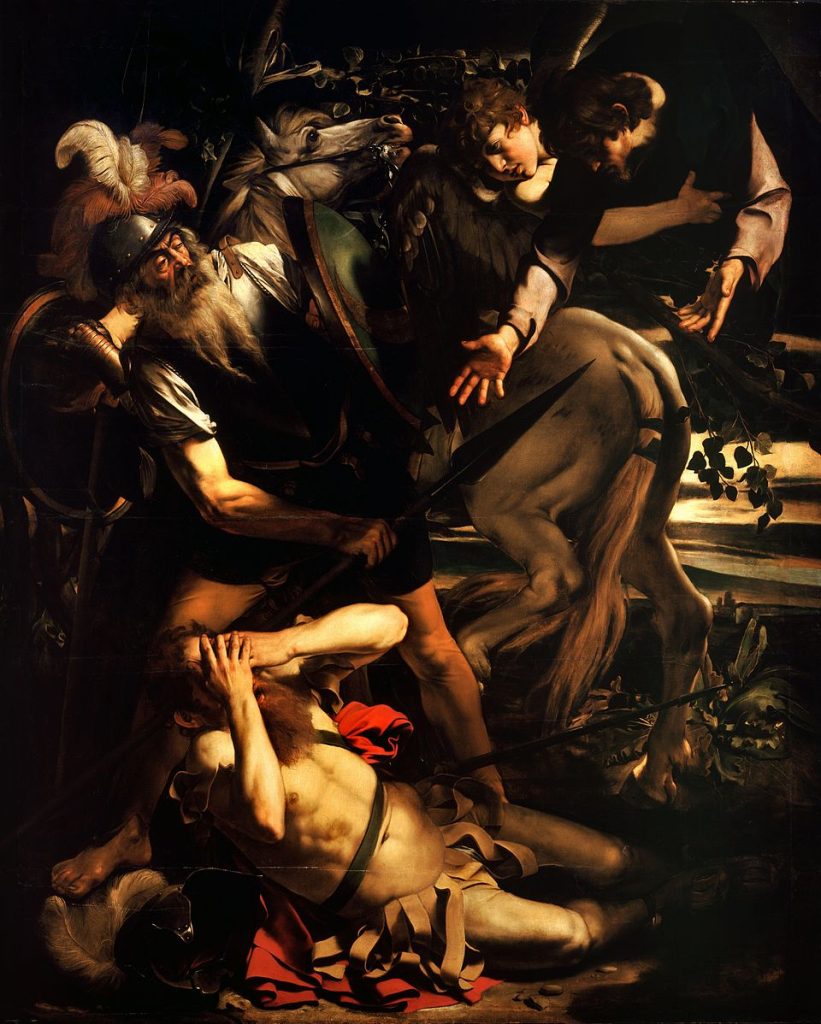
Pope Paul III commissioned Michelangelo to paint two frescoes for the newly constructed Cappella Paolina, the private chapel of the popes adjacent to the Sistine Chapel, shortly after the completion of The Last Judgment in 1541. The two subjects chosen, the Conversion of Saint Paul and the Crucifixion of Saint Peter, were the founding events in the apostolic narratives of the two patron saints of Rome, making them appropriate subjects for a papal chapel of the highest ceremonial significance. Michelangelo began work on The Conversion of Saint Paul around 1542 and completed it by 1545, painting it when he was already in his late sixties. The commission coincided with a period of intense personal religious reflection in the artist's life, shaped by his close friendship with Vittoria Colonna and his engagement with the spirituali movement, and the resulting fresco shows a markedly different approach to religious narrative than the earlier works in the Sistine Chapel. The Cappella Paolina frescoes are among the least known and least accessible of the major works of Michelangelo, as the chapel is not regularly open to the public, and they have consequently received less scholarly attention than the Sistine works despite representing the final major painted statement of an artist whose entire career had been building toward this kind of concentrated spiritual expression.
The composition of The Conversion of Saint Paul is remarkable for the way it refuses the kind of dramatic, all-encompassing spectacle that might be expected from the artist of The Last Judgment. The scene is organized around two separate and almost disconnected zones of action: above, a radiant figure of Christ descends in a burst of brilliant light, surrounded by a ring of angelic figures, while below, the fallen figure of Saul lies on the ground with his arm thrown across his face in an attitude of overwhelmed blindness. The two zones do not communicate through a clear visual bridge of gesture or gaze, and this compositional discontinuity mirrors the theological situation being depicted, in which the divine revelation is so absolute and so incomprehensible that it temporarily breaks the capacity of human consciousness to integrate its experience. The horse that rears in the background and the scattered figures of the soldiers who accompanied Saul respond to the event with gestures of confusion and flight, but their reactions seem peripheral to the central drama of the fallen man and the light that has undone him. The figure of Saul is foreshortened with great boldness, his feet toward the viewer and his body receding into the picture space in a way that creates a powerful sense of the viewer being present at the event. The palette of this fresco is notably cooler and more restrained than that of the Sistine Chapel, reflecting both the changed stylistic environment of mid-sixteenth century Rome and the more interiorized emotional register of the subject. This extraordinary and under-celebrated work is available as a hand-painted oil reproduction from ByMuseum.
The conversion of Saul on the road to Damascus, as recounted in the Acts of the Apostles, is one of the foundational narratives of Christian history, representing the transformation of the most zealous persecutor of the early church into its most prolific theologian and missionary. Michelangelo was drawn to this subject at a moment in his own life when questions of faith, grace, and personal transformation were of urgent personal importance, and the fresco can be read as a meditation on the experience of being overwhelmed by a truth one had previously refused to acknowledge. The theological concept most relevant to the scene, as interpreted within the spirituali framework that influenced Michelangelo in these years, was that of justification by faith, the idea that the individual soul is redeemed not by its own moral efforts but by an act of divine grace that exceeds and precedes any human deserving. The figure of Saul lying blinded in the dust embodies this condition of radical human helplessness before the divine, and the surrounding figures who cannot share his experience represent the ordinary world of action and social identity from which the converted individual is irrevocably separated. In the broader context of the Cappella Paolina program, the Conversion of Paul is paired with the Crucifixion of Peter to present two complementary models of the apostolic vocation, one beginning in violent disruption and the other ending in sacrificial suffering, both expressing the transformative power of committed belief. Own this late, profound, and historically significant work as a hand-painted oil reproduction from ByMuseum.