Loading cart…
No products in the cart.

1508 to 1512 · Fresco · Sistine Chapel, Vatican City
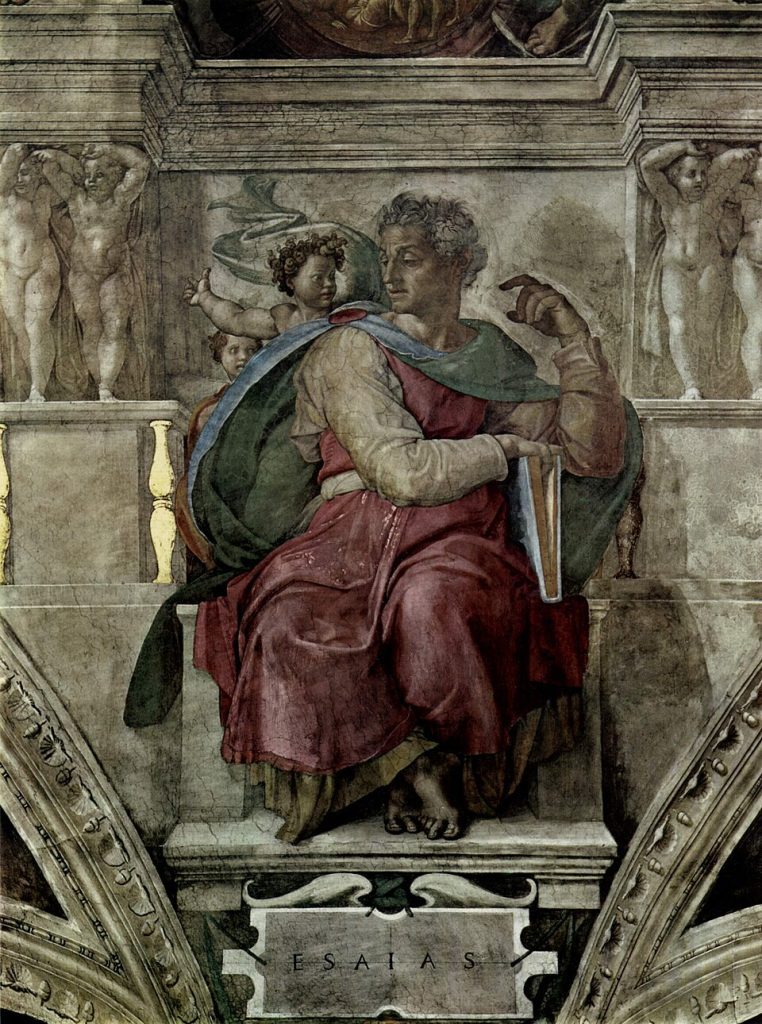
The figure of Isaiah was painted as part of the broader program of prophets and sibyls that flank the nine central Genesis panels on the Sistine Chapel ceiling, a program that Michelangelo developed beyond the original brief of the twelve apostles proposed by Julius II. Isaiah occupies one of the seven prophet thrones on the longitudinal axis of the ceiling, positioned between the Delphic Sibyl and the spandrel depicting the ancestors of Christ. In Renaissance theological interpretation, Isaiah was considered the most Christological of the Hebrew prophets, his writings containing numerous passages understood as explicit predictions of the birth, ministry, and passion of Jesus, including the famous verse describing a virgin who would bear a son. This theological significance explains why Isaiah is positioned with particular prominence in the ceiling program and why Michelangelo gives him a pose of such contained intensity, as though he is in the act of turning away from the written text toward the direct experience of prophetic vision. The style of the figure reflects the more assured and monumental approach that Michelangelo adopted in the second phase of the ceiling campaign, with a broader figural scale and a bolder, more economical treatment of drapery than is found in the earlier prophet figures such as Zechariah near the chapel entrance.
The figure of Isaiah is painted with a psychological complexity and a quality of inward absorbed attention that distinguishes it from many of the more overtly dramatic figures elsewhere on the ceiling. Michelangelo shows the prophet in the act of turning, his body twisted in a contrapposto pose that creates a strong sense of physical tension even in a seated figure, while his right hand marks his place in a scroll and his gaze is directed upward and to the left, toward something outside the frame of the panel. Behind his left shoulder, a small winged putto leans in to touch his shoulder, directing the prophet toward a revelation that the viewer cannot see. This compositional device of the interrupting messenger gives the figure a narrative dynamism that keeps it from becoming static despite its fundamentally contemplative character. The drapery of Isaiah is handled with great boldness, the fabric describing the forms of the body beneath while also creating an independent pattern of colored masses that reads effectively at the considerable distance from which the figure must be viewed. The color of the garments, warm orange against a cooler green, exemplifies the complementary color relationships that Michelangelo uses systematically throughout the ceiling to make individual figures visually distinct and readable. This extraordinary figure is available as a hand-painted oil reproduction from ByMuseum, allowing you to own a faithful rendering of one of the ceiling program's most psychologically nuanced figures.
The prophets of the Sistine Chapel ceiling occupy a pivotal position in the theological program of the work, serving as the figures who mediate between the primordial narratives of Genesis and the anticipated fulfillment represented by the coming of Christ. Isaiah in particular carried exceptional weight in Renaissance Christian interpretation because his texts were read as providing the most detailed and explicit Old Testament foundation for the core claims of Christian doctrine. By depicting him in a moment of transition between reading and seeing, between the written record of past revelation and the direct experience of new vision, Michelangelo captures the essential condition of prophetic consciousness as understood in his cultural moment. The figure also reflects the artist's broader interest in depicting states of heightened interior awareness, states in which the individual mind is reaching beyond its ordinary capacities toward a contact with something that exceeds ordinary experience. This interest connects the prophets and sibyls of the ceiling to the broader Neoplatonist theme of the soul aspiring toward divine knowledge that runs through much of Michelangelo's work. For contemporary viewers, the figure of Isaiah offers a compelling image of intellectual and spiritual searching that speaks across the distance of five centuries. You can bring this profound image into your own space as a hand-painted oil reproduction from ByMuseum, crafted by skilled painters who honor the full visual intention of the original fresco.