Loading cart…
No products in the cart.

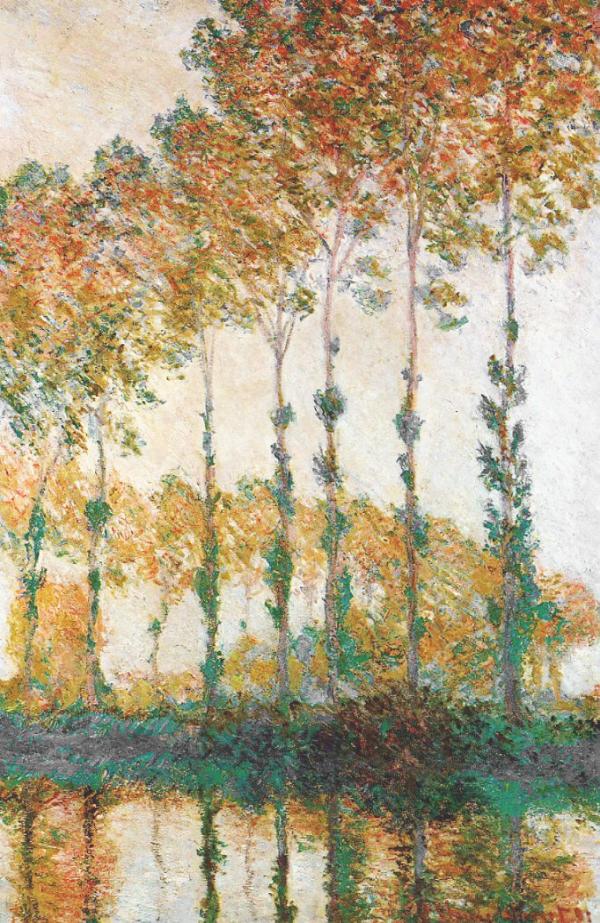
1891 · Oil on canvas · Philadelphia Museum of Art, Philadelphia, United States
Save articles to your collection
Log in or create a free account, and this article will be waiting in your Private Collection.
Log in or sign upMonet discovered the row of poplar trees along the Epte river near Giverny in 1890 and began painting them immediately, working from a boat moored in the river. When he learned that the local commune planned to auction and fell the trees, he negotiated with a timber merchant to delay the sale until he had finished the series. He exhibited fifteen canvases from the series at Durand-Ruel in 1892, the year after the Haystacks exhibition, cementing his reputation as the preeminent serial painter in France.nnThe Philadelphia canvas is among the most formally resolved works in the series, with the composition organized around the rhythmic alternation of tree trunks and the serpentine line of the treetops against the sky. It entered American collections in the early twentieth century through the network of collectors that Durand-Ruel had cultivated in the United States.
The composition exploits the natural geometry of the poplar row, using the vertical trunks to divide the canvas into a series of vertical bands while the serpentine curve of the treetops introduces a counterrhythm. The reflections in the river below mirror the upper half of the composition, creating a doubled structure that Monet explores throughout the series. The sky and its reflection together take up more than half the canvas, with the trees serving as a vertical framework for the study of atmospheric color.nnThe handling is lighter and more transparent than the heavily impastoed Haystacks canvases, with thinner paint allowing the weave of the canvas to contribute to the texture of the surface. The color is high-keyed and cool, dominated by blue, green, and silver, appropriate to the clear light of the Epte valley in summer.
The Poplars series was Monet most explicitly decorative, with the formal elegance of the composition and the thinness of the paint surface creating works that approach the condition of pattern. The alternation of verticals and the mirroring of the reflection give the canvases a quality of visual music, a rhythmic organization that Monet and his critics both recognized. Some contemporary reviewers compared the series to Japanese screens, and the comparison is not inapt.nnThe fact that Monet intervened to delay the felling of the trees until he had finished his paintings is revealing of his approach to the relationship between art and nature. The landscape he painted was not purely found but partly preserved and partly constructed according to his needs. This active relationship with his subjects, most fully expressed in the Giverny garden, runs through his entire career.
Enjoyed this story?
Save articles to your collection
Log in or create a free account, and this article will be waiting in your Private Collection.
Log in or sign up