Loading cart…
No products in the cart.

1899 · Oil on canvas · National Gallery of Art, Washington D.C., United States
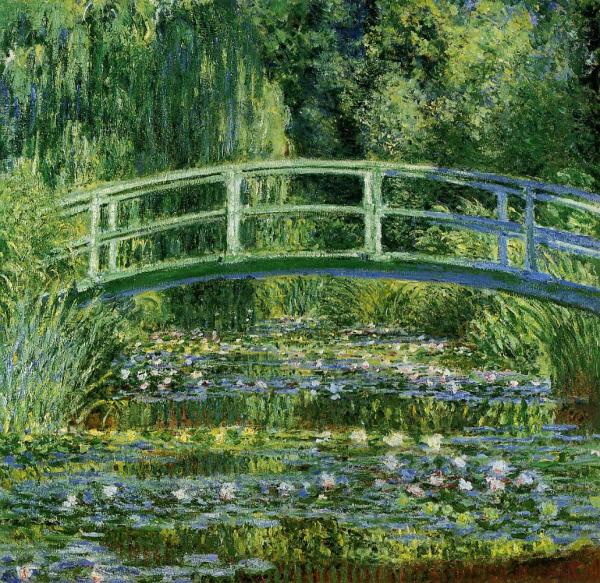
Monet constructed the Japanese-style wooden footbridge over his lily pond at Giverny in 1895 and began painting it in earnest in 1899, producing a series of canvases depicting the bridge from a fixed vantage point on the bank. He exhibited twelve works from the series at the Durand-Ruel gallery in 1900 alongside the first Water Lilies canvases. The pairing of the two subjects established the Giverny garden as the central site of his late work.nnThe National Gallery of Art canvas is among the most celebrated works from the series, notable for the clarity of its composition and the richness of its color. It entered American collections in the mid-twentieth century and has been a focal point of major Monet retrospectives in Washington and elsewhere.
The composition frames the arched bridge against a screen of weeping willows and aquatic vegetation, with the surface of the lily pond visible below. The bridge is painted in a warm green-grey that harmonizes with the surrounding foliage rather than contrasting with it, integrating the constructed element into the natural setting. The reflections in the water below the bridge mirror the colors of the vegetation above, creating a vertical symmetry that Monet would explore further in later canvases.nnThe brushwork in the foliage is particularly dense and varied, with individual marks describing the movement of leaves and the play of light through the canopy. The water surface is handled with broader horizontal strokes that contrast with the verticality of the vegetation, giving the composition a structural tension between stillness and movement.
The Japanese footbridge had specific cultural resonances for Monet, who was an avid collector of Japanese woodblock prints and had arranged the Giverny garden partly in response to Japanese aesthetic principles. The bridge itself referenced the tradition of Japanese garden design, in which bridges are placed as aesthetic objects as much as functional ones. By choosing this element as a subject for extended serial investigation, Monet was acknowledging the influence of Japanese visual culture on his own thinking.nnThe bridge also functions in the paintings as a threshold, a passage between two parts of the garden and by extension between two states of attention. Standing on the bridge, one looks down at the water and the lily pads, losing the conventional landscape orientation of horizon and sky. The paintings of the bridge prepare the viewer for the fully immersive experience of the later Water Lilies, in which the threshold has been crossed and the viewer is already on the surface of the water.