Loading cart…
No products in the cart.

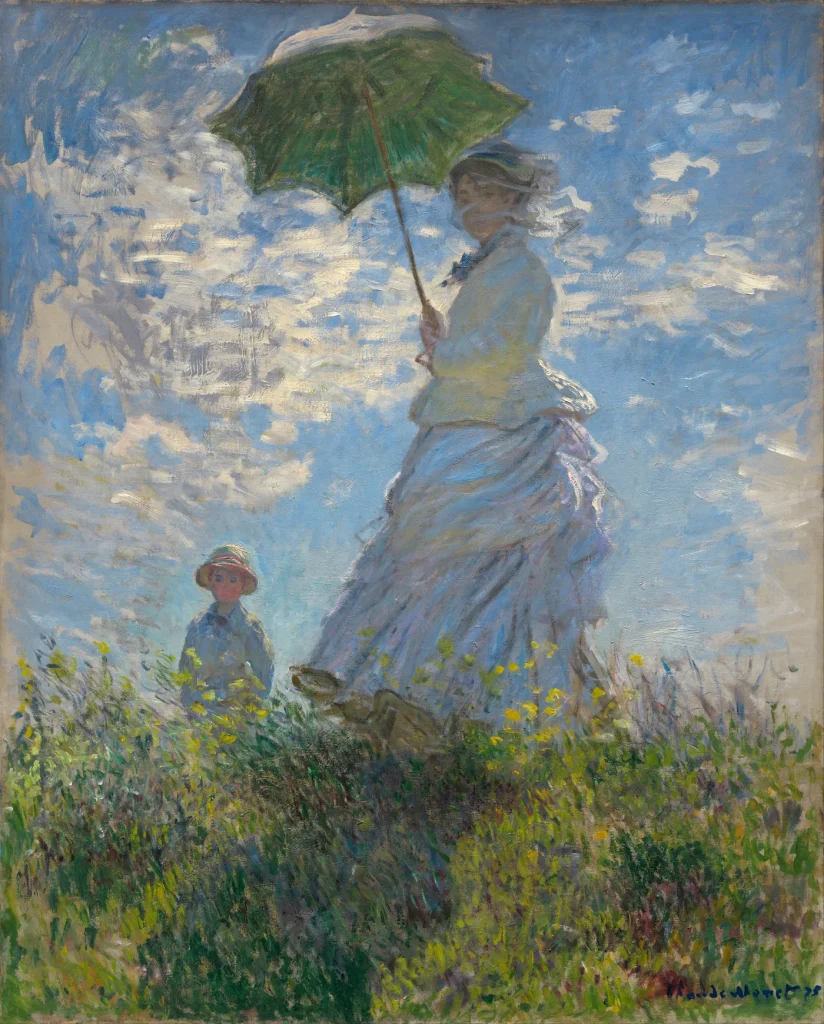
1875 · Oil on canvas · National Gallery of Art, Washington, DC
Save articles to your collection
Log in or create a free account, and this article will be waiting in your Private Collection.
Log in or sign upThis painting took a few hours. You can tell from the brushwork, which is fast everywhere, and from the subject, which is a woman and a boy on a hill in a wind that will not hold still. Monet did not go up that hill to make a masterpiece. He went to paint his wife and son on a summer afternoon near Argenteuil, the town on the Seine where the family lived, and to see if he could catch the light before it changed.
The woman is Camille Doncieux, twenty-eight, married to Monet for five years and his model since she was nineteen. The boy is Jean, their son, seven or eight. They are on a rise above the river, looking down at the painter, who has set up his easel below them so that the two figures stand against nothing but sky.
Monet showed it at the second Impressionist exhibition the next year under the plainest title he could find: La Promenade, The Walk. It has been called Woman with a Parasol ever since, and it is the picture people mean when they say the word Impressionism.
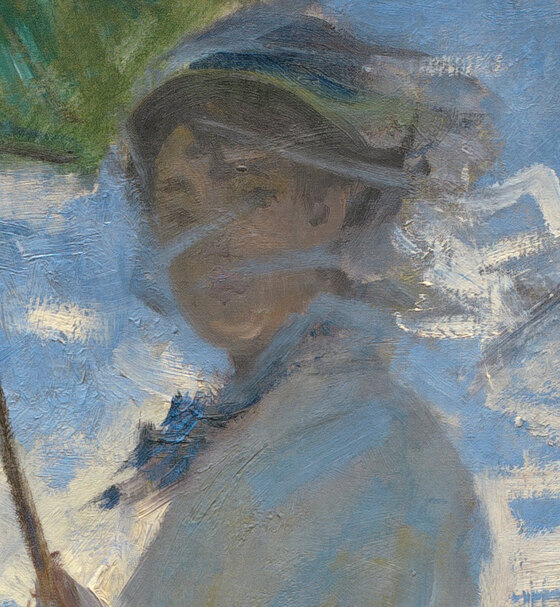
Look for her face and you will find almost nothing: a shadow under the parasol, a veil blown sideways, two dark touches for eyes and one for the mouth. Monet is not painting a portrait. He is painting what a face looks like from below, against the sky, in the green shade of a parasol, with a veil moving across it. That is a different thing, and in 1875 nobody else was painting it.
The whole figure is treated the same way. Her white dress is not white; it is blue where the sky reflects in it, green where the grass does, yellow where the sun hits the fabric through the parasol. The parasol itself is a few curved strokes of green with the sky showing through the gaps. She is standing in the light, and the light is doing the painting.
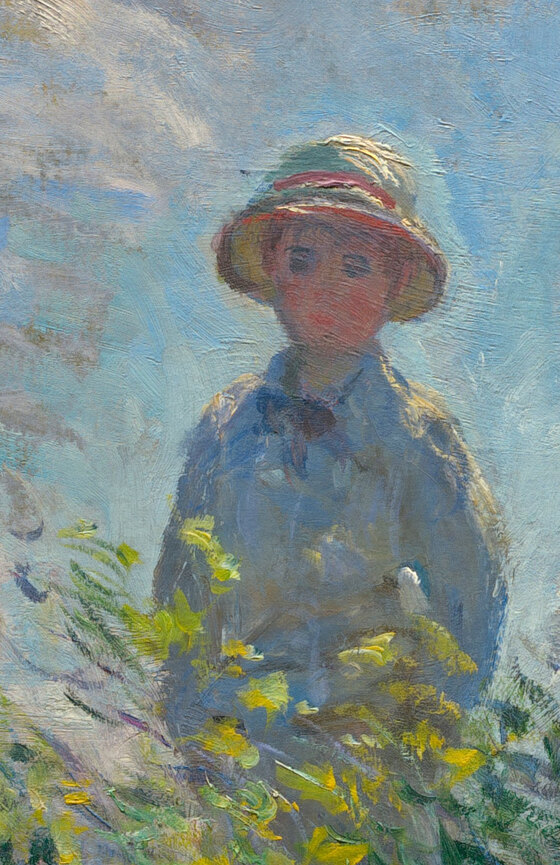
Behind her and lower down stands Jean, in a straw hat, up to his waist in grass and wildflowers. He is sketched even more loosely than his mother, a few strokes of blue and cream and a pink smudge for a face, and he is placed so that he balances her: she leans left, he stands right; she fills the top of the picture, he sits in the bottom corner. Without him the composition tips over.
Jean Monet appears in a dozen of his father's paintings of these years, on a hobby horse, at lunch in the garden, asleep. He grew up to be a chemist, married his stepsister, and died in 1914. This is the painting most people know him from, and he does not have a face in it.
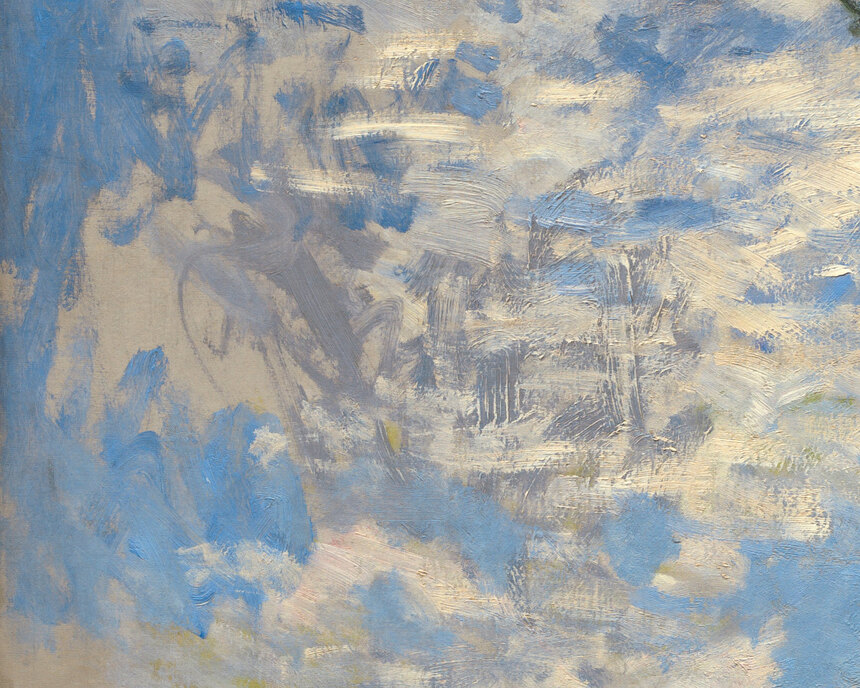
The real subject is the wind. It pushes the veil to the right, tilts the parasol, blows the dress sideways and drags the clouds across the sky in long horizontal strokes. The grass leans. Even the shadows on the slope seem to be moving. Monet has painted a moment that lasted a second, and the way he did it was to paint fast enough to keep up.
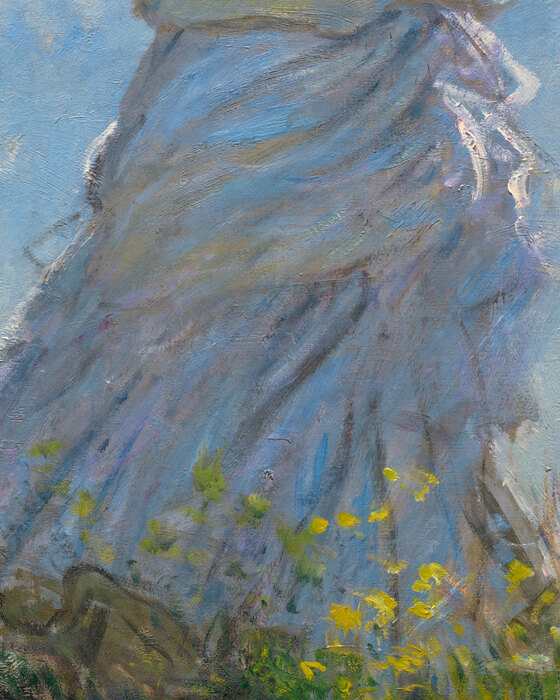
Look at any square inch and you see how. The strokes are broad, separate, and laid on wet; nothing is blended; there are no outlines anywhere. Where Camille's dress meets the sky there is no edge, only one set of blue strokes giving way to another. This was exactly what the critics of 1876 hated. To them it was unfinished. To Monet it was finished the moment it looked like the afternoon.
Camille Monet died in 1879, aged thirty-two, of an illness that was probably cancer. Monet painted her on her deathbed, and years afterwards told his friend Georges Clemenceau what he had caught himself doing at her bedside:
I found myself, without meaning to, studying the succession of colours that death was laying on her face. Blue, yellow, grey. Before I had thought to record the features I had loved, my instinct was to react to the colour.
Claude Monet to Georges Clemenceau, as Clemenceau recorded it
In 1886 he went back to the idea of this painting. He put Suzanne Hoschedé, the stepdaughter who had become his model, on a hill at Giverny with a parasol, in the same pose, and painted her twice, once turned left and once turned right. Both are in the Musée d'Orsay. In both, the woman has no face at all: Monet painted the veil and the light and left the features out. The 1875 picture is the one with a person in it, and she was already gone by the time he painted the others.
Nothing, in the sense that a history painting means something. There is no story, no allegory, no moral. A woman and a boy went for a walk and a painter looked up at them.
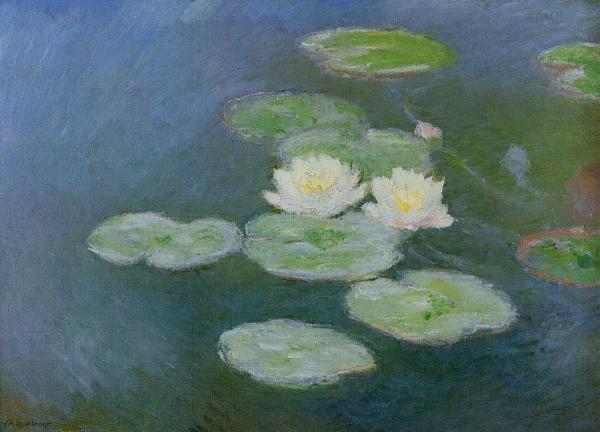
What it means in the history of painting is a great deal. It is the demonstration piece of the Impressionist idea: that the subject of a painting is not the thing but the light on the thing, that a moment is worth as much as a monument, and that the way to catch it is to work fast, outdoors, with pure colour and no outlines. Everything Monet did for the next fifty years, the haystacks, the cathedrals, the water lilies, comes from the discovery on this hill that he could paint the air.
And it means something private, which is why people keep it on their walls. It is a man painting his family on a good day, before anything went wrong.
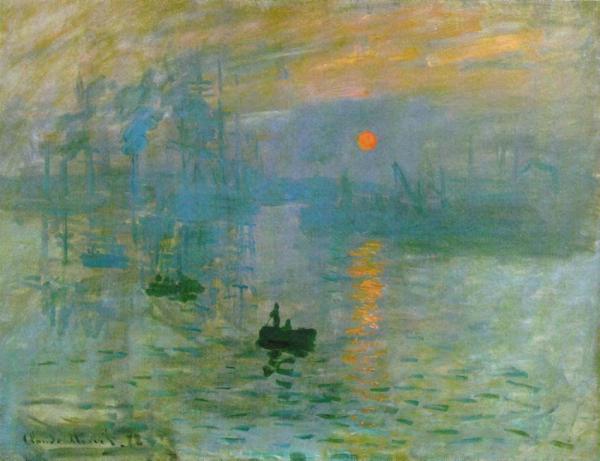
The Argenteuil years, 1871 to 1878, are the core of Impressionism. Monet was poor, borrowing from friends, and painting more freely than he ever would again: the Seine, the boats, the garden, the family. Impression, Sunrise, painted in 1872, gave the movement its name. The Seine at Argenteuil and Women in the Garden, with Camille posing for every figure, are the same world.
In the National Gallery of Art in Washington, DC, which is free to visit. It came with the collection of Paul and Rachel Mellon in 1983. It is oil on canvas, 100 by 81 centimetres, so Camille is a little under life size, and it hangs among the Gallery's Impressionists, a room away from the same museum's Renoir portrait of Camille and Jean from the year before.
It is one of the most reproduced paintings in the world, and one of the ones that suffers most in a print, because everything in it is brushwork and a print has none. Our hand-painted reproduction of Woman with a Parasol is painted in oil on canvas, stroke by stroke, from the Washington original, and the strokes are the point: the veil, the dress and the clouds are laid on the way Monet laid them, not printed flat. It suits bedrooms, living rooms and any wall that gets daylight, and it takes a white or pale wood frame better than gold.
See the rest of our guide to Claude Monet, our Monet collection, and the wider Impressionism archive.
Enjoyed this story?
Save articles to your collection
Log in or create a free account, and this article will be waiting in your Private Collection.
Log in or sign upVisible details, documented facts and interpretation are kept separate throughout this article.
A note from the studio
Our studio is working through an exceptional number of commissions, so we have paused new orders for a short time. We will start taking orders again on 1 October.
Every painting is made entirely by hand, and we would rather pause than rush one. Thank you for your patience and your trust.
Leave your details and we will reserve your place: we will write to you as soon as orders reopen.
Thank you
Your request is saved. We will write to you on 1 October, and a confirmation is on its way to your inbox.