Loading cart…
No products in the cart.

1872 · Oil on canvas · Musee Marmottan Monet, Paris, France
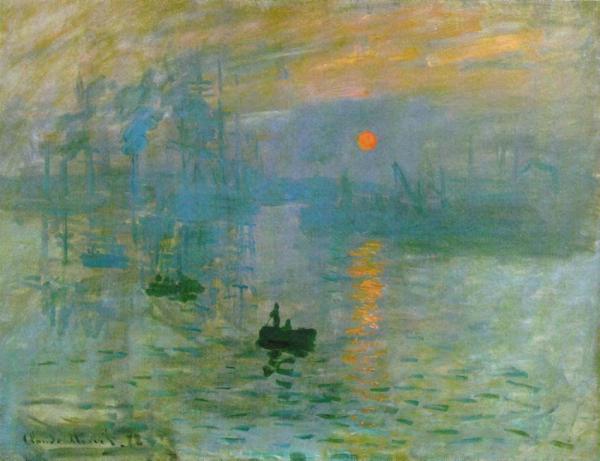
Monet painted this work in the harbor of Le Havre in November 1872, depicting the industrial port at dawn with fishing boats emerging from morning mist. He submitted it to the first Impressionist exhibition in Paris in April 1874, where critic Louis Leroy used its title to mockingly coin the term Impressionism, a label the group subsequently adopted with pride. The painting remained with Monet for many years before entering private collections and eventually the Musee Marmottan in Paris, where it was stolen in 1985 and recovered five years later in 1990.nnThe work is now among the most visited paintings in France. Its recovery from theft gave it an additional layer of cultural significance, and it has been the subject of major retrospective exhibitions documenting the origins of the Impressionist movement. The canvas is small, which makes its atmospheric ambition all the more remarkable, as Monet compresses an entire harbor, a rising sun, and the reflections of industry into a composition of extraordinary lightness.
Monet built this composition around a single orange disc of sun and its reflection in the water below, using a palette of blue-grey tones to render the mist and the harbor structures. The brushwork is rapid and gestural, with short strokes describing the movement of water and the diffusion of light through atmosphere. The industrial cranes and boat masts in the background are rendered as silhouettes, subordinated to the atmospheric effect rather than described in detail.nnThe contrast between the warm orange of the sun and the cool blue-grey of the surrounding water is the central technical achievement of the painting. Monet places this warm accent precisely at the optical center, drawing the eye inward and then outward along the reflection. The handling of water surface, with horizontal strokes of varying value, conveys movement and transparency simultaneously, a problem Monet would pursue for the rest of his career.
The painting captures the moment of industrial modernity emerging from natural light, a tension that defined much of Monet work in the 1870s. Le Havre was one of the most active commercial ports in France, and Monet chose to paint it not as a document of industry but as a study in atmosphere, transforming economic activity into a meditation on light and time.nnThe title itself, which Monet reportedly chose casually when pressed for a name, turned out to be the most consequential title in the history of modern painting. It gave a name to a movement and a way of seeing that would reshape Western art. The orange sun rising over grey water carries a sense of emergence and beginning, which made it an appropriate emblem for a group of artists who felt they were beginning something new.