Loading cart…
No products in the cart.

1906 · Oil on canvas · Art Institute of Chicago, Chicago, United States
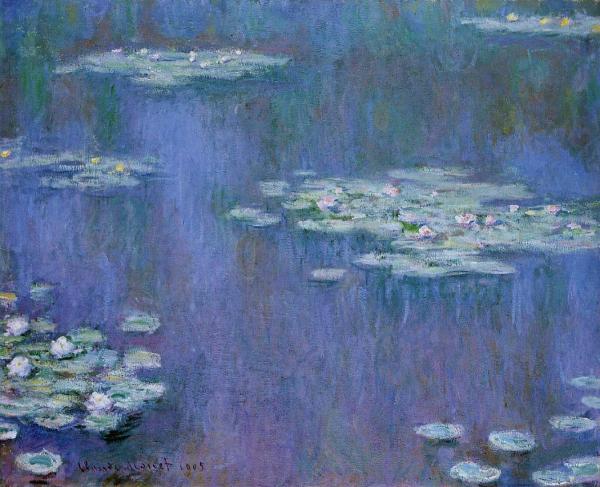
Monet began painting the pond he had constructed at Giverny in earnest in 1899, and by 1906 had developed the Water Lilies into a sustained investigation of surface, reflection, and atmospheric color. This particular canvas was among those exhibited at the Durand-Ruel gallery in Paris in 1909, where it was received with widespread critical admiration. Paul Durand-Ruel, who had championed the Impressionists since the 1870s, acquired several works from the series and placed them with major collectors in France and the United States.nnThe Art Institute of Chicago acquired this canvas in 1933, and it has remained one of the centerpieces of their Impressionist collection. It is among the most reproduced works in the museum and has been the subject of conservation studies examining Monet late technique and the condition of his pigments over time.
In this canvas Monet eliminates the horizon entirely, presenting the pond surface as an uninterrupted field that extends to all four edges of the canvas. The lily pads are distributed across the composition without a focal point, creating a sense of visual abundance that resists the conventions of traditional landscape organization. The reflections of clouds and sky appear between and beneath the lily pads, collapsing the distance between surface and sky.nnThe brushwork is varied and deliberate, with broader strokes describing the open water and more defined marks building the forms of the lily pads and flowers. The color range moves from cool blue-green in the deeper water to warmer rose and gold in the areas where clouds are reflected. Monet applies the paint in layers that give the surface both luminosity and physical depth.
The Water Lilies series marked a significant shift in Monet thinking about painting and its relationship to the viewer. By eliminating the horizon and conventional perspective, he created works that envelop rather than represent, asking the viewer to enter the surface of the water rather than look at it from a distance. This ambition became explicit in the large-scale Orangerie panels, but is already present in the 1906 canvases.nnThe pond at Giverny was itself a constructed environment, designed and planted by Monet to create the conditions he wanted to paint. The Water Lilies are therefore not straightforward observations of nature but meditations on a landscape Monet had shaped according to his own vision. This relationship between the artist and the subject, between observation and construction, gives the series a philosophical dimension that has made it enduringly significant.