Loading cart…
No products in the cart.

1894 · Oil on canvas · Musee d'Orsay, Paris, France
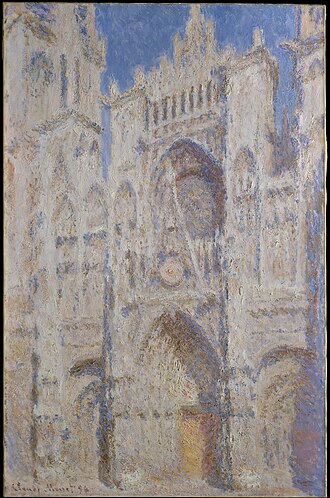
Monet rented rooms in buildings directly opposite the west facade of Rouen Cathedral during the winters of 1892 and 1893, working on as many as fourteen canvases simultaneously, moving between them as the light changed. He completed the paintings in his studio at Giverny and exhibited twenty works from the series at the Durand-Ruel gallery in 1895. The exhibition was among the most discussed artistic events in Paris that year, with critics debating whether the dissolution of architectural form into atmosphere represented progress or excess.nnThis canvas, depicting the facade in strong afternoon sunlight, entered French national collections and is now among the most studied works at the Musee d'Orsay. The series as a whole is distributed across major museums in France, the United States, and Russia, making it one of the most geographically dispersed of Monet serial projects.
Monet fills the entire canvas with the facade of the cathedral, cropping the towers at the top and the base of the portal at the bottom, so that the stone surface becomes an almost abstract field of color and texture. The impasto in this canvas is among the heaviest in Monet work, with paint applied in thick ridges that physically replicate the roughness of the stone. The color range moves from warm gold and orange in the sunlit areas to cool violet in the recesses of the portal.nnThe architectural detail of the facade is dissolved into texture and light rather than precisely described. Monet is not interested in the carved figures and decorative elements of the Gothic portal as individual forms but as surfaces that catch and modify light differently depending on their angle and depth. The result is a painting that is simultaneously about a specific building and about the general phenomenon of light falling on a complex surface.
The Rouen Cathedral series addresses the relationship between permanence and transience. The cathedral is one of the most enduring structures in northern France, a monument of stone that has stood for centuries. Yet Monet shows that even this permanence is subject to the constant transformation of light, that the stone changes color and character from morning to evening and from season to season. The series is an argument that there is no fixed appearance of anything, only conditions of observation.nnThe choice of a Gothic cathedral also introduced a tension between religious tradition and modern secular vision. Monet had no particular religious interest in the subject. For him the cathedral was above all a surface, an extraordinary complex of planes and recesses that offered an inexhaustible study in the behavior of light. This secular approach to a sacred subject was noted by critics at the time and contributed to the controversy surrounding the exhibition.