Loading cart…
No products in the cart.

1891 · Oil on canvas · Art Institute of Chicago, Chicago, United States
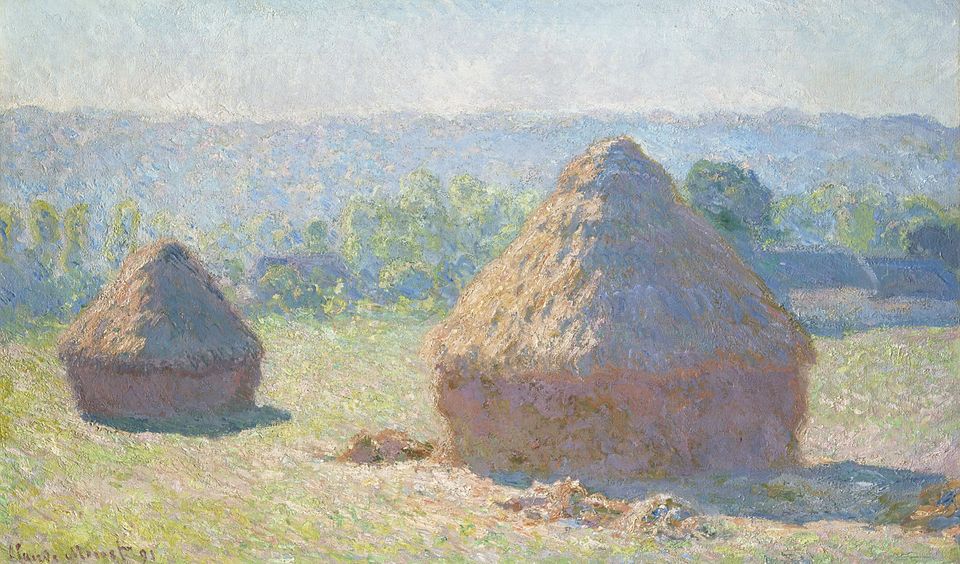
Monet began the Haystacks series in the autumn of 1890, working on multiple canvases simultaneously in the fields near Giverny to capture the same subject under changing conditions of light and weather. He exhibited fifteen works from the series at the Durand-Ruel gallery in May 1891, and the show sold out before it closed. The critical and commercial success of the exhibition established Monet as the leading figure of French painting and demonstrated the viability of the series as an artistic and commercial concept.nnThis canvas, depicting the haystacks in the warm, hazy light of late summer, entered American collections in the early twentieth century and was acquired by the Art Institute of Chicago, which now holds several works from the series. The Haystacks have been among the highest-valued Impressionist works at auction, with individual canvases regularly achieving prices above one hundred million dollars.
The composition centers two large haystacks in a field, with the treeline and hillside of the Giverny valley visible in the background. Monet works with a warm palette of gold, orange, and rose to capture the quality of late summer light, using broken brushstrokes to build the texture of the hay and the shimmer of the surrounding field. The shadows on the haystacks shift from cool violet to warm brown depending on the angle of light.nnWhat distinguishes this canvas from earlier landscape painting is the degree to which the subject is dissolved into atmosphere. The haystacks are fully present as forms but they are secondary to the envelope of light that surrounds them. Monet builds this envelope through the careful calibration of warm and cool tones across the entire surface of the canvas, so that the light seems to emanate from within the painting rather than from an external source.
The Haystacks series was the first sustained demonstration of what serial painting could achieve. By returning to the same subject over and over, Monet showed that the subject of painting was not the haystack itself but the conditions under which it was seen, the time of day, the season, the weather, and the quality of the air. This was a radical reorientation of what landscape painting was for.nnThe haystacks themselves carried cultural significance in rural France as symbols of agricultural labor and the seasonal rhythms of the countryside. Monet transforms them into something more abstract, vehicles for the study of light and atmosphere. The series anticipates the abstraction of the late Water Lilies and establishes the conceptual framework within which Monet would work for the rest of his career.