Loading cart…
No products in the cart.

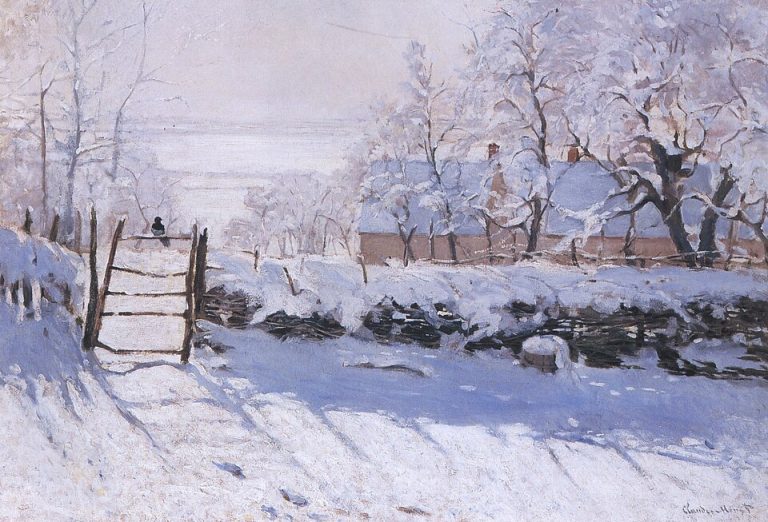
1869 · Oil on canvas · Musee d'Orsay, Paris, France
Save articles to your collection
Log in or create a free account, and this article will be waiting in your Private Collection.
Log in or sign upMonet painted this canvas in the winter of 1868 to 1869 near Etretat in Normandy, submitting it to the Salon of 1869 where it was rejected. The rejection contributed to Monet growing disillusionment with the Salon system and his eventual commitment to independent exhibition. The painting remained little known for many years and was not fully appreciated until the twentieth century, when it was recognized as among the most accomplished winter landscapes in European painting.nnThe Musee d'Orsay acquired the painting in 1984 and it has since become one of the most discussed works in their Impressionist collection. Its late recognition is itself historically significant, as it demonstrates how the criteria for evaluating Impressionist painting shifted over the course of the twentieth century toward an appreciation of subtlety and restraint over drama and incident.
The composition is built around the contrast between the blue shadows on the snow and the warm golden light falling on the gate and fence. Monet uses a remarkably extended range of blues, violets, and greys to render the shadow on the snow, demonstrating that white snow in shadow is anything but white. The single magpie perched on the gate provides the only dark accent in a composition otherwise dominated by light tones, its placement precisely calibrated to anchor the composition without disrupting its overall luminosity.nnThe handling of the snow surface is extraordinarily varied, with different areas described through different brushwork to convey the varying texture of snow that has fallen, drifted, and partially compressed under its own weight. The distant trees and the hedge in the background are painted with a softness that conveys their appearance through cold air, with edges dissolved rather than precisely defined.
The Magpie challenged the academic convention that snow scenes required strong tonal contrast and clear narrative incident. Monet instead built an entire composition from the most delicate distinctions of light and color, demonstrating that the most mundane winter landscape, a gate, a fence, a few trees, could sustain extended visual attention if approached with sufficient observational precision. The single magpie is the only conventional pictorial incident in the composition, and even it is treated as an element of color and form rather than as a narrative subject.nnThe painting anticipates the serial investigations of the Haystacks and Cathedrals in its insistence that the interest of a scene lies entirely in its conditions of light rather than in its subject matter. The gate and fence are no more or less significant than the haystacks or the cathedral facade. What matters is the quality of the light at a specific moment, and Monet commitment to capturing that quality with precision and honesty is the central achievement of this canvas.
Enjoyed this story?
Save articles to your collection
Log in or create a free account, and this article will be waiting in your Private Collection.
Log in or sign up