Loading cart…
No products in the cart.

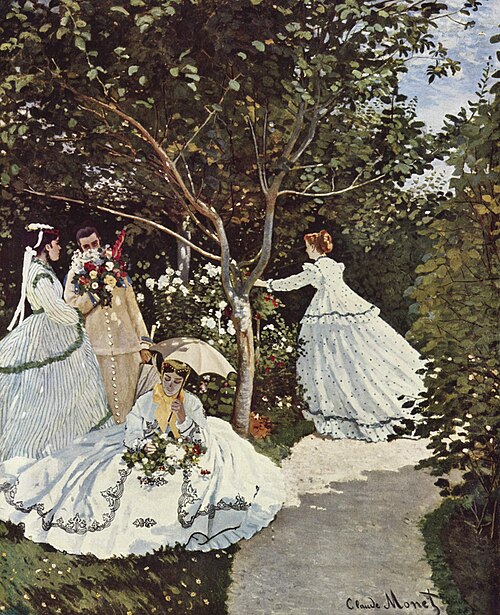
1866 · Oil on canvas · Musee d'Orsay, Paris, France
Save articles to your collection
Log in or create a free account, and this article will be waiting in your Private Collection.
Log in or sign upMonet painted this large canvas in the garden of a rented house at Ville-d'Avray in 1866, working outdoors on a canvas so large that he dug a trench in the garden and used a pulley system to raise and lower it as he worked on different sections. The Salon jury rejected the painting in 1867, and the writer Emile Zola defended it in print as evidence of a new approach to painting that the academic establishment was unwilling to recognize. Frederic Bazille purchased the painting from Monet for 2500 francs, paid in monthly installments, to help his friend through a period of financial difficulty.nnThe French state purchased the painting from Bazille family after the Franco-Prussian War in which Bazille was killed, and it entered the collection that would eventually become the Musee d'Orsay. It is one of the largest paintings Monet produced in his early career and one of the few to feature figures as primary subjects.
The composition arranges four female figures, all modeled by Camille Doncieux who would later become Monet wife, in a sunlit garden setting. Monet uses the figures to study the effect of direct sunlight on white fabric, capturing the strong shadows cast by the trees and the warm light reflecting upward from the grass. The handling of the white dresses is particularly accomplished, with the shadow areas rendered in blue-grey and the lit areas in warm white with touches of yellow.nnThe scale of the canvas presented specific technical challenges for plein air painting. Monet had to work quickly to maintain consistent lighting conditions, and the lower portions of the canvas were painted with the canvas partially in the trench. Despite these constraints, the surface is remarkably unified, with the light quality consistent across the entire composition.
Women in the Garden represents an early statement of the principles that would define Monet mature work, the commitment to painting entirely outdoors, the focus on the effects of natural light rather than academic idealization, and the use of figures as vehicles for the study of light rather than as narrative subjects. The rejection by the Salon jury confirmed for Monet that his approach was incompatible with the academic tradition and that he would need to find alternative exhibition venues.nnThe painting also documents an important transitional moment in Monet personal life. Camille Doncieux, who modeled for all four figures, became his companion and eventually his wife. The garden setting and the figures in white dresses carry a sense of domestic happiness that contrasts with the financial difficulties Monet was experiencing at the time. The painting is a record of a specific moment in a specific place, which is precisely what Monet intended it to be.
Enjoyed this story?
Save articles to your collection
Log in or create a free account, and this article will be waiting in your Private Collection.
Log in or sign upA note from the studio
Our studio is working through an exceptional number of commissions, so we have paused new orders for a short time. We will start taking orders again on 1 October.
Every painting is made entirely by hand, and we would rather pause than rush one. Thank you for your patience and your trust.
Leave your details and we will reserve your place: we will write to you as soon as orders reopen.
Thank you
Your request is saved. We will write to you on 1 October, and a confirmation is on its way to your inbox.