Loading cart…
No products in the cart.

1883 · Oil on canvas · Metropolitan Museum of Art, New York, United States
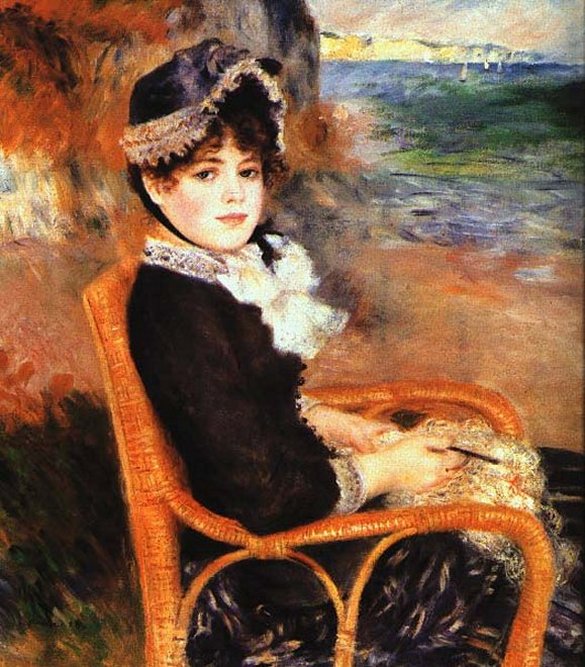
Renoir completed By the Seashore in 1883, a year that marked a decisive turning point in his career. Having recently traveled to Italy and absorbed the lessons of Renaissance figure painting, he was actively reconsidering the looser brushwork that had defined his earlier Impressionist output. The painting depicts a young woman, believed to be based on models Renoir frequently employed during this transitional period, seated casually against a backdrop of sea and sky. The work was exhibited in Paris and drew attention for its careful balance between the spontaneous outdoor atmosphere associated with Impressionism and a new interest in more structured compositional form. Renoir was spending considerable time along the Normandy and Brittany coasts during these years, finding in the seaside environment a subject that allowed him to explore the interplay of natural light on human figures in open air settings. The painting entered the collection of the Metropolitan Museum of Art in New York, where it remains one of the institution's notable examples of Renoir work from his so-called Ingres period, named for his renewed admiration of the French Neoclassical painter Jean-Auguste-Dominique Ingres. During this phase, Renoir pulled back from the dissolved forms of high Impressionism and sought firmer contours and more deliberate modeling of the figure. By the Seashore stands as a visual record of that internal artistic debate. Critics and historians have noted that the painting reflects both the confidence of a painter who had already achieved significant recognition and the restlessness of an artist unwilling to remain confined to a single approach. Its presence in a major American museum collection ensured that it reached an international audience and contributed to the broader understanding of how Impressionism evolved through the 1880s.
The composition of By the Seashore places the female figure slightly off-center, drawing the viewer into an easy, naturalistic relationship with the subject. She is dressed in a striped garment rendered with careful attention to fabric texture, a detail that reflects Renoir interest in the material world as a source of visual richness. Her gaze is directed away from the viewer, lending the scene a quality of quiet introspection rather than posed formality. The background is handled with fluid, abbreviated brushstrokes that suggest rather than describe the coastal environment, and this contrast between the more carefully rendered figure and the loosely painted setting creates a dynamic tension that gives the work much of its visual energy. The color palette draws on a range of cool blues and grays in the background, offset by the warmer tones of the figure clothing and skin. Renoir use of reflected light is particularly evident in the subtle color shifts visible across the face and hands of the subject, where the ambient light of the overcast coastal sky produces gentle transitions rather than harsh shadows. This sensitivity to the behavior of natural light remained a constant in Renoir work even as his technique evolved. The painting demonstrates how he synthesized his Impressionist training in observing fleeting atmospheric conditions with a new discipline borrowed from his study of older European painting traditions, resulting in a work that feels simultaneously immediate and considered.
By the Seashore invites reflection on the themes of leisure, solitude, and the relationship between the individual and the natural environment. During the late nineteenth century, the seaside had become a popular destination for the French middle class, enabled by expanding railway networks and growing disposable income among urban professionals. Renoir, who depicted leisure with consistent warmth and interest throughout his career, found in the coastal setting an opportunity to explore a particular kind of restful solitude that differed from the social energy of his celebrated cafe and boating scenes. The woman in the painting is not performing for an audience but appears absorbed in her own thoughts, and this quality gives the work a psychological depth that distinguishes it from more conventionally decorative treatments of similar subjects. The painting also carries meaning in the context of Renoir broader artistic journey. By choosing to render the figure with greater solidity and definition than his earlier Impressionist work, he signaled a conviction that beauty in painting required a dialogue between observation and structure. The sea behind the figure, rendered with atmospheric looseness, serves as a counterpoint to the deliberate care given to the human presence in the foreground. This juxtaposition suggests that for Renoir, the human figure held a special importance, worthy of sustained attention and craft. The painting communicates a belief that the people who inhabit the world are as worthy of careful study as the light and color that surround them, and that art is at its most meaningful when it honors both the fleeting moment and the enduring presence of human life.