Loading cart…
No products in the cart.

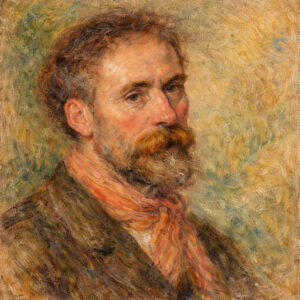
Picture a sun-drenched afternoon on the banks of the Seine, somewhere around 1881. A long wooden table stretches across a covered terrace, cluttered with wine bottles, half-eaten fruit, and the remnants of a cheerful meal. Men in straw hats lean…
Picture a sun-drenched afternoon on the banks of the Seine, somewhere around 1881. A long wooden table stretches across a covered terrace, cluttered with wine bottles, half-eaten fruit, and the remnants of a cheerful meal. Men in straw hats lean toward laughing women. A young woman in the foreground lifts a small dog toward her face with an expression of pure, uncomplicated joy. Light filters through an awning overhead, casting warm, flickering patterns across the faces of friends gathered together, unhurried and alive. This is Luncheon of the Boating Party, and it is one of the most joyful celebrations of ordinary human pleasure ever committed to canvas. The man who made it, Pierre-Auguste Renoir, believed that painting should be something pleasurable, not a burden or an intellectual exercise. He believed in the beauty of the everyday world, and he spent his entire career proving that belief correct. Renoir was born in Limoges in 1841, the son of a tailor and a seamstress, and the family moved to Paris when he was still a young child. At thirteen he began work as a decorator of porcelain, a trade that gave him an early and intimate relationship with delicate brushwork and the rendering of soft, luminous surfaces. He entered the studio of Charles Gleyre in 1861, where he met Claude Monet, Alfred Sisley, and Frederic Bazille, the group of young painters who would together transform French art. From those early friendships and shared outdoor painting sessions along the Seine, a new visual language emerged: one built on broken color, natural light, and the fleeting textures of modern life. Renoir exhibited in the first Impressionist exhibition of 1874 and continued to develop his distinctive approach throughout the following decades. Where some of his contemporaries moved toward increasing abstraction, Renoir remained devoted to the human figure, particularly to women, children, and scenes of social gathering. In his later years, crippled by rheumatoid arthritis, he continued to paint by having brushes strapped to his hands, a testament to how central the act of painting was to his identity. His legacy is a body of work that captures warmth, texture, and the simple happiness of being present in the world.
The visual language of Renoir is built first and foremost on light. Not the cool, contemplative light of the studio, but the shimmering, inconsistent light of the outdoors, light that moves across fabric and skin and water without ever quite settling. To achieve this effect, Renoir worked with short, feathery brushstrokes laid side by side rather than blended smoothly on the canvas. Colors are applied in small, vibrating patches, so that the eye of the viewer performs a kind of optical mixing, perceiving warmth, shadow, and reflected color simultaneously. His palette leans toward rose, gold, soft blue, and creamy white, and even his shadows are rarely cold or gray. Instead, shadow in a Renoir painting is likely to carry hints of violet or warm ochre, giving the entire surface of the canvas a quality of suffused warmth that feels almost tactile. His technique owes a clear debt to the porcelain work of his youth, where delicacy and translucency were prized above all else, and that sensibility never fully left him. Beyond technique, the visual concerns of Renoir are consistently human. Unlike Monet, who increasingly made landscape and atmospheric phenomenon the true subject of his canvases, Renoir kept people at the center. The figure in his work is never rigid or idealized in a classical sense. Bodies move, lean, turn, and catch the light in natural and uncontrived ways. Faces carry specific expressions. The social world he painted, whether a riverside restaurant, a Parisian dance hall, or a quiet afternoon in a garden, always feels inhabited rather than staged. Composition in his mature work tends toward the informal and the slightly crowded, giving paintings a sense of abundance and occasion. The effect is of a world generous with pleasure, color, and companionship, rendered in a technique that is itself a form of celebration.
Each card links to its own article with full analysis and reproduction details.
 #1
#1
 #2
#2
 #3
#3
 #4
#4
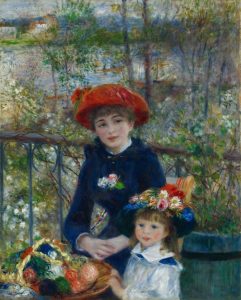 #6
#6
 #7
#7
 #8
#8
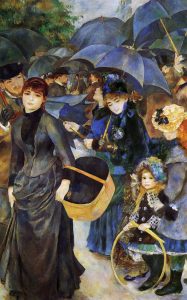 #9
#9
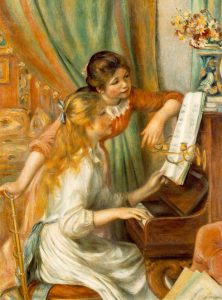 #11
#11
A print can reproduce colors. What it cannot reproduce is texture, depth, and the physical presence of oil paint on canvas. Pierre-Auguste Renoir technique depends on these.
At ByMuseum, every reproduction is painted by hand using oil on canvas. There is no inkjet, no digital print. The brushwork is real. The result looks like a painting because it is one.