Loading cart…
No products in the cart.

1869 · Oil on canvas · Nationalmuseum, Stockholm, Sweden
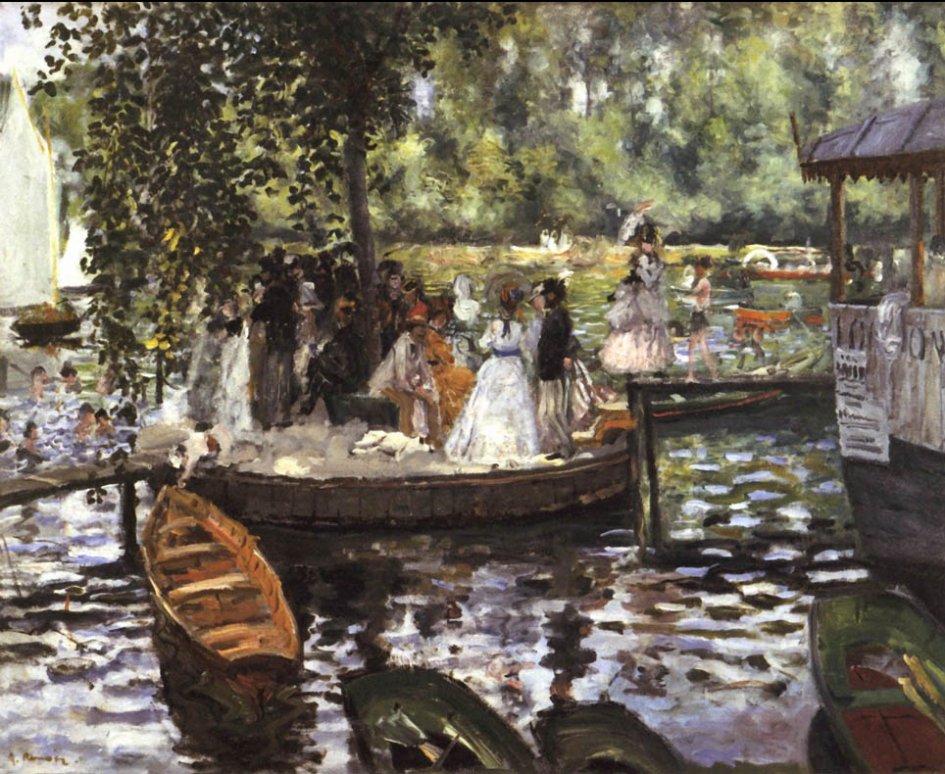
La Grenouillere, which translates loosely as the frog pond, was a floating restaurant and bathing establishment situated on the Seine near Bougival, a short distance from Paris. During the summer of 1869, Pierre-Auguste Renoir and his close friend Claude Monet worked side by side at this fashionable leisure spot, each producing multiple canvases of the same subject from closely related vantage points. The two artists were at an early and formative stage of their careers, and the friendly collaboration proved to be a turning point in the development of what would later be recognized as the Impressionist style. Renoir at this time had limited financial resources and relied partly on the support of Monet and their shared patron connections to afford materials. The choice of La Grenouillere as a subject reflected a broader cultural moment in which the expanding Parisian middle class was seeking affordable outdoor recreation along the riverbanks outside the city. The location was well known and frequently visited by fashionable crowds on weekends and warm evenings throughout the summer season. The painting now held at the Nationalmuseum in Stockholm represents one of Renoir specific contributions to this joint artistic investigation. While Monet produced his own versions, currently held in other collections, Renoir approach differed in subtle but meaningful ways that reflect his distinct sensibility. Renoir had trained formally at the Ecole des Beaux-Arts and had studied under Charles Gleyre, but by 1869 he was actively moving away from academic conventions toward a more direct and sensory engagement with outdoor subjects. The La Grenouillere paintings are frequently cited by art historians as some of the earliest clear demonstrations of proto-Impressionist technique, predating the first Impressionist exhibition of 1874 by several years. The work survived the disruptions of the Franco-Prussian War of 1870 and eventually entered the collection of the Nationalmuseum, where it remains a highly studied example of the movement origins.
Renoir composition at La Grenouillere organizes the scene around a central floating platform known as the camembert, a small circular island that served as a gathering point for bathers and visitors. This platform anchors the pictorial space while the surrounding water dissolves into a pattern of rapidly applied strokes of blue, green, white, and grey. The brushwork in the water passages is notably fragmented and directional, with individual marks of paint left clearly visible rather than blended into smooth transitions. This approach was a deliberate choice to replicate the visual experience of light reflecting off moving water rather than to describe the surface in a literal or detailed manner. The figures clustered on the platform and along the nearshore walkway are rendered with similar economy, their forms suggested through patches of color rather than defined through careful contour drawing or chiaroscuro modeling. The color palette Renoir employed draws on a relatively high-keyed range of tones, favoring light blues, creamy whites, warm flesh tones, and muted greens to convey the brightness of a summer afternoon without resorting to the stark contrasts of academic painting. Shadows on the water are rendered in cool blue and lavender rather than in brown or black, a practice that would become central to mature Impressionist technique. The handling of the foliage along the far bank is loose and gestural, suggesting depth and atmosphere without precise botanical detail. Renoir placement of figures in the middle ground creates a sense of casual social activity that gives the scene both human warmth and documentary interest. The overall compositional balance between the busy figural zone and the expansive water surface generates a pleasing tension between human presence and natural environment.
La Grenouillere carries considerable cultural meaning as a record of modern leisure in late nineteenth century France. The subject itself was deeply associated with the democratization of outdoor recreation that accompanied the expansion of the railway network and the growth of Parisian suburban life. Renoir choice to paint working-class and middle-class Parisians enjoying themselves at a riverside bathing spot rather than depicting mythological, historical, or aristocratic subjects was a statement about the value and dignity of contemporary everyday experience. This focus on modern life aligned with the broader program of realist and Impressionist painters who sought to make the present moment the legitimate subject of serious painting. The casual postures, fashionable summer clothing, and relaxed social mixing visible in the scene all reflect a specific historical moment of urban expansion and changing social norms in France under the Second Empire and early Third Republic. Beyond its social documentation, the painting carries meaning as evidence of a profound friendship and artistic exchange between two painters whose subsequent careers would shape the entire trajectory of modern art. The fact that Renoir and Monet worked at the same location on the same days, comparing observations and experimenting with technique in real time, speaks to a collaborative spirit that was central to the Impressionist project. Renoir version of La Grenouillere differs from Monet in its warmer palette and its slightly greater interest in the human figures populating the scene, a distinction that reflects his enduring attraction to people and social interaction as pictorial subjects. The painting thus serves as a document not only of a place and a moment in French leisure culture but also of the specific intellectual and artistic energy that surrounded the birth of Impressionism as a movement.