Loading cart…
No products in the cart.

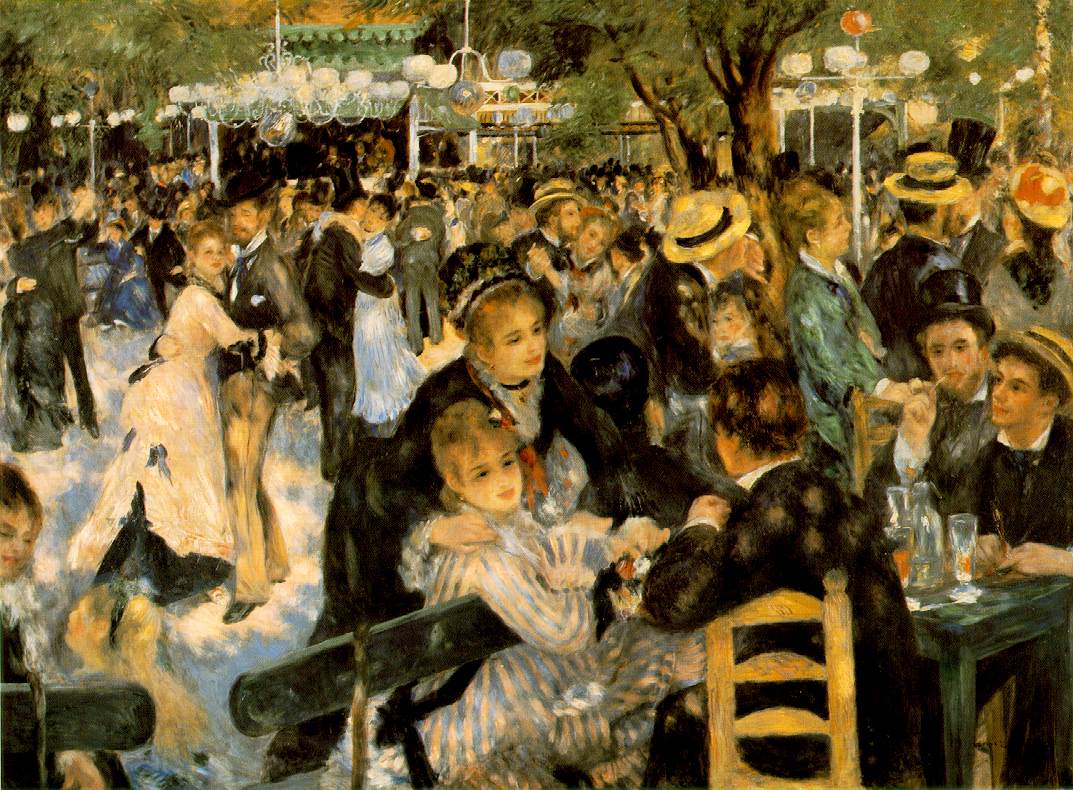
1876 · Oil on canvas · Musee d Orsay, Paris, France
Save articles to your collection
Log in or create a free account, and this article will be waiting in your Private Collection.
Log in or sign upDance at Le Moulin de la Galette was completed in 1876 and exhibited at the third Impressionist exhibition in 1877, where it drew considerable attention from critics and fellow artists alike. The painting depicts the outdoor dance hall located on the Butte Montmartre, a venue that attracted working-class Parisians and artists every Sunday afternoon. Renoir committed himself to painting the scene on location, reportedly carrying the large canvas up the hill to the garden repeatedly over several months. He populated the composition with friends and acquaintances from his circle, including fellow painters and models who were well known in the Montmartre community. The figures are identifiable to those who knew Renoir personally, lending the work an intimate documentary quality alongside its celebratory mood. The work was purchased by the art patron Gustave Caillebotte, himself a painter of note, who kept it in his personal collection until his death. When Caillebotte bequeathed his collection to the French state, Dance at Le Moulin de la Galette eventually entered the national collections, where it has remained one of the most visited works at the Musee d Orsay. The painting is widely regarded as a defining document of Parisian social life in the 1870s, reflecting the expansion of public leisure spaces during the Third Republic. Its journey from a private collection to a national institution mirrors the broader trajectory of Impressionism from radical experiment to celebrated cultural heritage.
Renoir organized the composition around clusters of figures arranged across a sun-dappled outdoor space, using the diagonal recession of seated and standing groups to draw the eye deep into the picture. The handling of light is among the most technically ambitious aspects of the work. Renoir observed how sunlight filtered through the foliage overhead created shifting patches of brightness and shadow across the clothing, skin, and ground of the scene. He rendered these effects with loose, broken brushstrokes that allow colors to mix optically rather than on the palette, a method central to the Impressionist approach to natural illumination. The blue and violet tones in the shadows of white garments were especially noted by critics, some of whom found them unconvincing, while others recognized them as a precise observation of how cool reflected light behaves in open shade. The figures in the foreground are rendered with greater definition than those in the middle and background distances, where forms dissolve into the general movement and color of the crowd. This gradation of focus mimics the way human vision actually perceives a busy social space, prioritizing nearby detail while allowing peripheral activity to blur into impression. The warm golden tones that dominate the palette convey the feeling of late afternoon sun, and the expressions and postures of the figures communicate ease, conversation, and enjoyment. Renoir used varied brushwork throughout, alternating between tight strokes for faces and looser, more gestural marks for fabrics and foliage, demonstrating the range of his technical vocabulary within a single ambitious composition.
The painting functions as a meditation on the pleasures available to ordinary Parisians during a period of rapid urban transformation. Montmartre in the 1870s occupied a distinctive social position, sitting outside the formally redesigned boulevards of central Paris and retaining a village-like character that attracted artists, workers, and bohemians. By choosing this specific location and this specific social event, Renoir affirmed the value of everyday communal pleasure as a legitimate subject for serious painting, challenging academic hierarchies that privileged historical, mythological, or religious themes. The painting does not idealize its subjects into timeless figures but presents them as recognizable contemporaries engaged in recognizable activities, which was itself a meaningful artistic statement. The work also carries resonance as a record of a world that was already changing when Renoir painted it. The expansion of the city, rising rents, and shifting patterns of entertainment would gradually transform Montmartre over the following decades. In this sense the painting preserves a particular social moment with the specificity of a firsthand account. The intermingling of different social types within the festive space, the relaxed postures of the dancers, and the warm inclusivity of the light all suggest a vision of urban life in which joy is democratically shared. Renoir returned to themes of communal leisure throughout his career, but this painting stands as his most sustained and fully realized engagement with that subject.
Enjoyed this story?
Save articles to your collection
Log in or create a free account, and this article will be waiting in your Private Collection.
Log in or sign up