Loading cart…
No products in the cart.

1892 · Oil on canvas · Musee d Orsay, Paris, France
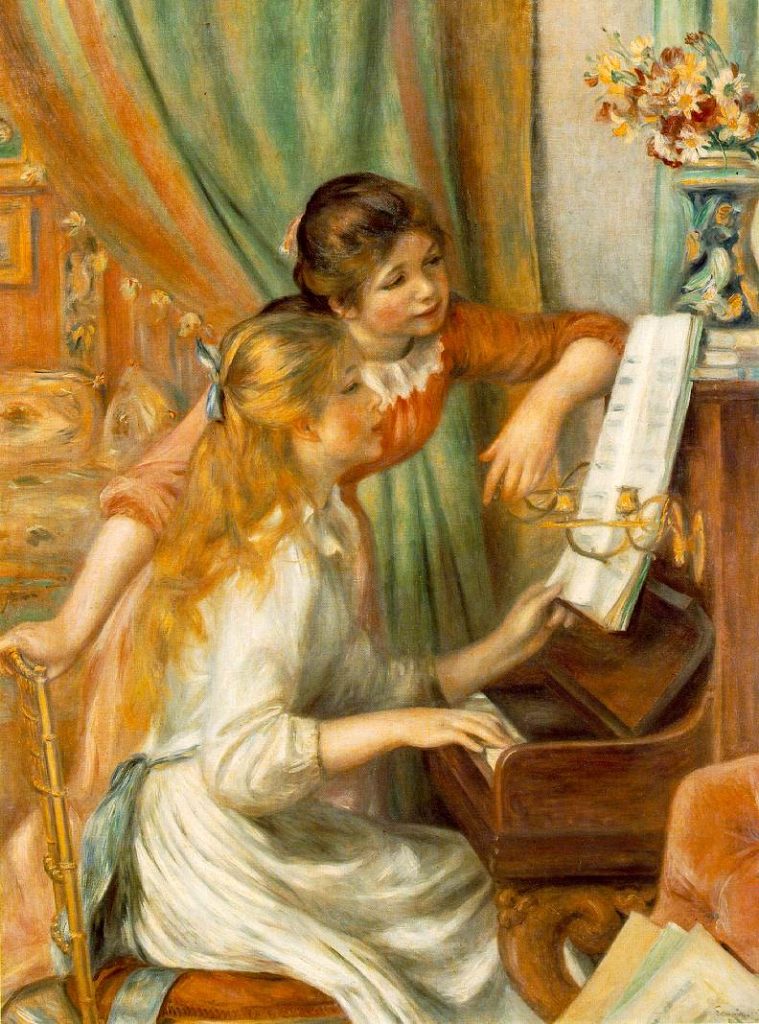
Young Girls at the Piano holds a distinguished place in Renoir career as the first work by the artist to be officially purchased by the French government. The commission was arranged through the involvement of Stephane Mallarme, the celebrated Symbolist poet and a close friend of Renoir, who recommended the artist to the Director of Fine Arts Henri Roujon. The state commission was a significant mark of official recognition for a painter who had spent much of his earlier career outside the mainstream of institutional French art. Renoir produced multiple versions of the composition, reportedly working on at least five or six variants before settling on the version that was submitted to the state. These multiple iterations reflect the seriousness with which Renoir approached the commission and his desire to achieve a particular quality of harmony between the figures and their domestic setting. The state version entered the collection of the Musee du Luxembourg in Paris, which at the time served as the museum of living artists, before eventually transferring to the Musee d Orsay. Other versions of the composition are held in major collections including the Metropolitan Museum of Art in New York and the Musee de l Orangerie in Paris, reflecting the degree to which Renoir worked and reworked this subject. The painting was widely reproduced in the years following its acquisition and helped consolidate Renoir reputation with a broad public audience that had not previously encountered his work through the Impressionist exhibitions. It remains among the most beloved works in the Musee d Orsay collection.
The composition centers on two girls, one seated at the piano and the other leaning over her shoulder to read the sheet music, their bodies forming a gentle curve that draws the eye through the painting from left to right. The figure at the piano wears a white dress whose soft folds are rendered with the warm, luminous technique Renoir developed across decades of figure painting, while the standing girl in a pink dress provides a warm chromatic counterpoint. The arrangement of the two figures is intimate without being crowded, suggesting closeness and shared concentration. Renoir balanced the human subjects against the decorative elements of the domestic interior, including the piano itself, the vase of flowers on its surface, and the richly patterned wall covering behind the figures. The brushwork throughout is fluid and confident, with Renoir moving between tighter passages in the faces and hands and looser, more suggestive handling in the background and furnishings. The light source appears to come from the left, warming the sides of both figures that face toward it and casting soft shadows that give the figures volume without harsh contrast. The color harmonies are carefully orchestrated, with the warm tones of the girls skin, hair, and clothing set against the cooler blues and greens of the background wall and the dark body of the piano. This interplay of warm and cool tones within an overall golden atmosphere is characteristic of Renoir mature style and gives the painting its sense of comfortable, glowing domesticity.
The subject of young girls at a piano was a familiar motif in French bourgeois painting and culture of the late nineteenth century, representing the cultivation of musical accomplishment as part of a proper feminine education. By choosing this subject for a state commission, Renoir engaged with a deeply legible cultural ideal and presented it through the warmth and sensory immediacy of his Impressionist technique. The painting affirms the value of domestic music-making not as a social obligation but as a genuine shared pleasure, communicated through the absorbed attention of both figures and the gentle physical closeness of their shared activity. There is no sense of performance for an outside audience but rather the self-sufficiency of two people engaged with something they find absorbing. The painting also marks a moment of reconciliation between Renoir and the French artistic establishment that had not always been receptive to his work. The state commission represented an acknowledgment of his standing as a significant figure in contemporary French art, and Renoir response to it, producing multiple careful versions and investing considerable effort in the result, suggests that the recognition mattered to him. The work communicates a warmth and optimism that characterizes much of Renoir later production, a sustained commitment to the pleasures of everyday life, beauty, and human connection as subjects that deserve the full resources of serious painting.